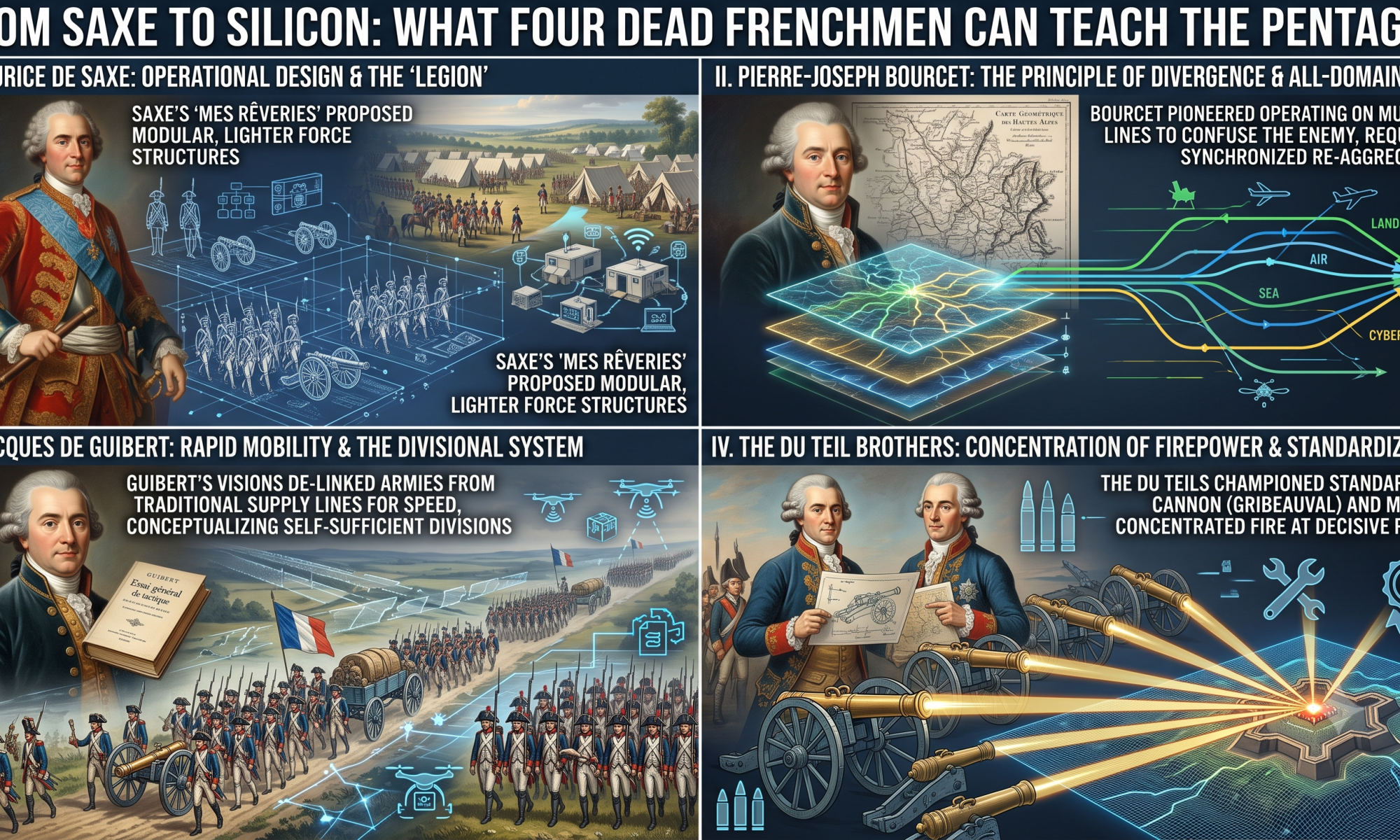

I've been living inside an 18th-century archive for the past few weeks, and I keep coming back to the same uncomfortable thought: we've seen this movie before. Maurice de Saxe. Pierre-Joseph Bourcet. Jacques de Guibert. The du Teil brothers. Four names most people have never heard, and yet between them they built the intellectual toolkit …
The Lost Generation Then and Now: Disillusionment, Culture, and the Search for Meaning in America: DeMarco Banter
In the aftermath of World War I, American writers like Ernest Hemingway, F. Scott Fitzgerald, and Malcolm Cowley found themselves part of what Gertrude Stein famously termed a "Lost Generation." Hemingway used Stein's remark — "You are all a lost generation" — as the epigraph to The Sun Also Rises, capturing the disillusionment of a generation …
Checkers in a Go Tournament: Notes Toward a Theory of 21st Century War: DeMarco Banter
I've been reading Robinson's The Blind Strategist (a book I disagree with more than I agree with), and one line in it sent me down a rabbit hole that has nothing to do with Boyd and everything to do with a feeling I can't quite shake. Something has changed in the nature of war over the last …
The Strategic Age: Naming the Era We Are Already In: DeMarco Banter
There is an old observation that fish do not know they are in water. Nations have a version of the same problem. The generations that competed through the Cold War knew what time it was. The name itself carried a theory of the world, a sense of the stakes, and an implied role for every …
Continue reading "The Strategic Age: Naming the Era We Are Already In: DeMarco Banter"
Breaking Things Faster Isn’t A Strategy: DeMarco Banter
Two pieces crossed the desk this week that, on the surface, have nothing to do with each other. One was about drones and defense budgets. The other was about why the United States keeps losing the peace after it wins the war. Put them side by side and they're arguing the same point from two …
Continue reading "Breaking Things Faster Isn’t A Strategy: DeMarco Banter"
Riders on the Storm: Heidegger and the Beginning of Strategy: DeMarco Banter
There are songs that define a generation, and then there are songs that somehow escape the generation that produced them. More than fifty years after its release, Riders on the Storm by The Doors continues to find new audiences. Part of its appeal lies in its haunting simplicity: rain falls in the background, thunder rolls across the …
Continue reading "Riders on the Storm: Heidegger and the Beginning of Strategy: DeMarco Banter"
Wondering Where the Lions Were: France, 1940, and the Adaptation Window: DeMarco Banter
Part of this week went to rereading Stephen Robinson's The Blind Strategist. It is a useful book, though maybe not for the reasons Robinson intends. At its core, the book is an attack on John Boyd, maneuver warfare, and a generation of military thinkers who leaned hard on German operational history. Robinson's argument, stated plainly, is …
The Screwdriver We Can’t Put Down: Mission Command in the Age of Everything Visible—DeMarco Banter
Before the Battle of Trafalgar in October 1805, Horatio Nelson sent a signal to his fleet that has outlived almost everything else about that day: “No Captain can do very wrong if he places his ship alongside that of an enemy.” It reads like a grant of tactical freedom. It was something closer to the …
Moving the Boxes Again: On Innovation Reform and the Limits of Reorganization: DeMarco Banter
In late April 2026, the Air Force Research Laboratory announced it was consolidating eleven of its organizations into seven. The press release called it “the most significant organizational change for AFRL in nearly 30 years.” AFWERX and SpaceWERX, along with pieces of three other former directorates, were folded into a new Technology Transition Office — …
Wondering Where the Lions Were: The Redux — Energy, the Three Webs, and the Chokepoint Already Built
DeMarco Banter The nation that breaks the hydrocarbon monopoly rules the twenty-first century. That line was written in 2008, in a National Security Affairs Fellowship thesis at the Hoover Institution. It sat inside a strategy sketch called Quantum Look, which argued that the United States should treat alternative energy not as an environmental preference but …