

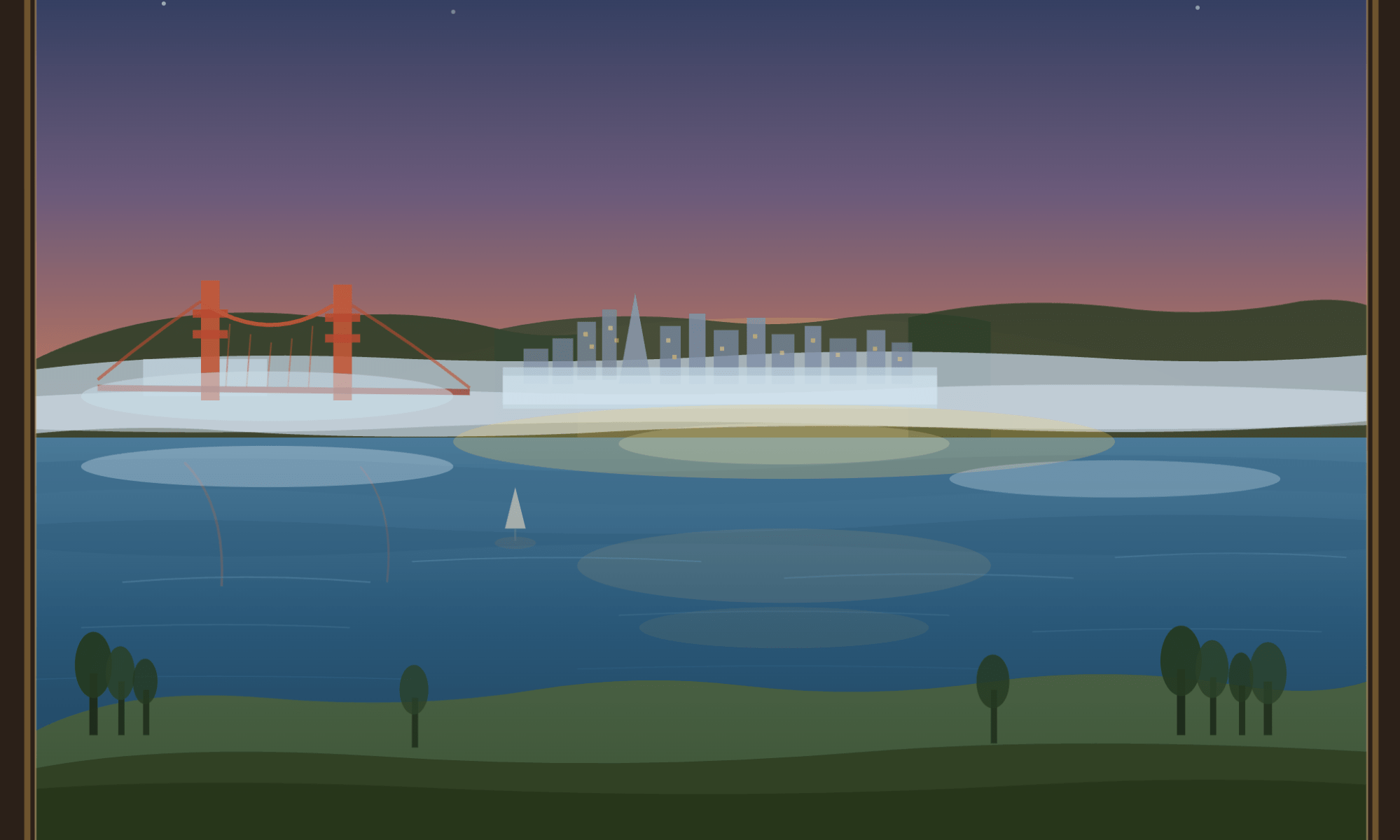
One of the things I enjoy is putting on a song, really listening to it, and then taking it apart — turning it over, getting into what the artist was after, what’s hiding underneath the melody, what it means beyond what it says. Sometimes a song rewards that kind of attention in ways that surprise you. Van Morrison’s “Across the Bay” is one of those songs.
San Francisco has a particular hold on those who grew up in its gravity. I’m one of them. The Bay Area shaped me early, and even after leaving, the city never quite let go — it became that rare place you carry with you as a kind of internal compass. I was fortunate enough to return twice in uniform, stationed at Travis AFB, and again later at Stanford, and I make my way back whenever I can. Each time, the fog over the bay, the light on the hills, the specific weight of the air coming off the water — it all lands the same way it did when I was young.
That’s why “Across the Bay” hits differently for me than it might for a casual listener. This isn’t just an elegant piece of musical nostalgia. It’s a song about the specific ache of loving a place across time and distance — looking at it from the other shore, knowing it has changed, knowing you have changed, and feeling the pull anyway. Morrison is standing in Tiburon looking across at San Francisco. I know that view. I know what it does to you.
What the Song Is Doing
At its core, this is an elegy for a vanished world — specifically the Beat Generation San Francisco of the late 1950s and early 1960s — filtered through a love song. Morrison is doing something structurally unusual: using place as the vehicle for both cultural mourning and personal longing simultaneously.
The Geography as Sacred Space
Morrison is mapping a very specific physical landscape: Tiburon and Belvedere (Marin County across the bay), North Beach, the Cliff House at Seal Rock, Sausalito’s No Name Bar, the Trident. This isn’t vague nostalgia — he’s naming exact coordinates. The bay itself becomes a metaphysical threshold. You’re on one shore looking at another, which mirrors the whole emotional structure of the song: looking across at something you can’t quite reach anymore.
The Roll Call of the Beats
Morrison drops a remarkable roster in quick succession:
- Ferlinghetti — City Lights bookstore owner and poet, the institutional anchor of North Beach
- Kerouac and Ginsberg — the two defining figures of the movement
- Gregory Corso — often overlooked third Beat poet, significant that Morrison includes him
- Neal Cassady — the real-life inspiration for Dean Moriarty in On the Road, more mythic figure than writer
- Lenny Bruce — busted at the Hungry i (Morrison spells it “Eye”) for obscenity; the comedian as free-speech martyr
- Vince Guaraldi — the jazz pianist whose “Cast Your Fate to the Wind” became a Bay Area signature
- Chet Baker — the tragically beautiful trumpet player, playing at the Trident in Sausalito
This isn’t namedropping. Morrison is performing an act of cultural liturgy — naming the saints of a lost bohemia. He’s essentially saying these people consecrated this geography.
The Emotional Architecture
The song has a double helix structure — the cultural-historical strand and the personal-romantic strand keep intertwining:
- The woman looking out at the Golden Gate in the opening anchors everything personal
- “My heart was beating on the hillside” is pure physical, embodied emotion
- “Now we need each other, need each other to lean on” escalates into almost desperate repetition by the end
The genius is that Morrison fuses these two strands — the lost cultural world and the intimate relationship — so that grieving for Beat San Francisco and needing this particular person become the same feeling. The city’s vanished vitality and the urgency of the relationship mirror each other.
The Irish Note
“Gerry Street culchies left their homeland a long while ago” is a fascinating intrusion. Culchies is Irish slang for rural people (roughly equivalent to “country folk”). Morrison — himself from Belfast — suddenly inserts the Irish immigrant experience into this San Francisco tapestry. Some came, some stayed, some didn’t. It’s a fleeting acknowledgment that this city was also built by displaced people, and that displacement is universal. It also quietly reminds you that Morrison himself is always an outsider looking in, even when he’s deeply in love with a place.
The Incantatory Ending
The final repetitions of “Across the bay in Tiburon” and “we need each other to lean on” aren’t just fading out — Morrison is performing something close to a mantra. He’s trying to hold something in place through sheer repetition. The more it slips away (the Beats are gone, Chet Baker is dead, Lenny Bruce is dead, Guaraldi is dead), the harder the incantation has to work. The personal plea (“lean on me”) is the only thing left that can answer cultural loss.
Bottom line: It’s a song about what places mean when the people who made them sacred are gone, and whether love can serve the same function that a whole lost world once did. Morrison’s answer seems to be: maybe, but only if we hold on hard enough.

