

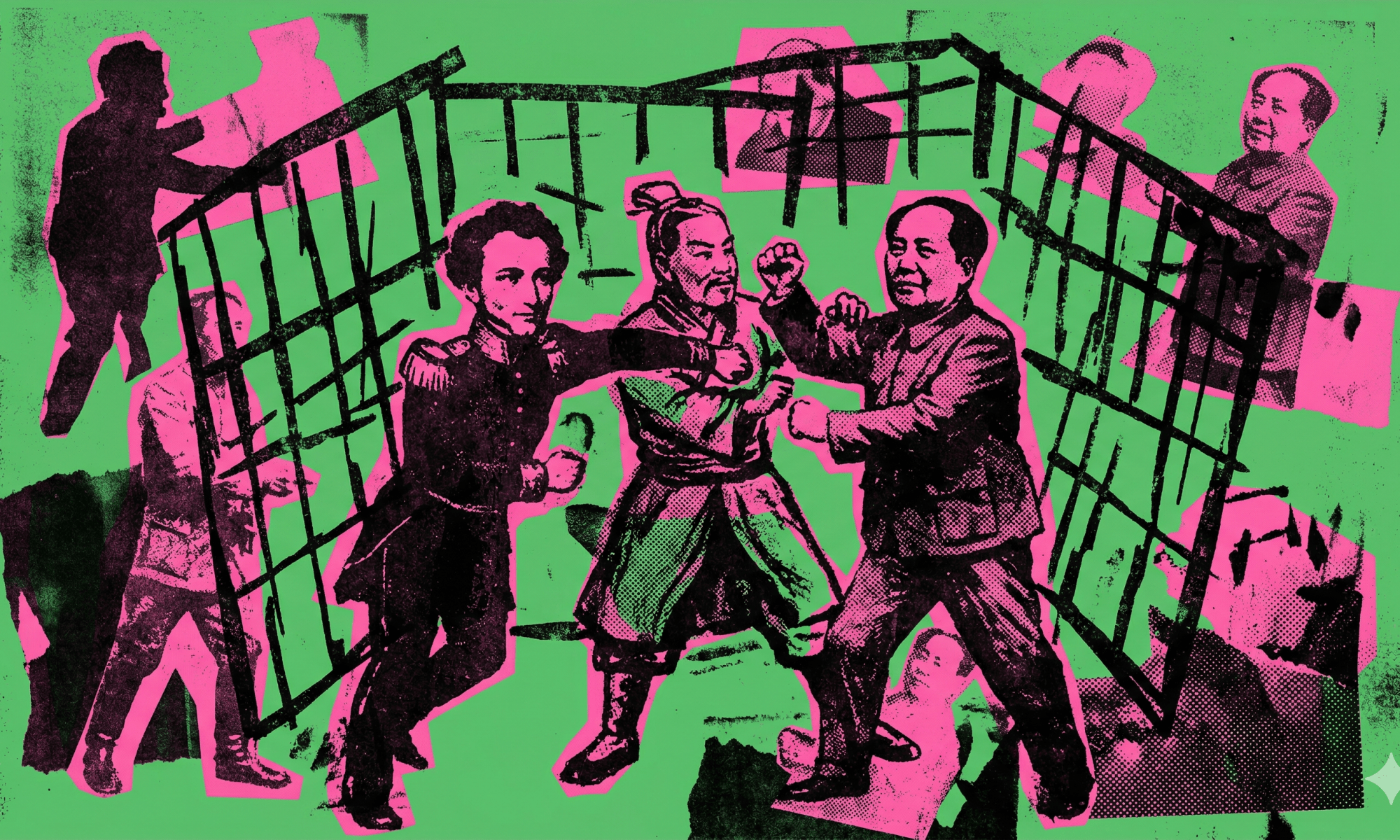
I. The Foundational Split: Two Incompatible Visions of War
The most important thing to understand about Clausewitz and Sun Tzu is that they are not simply different tacticians — they inhabit fundamentally different universes of what war is.
Clausewitz
Clausewitz defines war as an act of violence intended to compel the opponent to fulfill one’s will.1 His framework is narrowly military: find the enemy’s center of gravity, concentrate overwhelming force, destroy their capacity to resist. He was preoccupied with the massive application of force and mitigating friction in combat operations, and stressed the importance of finding the single center of gravity — the critical point at the critical time upon which the outcome of the conflict depended.
His famous axiom that war is the continuation of politics by other means acknowledges the political frame, but once committed to action, Clausewitz’s prescriptions are martial through and through.2
Sun Tzu
Sun Tzu operates at a fundamentally different level.3 Success in war is not measured by the destruction of an adversary’s army, but by shattering his will to fight. The most successful strategy emphasizes psychology and deception — to subdue the enemy without fighting is the acme of skill. His hierarchy of preference: (1) attack the enemy’s strategy, (2) attack his alliances, (3) destroy his army. Destruction of forces is the method of last resort, not first recourse.
As Michael Handel observed, Sun Tzu and Corbett share a preference for the indirect approach that Clausewitz largely ignored — the search for comparative advantage, economy of force, and limited war.4 As Kissinger framed it in On China: when the Western tradition prized the decisive clash of forces emphasizing feats of heroism, the Chinese ideal stressed subtlety, indirection, and the patient accumulation of relative advantage.
Core Contrast
- Clausewitz: Force is the primary instrument. Find and strike the center of gravity. War is bounded by politics but executed through violence.
- Sun Tzu: Will and psychology are the primary instruments. Shatter enemy cohesion. War is won before battles are fought.
- Visual metaphor: Clausewitz plays chess — position, force, decisive engagement. Sun Tzu plays go — encirclement, patience, accumulation of advantage until the opponent collapses from within.
II. Mao: Neither Sun Tzu Nor Pure Clausewitz — A Synthesis
Some analysts assume Mao is simply Sun Tzu updated for the twentieth century. This is wrong, and the error matters enormously for understanding modern adversaries.
Sun Tzu and Mao are in fact diametrically opposed on two key concepts.5 Sun Tzu warned against protracted war, recognizing that it drains resources, lowers morale, and leaves states vulnerable. Mao embraced it and literally wrote the book on protracted war.6
More strikingly, Mao is heavily Clausewitzian in his political theory. His 1938 work On Protracted War is suffused with Clausewitzian concepts — war as political instrument, primacy of policy during war — and quotes Clausewitz directly several times.7
What Mao contributed was a unique operational engine: the three phases of guerrilla war — strategic defensive, stalemate, strategic offensive — allowing weaker forces to steadily build popular support while bleeding superior conventional enemies.8 This template proliferates globally. Vietnam, Afghanistan (Soviet and American), the Iraqi insurgency, Iran’s proxy network — all draw on this heritage.
Mao’s synthesis:
- Political theory: Clausewitzian — war is the continuation of politics; the party commands the gun
- Strategic patience: Anti-Clausewitzian — avoid decisive battle, protract, exhaust the enemy’s will
- Operational method: Sun Tzu inflected — deception, indirection, will over firepower
- Revolutionary engine: Unique — the peasant as weapon, the people as center of gravity
III. The Case Studies: A Strategic Scorecard
Desert Storm (1991) — America’s Most Clausewitzian War
Desert Storm is the closest the post-WWII United States has come to executing Clausewitz correctly — and the results prove the framework. The political goal was clear, limited, and achievable: expel Saddam Hussein’s forces from Kuwait.9
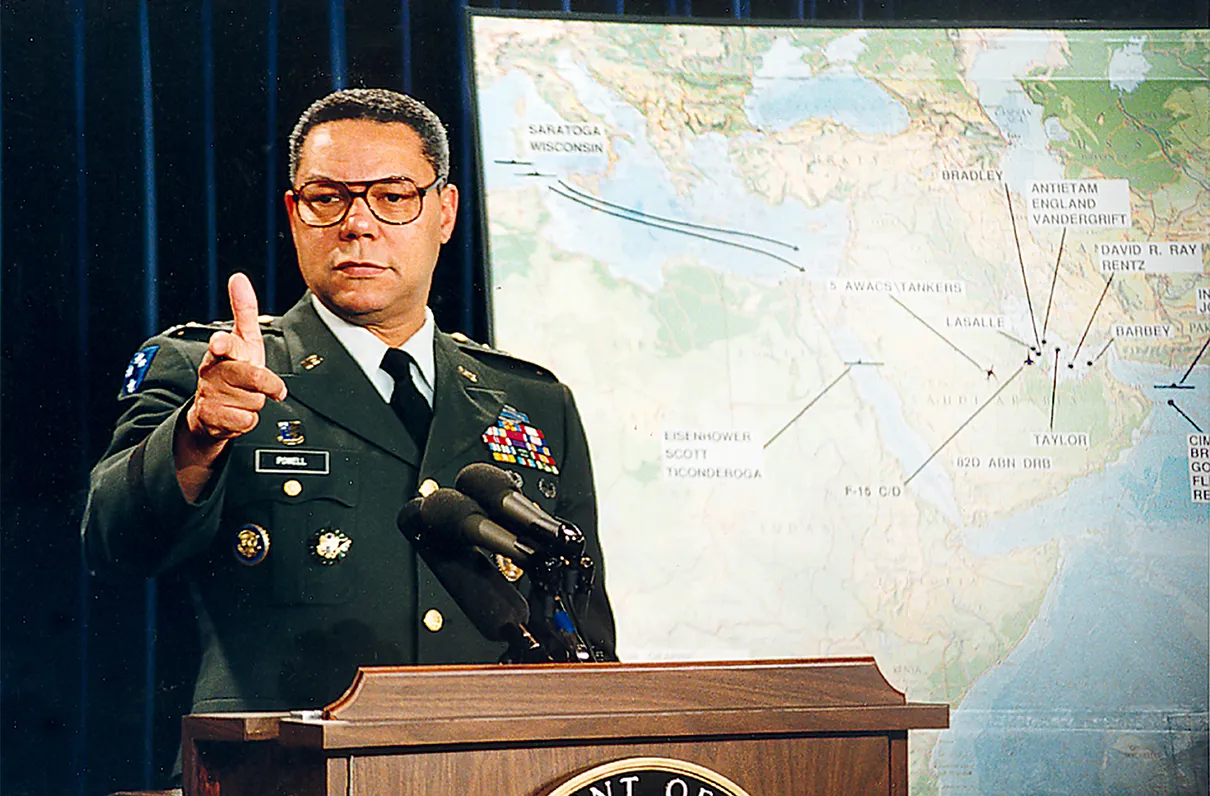
After the campaign, Colin Powell appeared before the press holding On War, signaling that the U.S. had learned from Vietnam and won with Clausewitz.9 The Powell Doctrine operationalized Clausewitz almost perfectly: clear political objective, overwhelming force, defined end state, popular and congressional support, exit strategy.10
By stopping at Kuwait rather than marching on Baghdad, the U.S. was actually being more Clausewitzian — the political objective was achieved; going further would have created a new, more dangerous strategic problem (which it did, twelve years later).11
The United States accomplished the first three major war aims but not the fourth — promoting the security and stability of the Persian Gulf. Desert Storm was tactically and operationally brilliant but strategically incomplete — a harbinger of what would follow.11
Vietnam — The First Catastrophic Mismatch
Vietnam is the defining case. The famous exchange captures it perfectly: Colonel Summers told his North Vietnamese counterpart, “You know, you never defeated us on the battlefield.” Colonel Tu replied: “That may be so. But it is also irrelevant.”13
The North Vietnamese strategy was Maoist at its core. Ho Chi Minh and Giap developed dau tranh — to struggle — containing two inseparable elements: the Armed dau tranh and the Political dau tranh.14 Neither could succeed alone.
Tet 1968 was not a military victory for Hanoi — it was a catastrophic military defeat for the Viet Cong, from which they never recovered. But Tet’s political effect — the shattering of American domestic will — was precisely the strategic objective. Giap was targeting the third leg of Clausewitz’s trinity: the people.
America’s failure was not tactical. Senior U.S. security practitioners were unable to fathom the intangible resources the North Vietnamese brought to the fight — morale and will. Senior civilian leaders did not appreciate the disproportionate value each side placed on its political objectives.15 The U.S. fought a Clausewitzian war against an enemy fighting a Maoist one — contests taking place in entirely different strategic registers.
A further complication: most American analysts focused on Mao and Giap, but it was Trường Chinh’s adaptation of Mao’s model — emphasizing political and diplomatic dimensions alongside military power — that actually proved decisive for both the French and American phases of the war.16
Iraq (OIF, 2003) — Clausewitz Applied Correctly to the Wrong Problem
The initial invasion was actually Clausewitzian in execution. Coalition forces defeated Iraqi military defenses throughout 450,000 square miles and took Baghdad in 21 days — a textbook center-of-gravity strike against the regime.17
The catastrophic failure came after. Rumsfeld and his generals misidentified Iraq’s center of gravity. They believed the outcome hinged on defeating Saddam’s Republican Guard, and that occupation of Baghdad would seal the victory. What was actually required was the support of the Iraqi people — which center-of-gravity thinking systematically ignored.18
When the U.S. did finally refocus its efforts on combating the insurgency, it again misidentified the center of gravity. In an insurgency, Clausewitz identified the center of gravity as the personalities of leaders and public opinion. The Americans attempted to overcome resistance with brute force — counterproductive, fanning the flames of the growing insurgency.18
The war in Iraq illustrates what happens when policy absent strategy creates new monsters: the United States opened a secondary theater of choice against an odious but secular dictator in no way linked to the events of 9/11, with strategic aims that were not realistic given that country’s previous history and culture.19
Afghanistan — The Longest Mismatch
Afghanistan reveals a structural problem: the U.S. entered with nearly unlimited war aims but with the intention of only using limited force. This strategic error undermined the intervention from the start.20
The Taliban adopted Mao’s three-stage war strategy for their nearly 20-year conflict against the United States.21 They didn’t need to win. They needed to not lose while America’s political will eroded — exactly what Mao prescribed and exactly what Sun Tzu’s maxim about protracted war predicts.22
Regarding Vietnam, Afghanistan, and Iraq, the United States ignored Clausewitz’s core requirements in each case: failing to achieve stated political goals, failing to harmonize ends, ways, and means, and failing to maintain the unity of people, government, and armed forces.28
IV. Iran — The Most Sophisticated Non-Clausewitzian Adversary
Iran represents the most sophisticated synthesis of these traditions currently operating against American interests — and it is explicitly designed to exploit America’s strategic failure modes.
Iran’s military doctrine was shaped by two formative experiences: the Iran-Iraq War (1980–88) and the Israeli invasion of Lebanon. Both entrenched a strategy of proxy and asymmetric warfare to confront adversaries with superior technological capabilities and manpower. The IRGC’s use of small boats, mines, and anti-ship cruise missiles during the Tanker War placed asymmetric warfare at the center of Iranian offense and deterrence.23
Doctrinal Structure
- Mosaic Defense: A decentralized command-and-control system designed to be resilient to decapitation strikes, announced by the IRGC in 2005 under General Mohammad Jafari.24
- Cost Asymmetry: A Shahed drone costing $20,000–$50,000 forces Patriot missile interceptors costing $4 million per shot. Iran bleeds adversaries economically while absorbing damage.24
- Horizontal Escalation: Rather than direct confrontation, Iran projects pressure through proxies across multiple theaters simultaneously — Lebanon, Iraq, Yemen, Gaza — stretching adversary defenses and imposing distributed costs.26
- Proxy Network (‘Axis of Resistance’): Hezbollah, Houthis, Hamas, and Iraqi Shia militias receive weapons, training, funding, and ideological guidance, allowing Tehran to threaten Israeli and U.S. forces on multiple fronts at a fraction of the cost of deploying its own forces.25
Iran’s Foreign Minister captured the doctrine’s self-awareness in early 2026: “We’ve had two decades to study defeats of the U.S. military to our immediate east and west. We’ve incorporated lessons accordingly. Bombings in our capital have no impact on our ability to conduct war.”24
Strategic Lineage
- Maoist: Protracted/proxy structure; three-phase patient erosion; war extends across all domains
- Sun Tzu: Indirection, deception, avoiding direct confrontation until conditions are favorable
- Clausewitzian: War remains a tool of political purpose — preserving the Revolution, deterring the U.S. and Israel
- Anti-Clausewitzian: Explicitly rejects the decisive battle, the single center of gravity, and the direct application of overwhelming force
V. When Did the Shift Happen? The Inflection Points
Korea (1950–53): First Signal
The U.S. achieved its limited Clausewitzian objective — restore South Korea — but at enormous cost, and only after China’s Maoist intervention nearly destroyed the campaign. The lesson was partially absorbed but never institutionalized.
Vietnam (1965–75): The Full Rupture
This is where the gap between America’s Clausewitzian military culture and the Maoist adversarial template first became undeniable. The U.S. built a military for conventional war in Europe, fought a political-guerrilla war in Southeast Asia, and couldn’t reconcile the two. The Army retreated from counterinsurgency after Vietnam almost as a trauma response — and rebuilt itself for AirLand Battle and the conventional fight it preferred.
Desert Storm (1991): A False Recovery
The U.S. convinced itself it had fixed the problem — that Vietnam was an aberration, and that technological superiority plus Clausewitzian limited-war doctrine would prevail. Powell literally held up On War at the press conference.9 But this was pattern-matching to a war that happened to fit the template.
Post-9/11 (2001–Present): The Full Regression
The U.S. applied the Desert Storm template — regime change as center of gravity, decisive force — to environments that were fundamentally Maoist in their strategic logic. The enemy had studied Vietnam. The U.S. had not.
As America neared the 21st century, Clausewitz’s remarkable trinity was remarkably imbalanced. Senior political and national security leaders were remiss in their responsibilities to formulate and articulate coherent political purposes. Military professionals were increasingly inclined to fill this void in strategy with operational methods and actions. Both groups ignored the principle that in war, military aims cannot be divorced from political purposes.27
VI. The Core Problem: A Clausewitzian Military in a Post-Clausewitzian World
The deepest issue is structural, not doctrinal. Clausewitz’s paradigm held true in the American Civil War, the Spanish-American War, and both World Wars. Yet the defeats in Vietnam and Afghanistan demonstrated a persistent failure: how could overwhelming firepower, numerical strength, financial power, and advanced technology fail to defeat enemies lacking airpower, heavy artillery, armor, superior logistics, and technology?29
In both Vietnam and Afghanistan the U.S. military faithfully applied Clausewitzian theory — bringing the full weight of firepower to bear. Yet the end result was defeat despite trillions of dollars spent and thousands of lives lost.29
The adversaries America has faced — North Vietnam, the Taliban, Iraqi insurgents, Iran’s Axis of Resistance — have all understood something that American strategic culture resists: you don’t have to win. You just have to make the cost of victory higher than the value your opponent places on the objective. That is Sun Tzu’s ‘shatter the will to fight’ applied at the strategic level. That is Mao’s protracted war as political weapon.
Recent history demonstrates the risks of mindsets that emphasize tactical and operational tasks without sufficient consideration of how they may affect the political dynamics of war. During the American war in Afghanistan, the failure to appreciate the simultaneous nature of war prevented the development of a military strategy capable of generating the political consequences necessary for securing the United States’ political objective.30
VII. Synthesis
The irony of American strategic history is this: the U.S. knows Clausewitz. It teaches Clausewitz. But it has applied only a partial Clausewitz — the half about force, center of gravity, and decisive battle — while repeatedly neglecting the deeper half about the primacy of political purpose, the trinity of people/government/military, and the need to match ends to means.
Its adversaries, meanwhile, have synthesized the tradition the U.S. neglects: Mao’s patient protraction, Sun Tzu’s indirect approach, and — crucially — a Clausewitzian clarity about political objective that American strategists have repeatedly failed to maintain.
The pattern of winning battles and losing wars is not a failure of military capacity. It is a failure of strategic literacy — specifically, the recurring inability to ask what kind of war are we in before committing force designed for an entirely different kind of contest.
Endnotes
3. Sun Tzu. The Art of War, trans. Samuel B. Griffith. Oxford University Press, 1963.
4. Handel, Michael I. “Corbett, Clausewitz, and Sun Tzu.” Naval War College Review 53, no. 4 (2000).
7. “On Protracted War.” Wikipedia, citing Mao Zedong, On Protracted War (1938).
8. “Mao’s Strategy Inspires Afghan Guerrillas and Chinese Planners.” Foreign Policy, January 24, 2023.
12. Bacevich, Andrew J. “A Second Look at the Powell Doctrine.” War on the Rocks, February 2014.
14. “How the North Vietnamese Won the War: Operational Art Bends.” CGSC Digital Library.
15. Cassidy, Robert. “The Wages of War Without Strategy, Part I.” War on the Rocks.
17. “The Relevance of Carl von Clausewitz in Operation Iraqi Freedom.” Air University, ASPJ.
19. Cassidy, Robert. “The Wages of War Without Strategy.” The Strategy Bridge, June 2017.
21. “People’s War.” Wikipedia.
22. Callimachi, Rukmini. “Mao’s Strategy Inspires Afghan Guerrillas.” Foreign Policy, January 24, 2023.
23. McInnis, Matthew. “The Strategic Foundations of Iran’s Military Doctrine.” IISS, December 2017.
25. “How Iran’s ‘Forward Defence’ Became a Strategic Boomerang.” Chatham House, March 2026.
26. “Iranian Revolutionary Guard’s Horizontal Escalation Doctrine.” In the War Room.
27. Cassidy. “Wages of War Without Strategy, Part I.”
28. Bensahel, Nora. “Clausewitz: Still Relevant.” Hoover Institution, April 2025.
Research synthesized with Claude (claude.ai) · April 2026

