

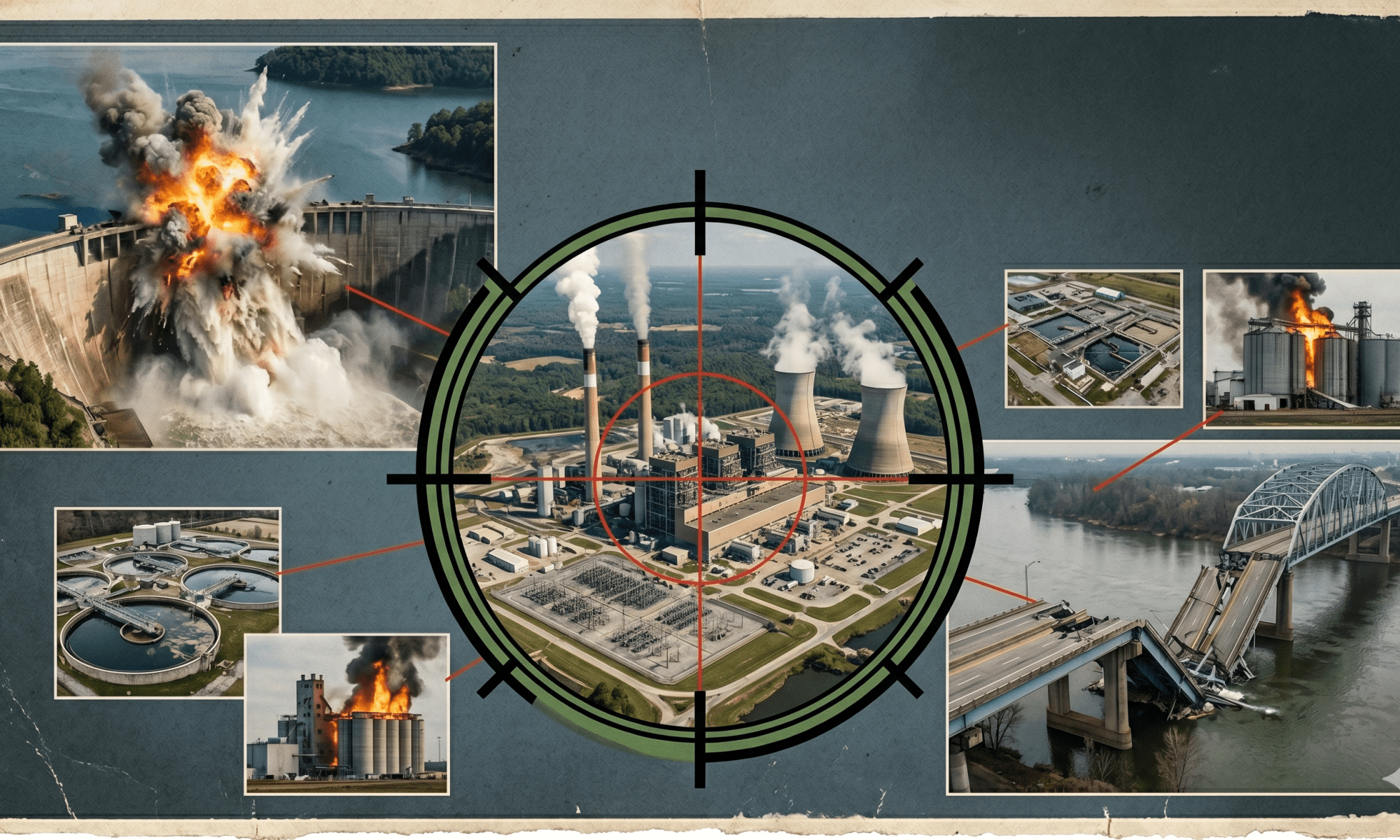
Recent public statements about targeting national infrastructure—power grids, bridges, and even water systems—have revived an old and uncomfortable question: when does war against an adversary’s capacity become war against the society itself? The distinction is not academic. It sits at the center of how modern conflict is constrained, justified, and ultimately judged.¹
States have always sought to weaken their enemies by striking the systems that sustain them. Railroads, factories, oil refineries, and communications networks have long been targets in major wars. Yet there is a meaningful difference between attacking infrastructure as a means of degrading military capability and threatening destruction in terms that implicate civilian survival directly. That difference—often blurred in rhetoric, sometimes crossed in practice—marks the boundary between coercion aimed at war-making capacity and coercion aimed at the population itself.
Understanding that boundary requires three lenses: the law of armed conflict, the historical record, and the strategic logic that links them. Taken together, they suggest that infrastructure targeting is neither new nor inherently unlawful—but that its justification, scope, and framing determine whether it remains within accepted bounds or drifts toward a more dangerous and corrosive form of warfare.
The Legal Framework: Distinction, Proportionality, and Survival
The modern law of armed conflict does not prohibit attacks on infrastructure per se. Instead, it regulates them through a set of interlocking principles. The most fundamental is distinction: parties must distinguish between civilian objects and military objectives. A military objective is defined not by category alone, but by function—whether the object makes an effective contribution to military action and whether its destruction offers a definite military advantage.
This definition creates space for what are often called “dual-use” targets. Electrical grids, transportation networks, petroleum facilities, and communications systems can all fall within the category of lawful targets if they sustain military operations. That is the legal foundation upon which much of twentieth-century strategic bombing—and modern targeting doctrine—rests.
But this permissive space is bounded. The principle of proportionality prohibits attacks in which the expected incidental civilian harm would be excessive relative to the anticipated military advantage. This is not a vague moral aspiration; it is a binding rule that requires commanders to weigh concrete military gain against foreseeable civilian cost.
More restrictive still are the protections afforded to objects indispensable to the survival of the civilian population. Drinking water installations, food supplies, and systems essential to public health occupy a distinct category. Even where such systems might have some indirect military relevance, their centrality to civilian survival places them under heightened legal and moral scrutiny.² The law recognizes that certain forms of deprivation—particularly those that undermine basic human survival—risk transforming war into a form of collective punishment.
The implication is straightforward but often misunderstood. Infrastructure can be targeted lawfully under certain conditions. But not all infrastructure is equal, and not all justifications carry the same weight. A rail hub feeding military logistics is not equivalent to a desalination plant sustaining a civilian population. Treating them as interchangeable is not simply imprecise—it obscures the very distinction the law is designed to preserve.
Total War and Its Shadows
The historical record reinforces this complexity. The twentieth century, particularly World War II, provides the most expansive examples of infrastructure targeting at scale. The Allied Combined Bomber Offensive sought to dismantle Germany’s war-making capacity by striking industrial production, transportation networks, and energy systems. Among the most consequential campaigns was the attack on synthetic oil production, which crippled German mobility and operational reach.
From a modern legal perspective, such targets can be understood as military objectives. Oil production directly sustained mechanized warfare; its destruction yielded clear and measurable military advantage. Yet the broader campaign also inflicted extensive civilian suffering, both directly and indirectly. The degradation of transportation and energy systems rippled through civilian life, blurring the line between industrial interdiction and societal disruption.
More controversial still were the area bombing campaigns conducted by the Royal Air Force and, later, the United States Army Air Forces. Cities such as Hamburg and Dresden became symbols of a strategy that, at times, prioritized the destruction of urban environments as a means of undermining morale and capacity. Whether framed as attacks on industrial districts or population centers, these campaigns remain enduring case studies in how quickly the logic of infrastructure targeting can expand into something more indiscriminate.
The lesson is not that democracies refrained from such practices. They did not. Rather, it is that even in wars widely regarded as just, the pressures of total war pushed states toward the outer edges—and sometimes beyond—of what would later be codified as lawful and legitimate.
Vietnam and the Persistence of Dual-Use Targeting
The Vietnam War offers a more modern example of infrastructure targeting under conditions of legal constraint and political sensitivity. U.S. air campaigns against North Vietnam, particularly during Operations Linebacker I and II, included strikes on railroads, power plants, and logistical nodes supporting the North Vietnamese war effort.
These targets were framed as integral to military operations, and in many cases they were. Rail lines carried troops and supplies; electrical systems powered industrial production and communications. Yet the effects of these strikes extended beyond the battlefield. Civilian infrastructure and daily life were inevitably affected, raising persistent questions about proportionality and necessity.
What distinguishes Vietnam from earlier total war campaigns is not the absence of infrastructure targeting, but the presence of a more developed legal and normative framework shaping how such targeting was justified and constrained. Even as the United States struck dual-use systems, it did so within a discourse that emphasized military necessity rather than civilian deprivation as the primary objective.
That distinction—between degrading capability and imposing suffering—remains central.
Contemporary Conflict: Infrastructure as Leverage
Recent conflicts have brought infrastructure targeting back to the forefront of strategic debate. Russia’s campaign against Ukraine, particularly its systematic strikes on electrical grids and energy infrastructure, illustrates how infrastructure can be used not only to degrade military capacity but to impose hardship on the civilian population. By targeting energy systems during winter months, the campaign has had predictable and profound effects on heating, water, and basic services.³
These actions have drawn sustained international scrutiny and legal attention, including proceedings at the International Criminal Court. The concern is not simply that infrastructure has been struck, but that the pattern and timing of attacks suggest an intent to use civilian vulnerability as a lever of coercion.
This is a critical distinction. Infrastructure can be targeted as part of a military campaign; it can also be targeted as part of a strategy of pressure against a population. The difference lies in intent, effect, and proportionality—and in how openly that intent is expressed.
The Danger of Rhetoric
This brings the discussion back to the present. Public statements that frame infrastructure—particularly systems essential to civilian survival—as legitimate targets raise more than legal questions. They shape expectations about what is permissible, signal intent to adversaries, and influence the boundaries within which military planners operate.
Historically, states have often maintained a degree of ambiguity in how they describe targeting decisions, even when those decisions carried significant civilian risk. This ambiguity has served, in part, as a buffer—preserving the formal distinction between military objectives and civilian harm, even when the practical effects were more complex.
When that ambiguity is replaced by explicit language that blurs or dismisses the distinction, the risk is not merely reputational. It is operational. The normalization of civilian-dependent systems as targets lowers the threshold for their use, erodes legal restraint, and invites reciprocal logic from adversaries.
This is not a theoretical concern. War is, at its core, a contest of reciprocal adaptation. Once one side frames civilian infrastructure as a legitimate domain of coercion, the other is incentivized to respond in kind. The result is not simply escalation, but diffusion—an expansion of the battlefield into the systems that sustain everyday life.
Beyond Regime Type
It is tempting to attribute this dynamic to regime type—to argue that authoritarian systems are more prone to targeting civilian infrastructure, while democracies are more restrained. There is some truth in this. Authoritarian regimes often operate with fewer internal constraints, less transparency, and greater tolerance for civilian harm.
But history resists clean categorization. Democratic states have, under conditions of existential threat, engaged in forms of warfare that imposed significant civilian suffering. The difference lies less in capability than in constraint—legal, institutional, and normative.
Democracies tend to justify infrastructure targeting in terms of military necessity and to subject those justifications to scrutiny, both internal and external. Authoritarian regimes are more likely to treat civilian vulnerability itself as a legitimate instrument of policy. The distinction is not absolute, but it is meaningful.
The risk arises when the language and logic of one begin to resemble the other.
From Infrastructure to Survival
The most important analytical distinction, and the one that should anchor contemporary debate, is between infrastructure that sustains military operations and infrastructure that sustains civilian survival. The former has long been a recognized domain of warfare. The latter occupies a more restricted and contested space.
Oil refineries, rail networks, and industrial facilities may be lawfully targeted under certain conditions, even when they have civilian implications. Water systems, food supplies, and basic public health infrastructure are different. Their destruction does not merely degrade an adversary’s capacity; it undermines the conditions of life itself.
When leaders speak of targeting such systems, they are not simply signaling a willingness to escalate. They are signaling a shift in the underlying theory of victory—from defeating an enemy’s forces to breaking the resilience of its society.
That shift carries profound consequences. It alters the legal calculus, challenges long-standing norms, and risks transforming conflict into a contest of endurance measured in civilian suffering.
Conclusion: The Boundary That Matters
Infrastructure will remain a central feature of modern warfare. As societies become more interconnected and technologically dependent, the systems that sustain military power and civilian life will continue to overlap. This reality ensures that difficult targeting decisions—and difficult debates—will persist.
But the boundary between military necessity and civilian coercion is neither obsolete nor irrelevant. It is the line that distinguishes war against an adversary’s capacity from war against its population.
History shows that this line has been tested, stretched, and at times crossed. Law seeks to preserve it. Strategy, at its best, respects it—not out of sentiment, but out of recognition that wars fought without such boundaries risk becoming wars without end.
The danger is not that infrastructure will be targeted. That has always been the case. The danger is that the logic of targeting shifts—subtly at first, then openly—toward treating the civilian systems that sustain life as instruments of coercion in their own right.
When that happens, the character of war changes. And once changed, it is not easily restored.
- Reuters, “Trump Says U.S. Will Target Iran’s Infrastructure,” April 2026.
- International Committee of the Red Cross, Protocol Additional to the Geneva Conventions of 12 August 1949 (Protocol I), Articles 52 and 54.
- International Criminal Court, statements and proceedings related to attacks on Ukraine’s civilian energy infrastructure, 2023–2025.

