


Empires do not fall because they expect to. They fall because they misread the direction they are moving until the range of available choices narrows beyond recovery. This is not a story of sudden collapse. It is a story of gradual imbalance—of systems that once integrated power effectively beginning to rely too heavily on a single instrument. By the time decline becomes obvious, it is usually too late to reverse.
There is a persistent temptation in the United States to assume exemption from this pattern. The logic is familiar: America is more innovative, more adaptive, more self-correcting than past great powers. There is truth in that claim. But it is also incomplete. As Richard E. Neustadt and Ernest R. May mention in Thinking in Time reminds us, the most dangerous misuse of history is not drawing false parallels—it is assuming that historical patterns no longer apply. The purpose of history is not to predict outcomes, but to sharpen judgment about the present.
The challenge, then, is not to declare that the United States is in decline. It is to ask a more disciplined question: What do current indicators suggest about the direction of American power, and how do those indicators compare to patterns observed in past great powers under stress? Answering that question requires a framework that can move beyond surface-level comparisons. It requires understanding how power is structured, how it is exercised, and how imbalance begins to emerge.
A useful way to think about this is through three interrelated layers of power: the Industrial Web, the Strategic Web, and the Cognitive Web. Together, these layers define how modern states generate, project, and sustain power. They also provide a way to read early indicators of imbalance—before outcomes are determined.
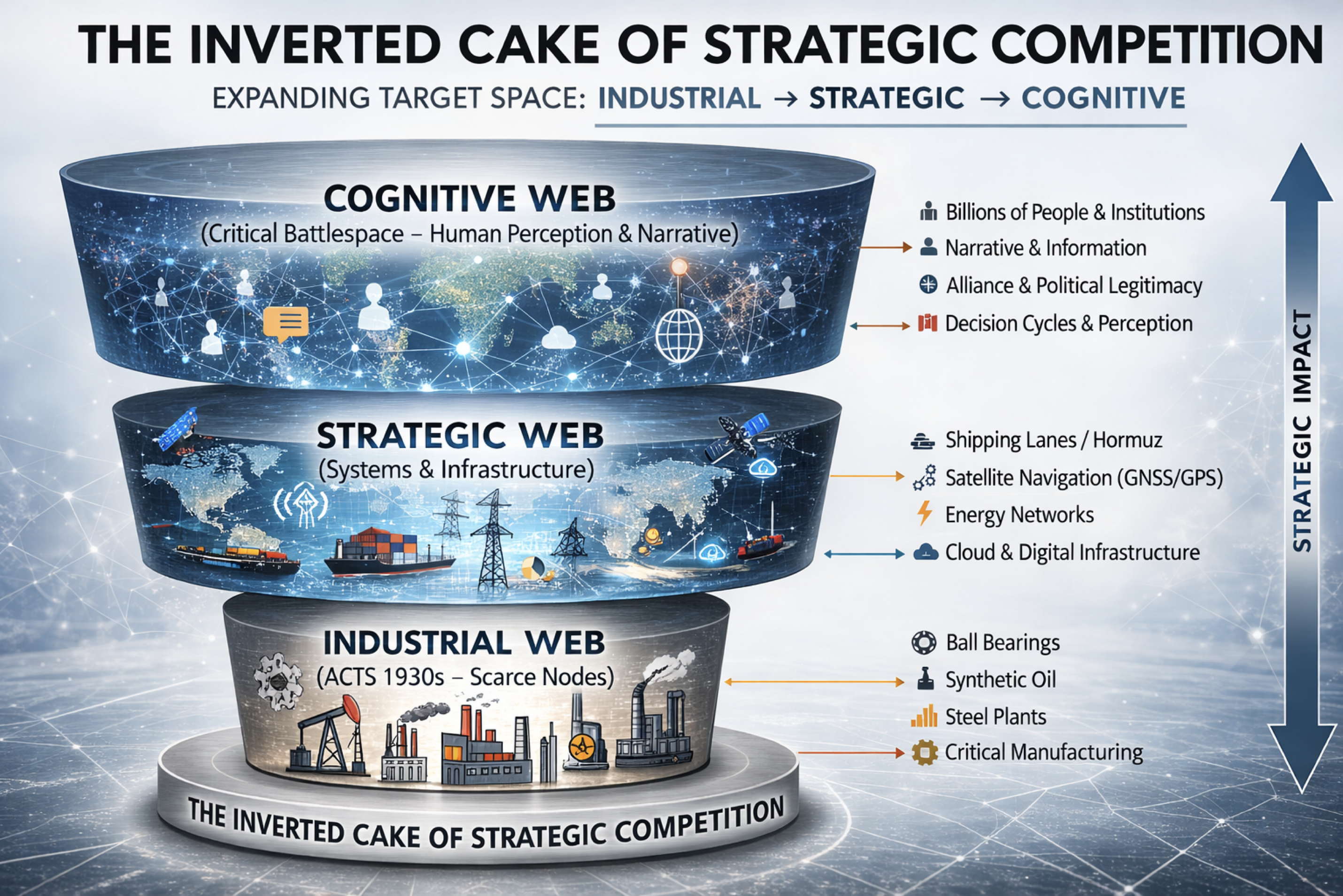
The Industrial Web is the foundation. It consists of the physical and material systems that enable national power: energy production, manufacturing capacity, logistics networks, transportation systems, and increasingly, the industrial base that supports advanced technologies such as artificial intelligence and precision munitions. This layer echoes the targeting logic of the interwar Air Corps Tactical School—power grids, railways, oil, steel—but updated for a modern economy. It is the realm of production, throughput, and material advantage. Recent proposals to expand U.S. defense spending toward the $1.5 trillion range, with a heavy emphasis on munitions, shipbuilding, and the defense industrial base, underscore that this layer remains a central focus of national strategy.¹
The Strategic Web sits above it. This layer connects states to one another through alliances, trade networks, financial systems, and access to key geographic and economic nodes. It includes maritime routes, undersea cables, global supply chains, and institutional frameworks that govern interaction. If the Industrial Web is about what a state can produce, the Strategic Web is about how it connects that production to the wider world. It is the architecture of influence. Here, subtle shifts are increasingly visible. Public pressure on allies to increase defense contributions, periodic suggestions of conditional commitments within the NATO alliance, and more transactional framing of burden-sharing all point to a network that remains intact, but is being renegotiated in tone and expectation.²
The Cognitive Web is the most expansive and the least tangible. It encompasses perception, legitimacy, trust, and the narratives that shape decision-making. It includes information ecosystems, media environments, political cohesion, and the broader question of whether populations—both domestic and international—believe in the system a state is trying to sustain. In an era of digital connectivity and information competition, this layer has become decisive. It is where advantage is translated into outcomes. At the same time, indicators such as declining institutional trust and increasing political polarization suggest that this layer is becoming more contested.³
At its height, American power has operated effectively across all three layers. The United States has maintained a robust Industrial Web, anchored by a dynamic economy and technological leadership. It has built and sustained a Strategic Web through alliances, trade, and institutions that extend its reach far beyond its borders. And it has benefited from a powerful Cognitive Web, rooted in legitimacy, credibility, and a broadly accepted narrative of leadership.
What matters now is not whether these layers still exist—they do—but whether they remain balanced.
A review of current indicators suggests a subtle but important shift. The United States continues to invest heavily in its Industrial Web, particularly in areas tied to defense production, advanced technologies, and supply chain resilience. This is not surprising in an era of renewed great power competition. Material strength remains essential.
At the same time, there are signs that the Strategic Web is under increasing strain. Alliances that once functioned primarily as mechanisms of shared purpose are showing signs of becoming more transactional. Burden-sharing debates, conditional commitments, and shifting expectations are not new, but their tone and frequency matter. The Strategic Web depends not only on capability, but on trust and predictability. When those begin to erode, the network becomes more fragile—even if it remains intact.
The most significant pressure, however, may be emerging in the Cognitive Web. Domestically, levels of institutional trust and social cohesion are under stress. Internationally, the credibility of American commitments and the attractiveness of its model are increasingly contested. Adversaries are actively targeting this layer, recognizing that influence over perception and decision-making can offset traditional military advantages. The result is a more contested information environment in which legitimacy cannot be assumed.
What makes this pattern notable is not any single indicator. It is the interaction between them. A strong Industrial Web can compensate for weaknesses elsewhere—but only up to a point. If the Strategic Web becomes less cohesive and the Cognitive Web less stable, the burden on the Industrial Web—and particularly on military power—increases. Over time, this can lead to a familiar dynamic: the substitution of coercive capacity for broader forms of influence.
History offers several examples of this pattern, though each must be used carefully. Late Rome, for instance, maintained formidable military capabilities even as internal cohesion weakened and the costs of securing its frontiers grew. The issue was not a lack of power, but an increasing imbalance in how that power was structured and applied. Military requirements began to dominate the system, shaping political and economic choices in ways that ultimately proved unsustainable.
The British Empire in the mid-twentieth century presents a different variation. Britain retained global commitments and military prestige, but its economic base and administrative capacity were no longer sufficient to sustain its position. The result was not immediate collapse, but a gradual contraction punctuated by moments—such as the Suez Crisis—that exposed the gap between ambition and capability.
The late Soviet Union offers yet another perspective. It maintained significant military strength and global reach, but at the cost of a weakening economic system and declining legitimacy. Here again, the issue was not the absence of power, but the misalignment of its components.
The United States is not Rome, Britain, or the Soviet Union. It operates in a fundamentally different environment—one defined by global networks, digital systems, and a scale of economic and technological integration those earlier powers did not possess. But the underlying dynamic—imbalance across the components of power—remains relevant.
The question, then, is how to respond.
The answer is not to reduce military strength. In an era of contested domains and capable adversaries, that would be strategically unsound. Nor is the answer to assume that existing structures will self-correct. The more useful approach is to recognize the risk of imbalance early and take steps to reintegrate the instruments of power.
This begins with clarity about the role of military force. Military capability is essential, but it is most effective when it is part of a broader strategy that includes diplomatic, economic, and informational tools. When military power begins to substitute for those tools—when it is used to address problems that are fundamentally political or economic—the result is often inefficiency and overextension.
It also requires renewed attention to the Strategic Web. Alliances are not simply mechanisms for distributing costs; they are a form of infrastructure that enables collective action and amplifies influence. Maintaining them requires more than capability. It requires consistency, credibility, and a shared sense of purpose.
Finally, it demands a serious engagement with the Cognitive Web. Legitimacy, trust, and narrative coherence are not secondary concerns. They are central to strategic effectiveness. A state that struggles to maintain internal cohesion or to project a credible external narrative will find it increasingly difficult to translate material strength into desired outcomes.
None of this suggests inevitability. The United States retains significant advantages across all three layers of the web. Its economy remains dynamic, its alliances extensive, and its capacity for innovation considerable. The point is not that decline is predetermined, but that direction matters.
The real danger lies in two opposing errors. The first is complacency: the belief that past success guarantees future performance. The second is fatalism: the assumption that any sign of stress indicates irreversible decline. Both obscure the more useful middle ground, where strategy operates.
A more disciplined approach recognizes that great powers rarely fail because they lack strength. They fail because they become unbalanced—because they rely too heavily on one form of power at the expense of others. The task of strategy is to maintain that balance over time, adjusting as conditions change.
The United States is not exempt from history. But neither is it bound to repeat it. The patterns are there to be studied, not to be obeyed. The question is whether they are recognized early enough to inform action.
The shift from ball bearings to bandwidth captures the evolution of the problem. In the twentieth century, power could be measured in industrial output and the ability to disrupt it. In the twenty-first, it must also be understood in terms of networks and cognition—of how systems are connected and how decisions are shaped.
Reading American power through this lens does not produce a simple answer. It produces something more valuable: a way of asking better questions. Not whether the United States is declining, but whether it is maintaining the balance necessary to remain effective.
That is not a question for the future. It is a question for now.
Endnotes (Chicago Style)
- Rebecca Falconer, “Trump Proposes Major Defense Spending Increase as Part of 2027 Budget,” Axios, April 3, 2026; and Reuters, “Trump Budget Proposes 10% Cut to Discretionary Spending While Increasing Defense Outlays,” April 3, 2026.
- Associated Press, “Trump Complains NATO ‘Wasn’t There When We Needed Them’ After Talks with Alliance Leader,” April 2026.
- Pew Research Center, “Public Trust in Government: 1958–2024,” Washington, DC, 2024.
 Mastermind Century Group