

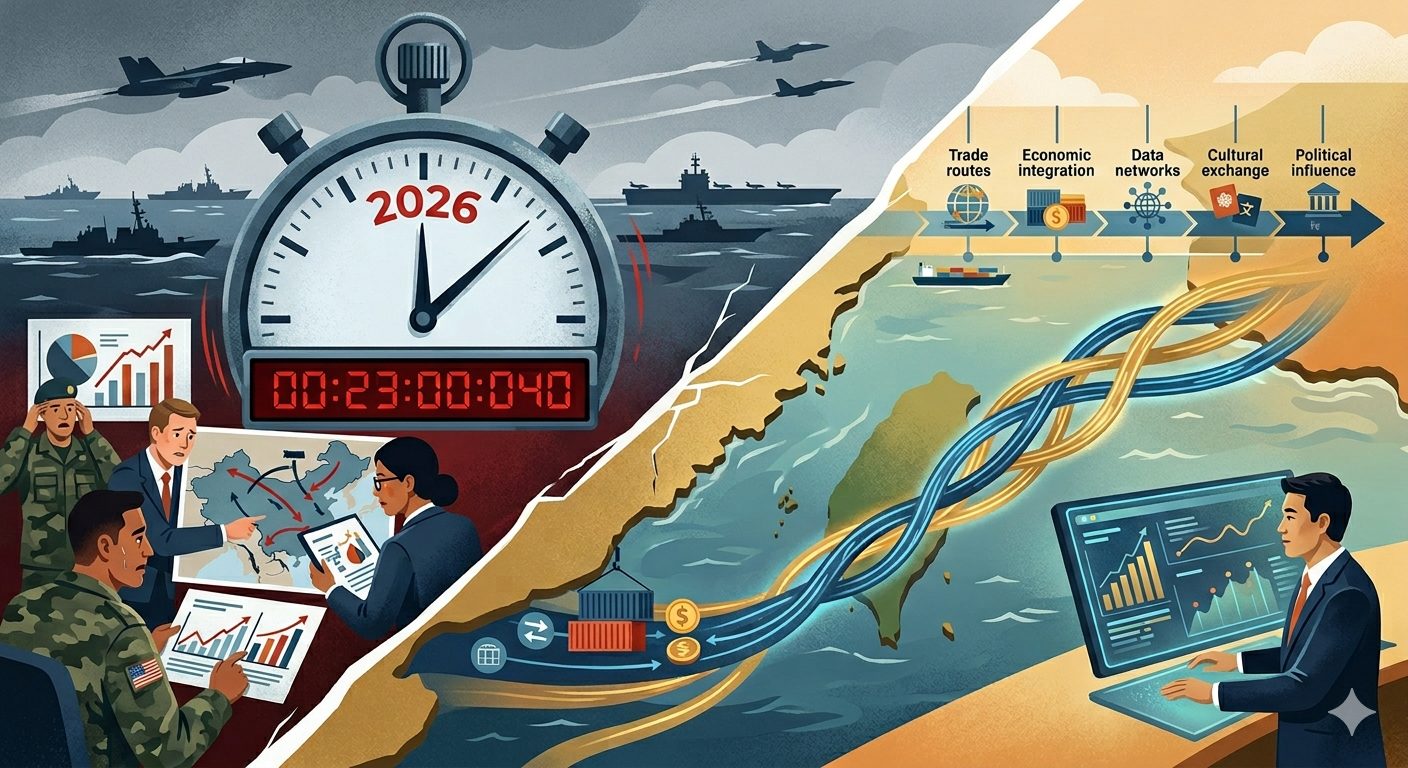
Why China’s 2026 posture toward Taiwan is about absorption, not assault — and why the United States is competing on the wrong clock
Reframing the Question
Western analysis of Taiwan has been dominated for years by a single question: when will China invade? Force postures, amphibious lift, missile inventories, and war-game timelines now define the debate. American officials warn that Beijing could possess the capability for an invasion within the next several years, and much of the Indo-Pacific think-tank literature has organized itself around the operational requirements of defeating an assault.
The concern is not unfounded. PLA modernization has been disciplined and explicit about altering the regional balance. Beijing fields advanced missile forces, an expanding navy, sophisticated cyber tools, growing nuclear capabilities, and increasingly capable aerospace and unmanned systems. Coercive activity against Taiwan has intensified across every domain over the past decade.
But the framing itself may be the problem. If Beijing does not believe time is running against it, the invasion-clock model misreads the entire competition. Chinese leaders appear to believe the balance of power continues to shift in their favor — provided they avoid a catastrophic war before the country has fully matured into the comprehensive power they intend it to become. That reading explains why the pressure campaign against Taiwan is persistent and coercive yet still calibrated below the threshold of war.
What is unfolding in 2026 is not the runway to an amphibious assault. It is the construction of a system designed to make the assault unnecessary.
The Patience Logic
Chinese strategic thinking remains shaped by the conviction that the country is in a transitional phase of national rejuvenation — promising but vulnerable. Party leaders openly describe the dangers ahead: demographics, economic restructuring, technological choke points, energy dependencies, and the risk of premature confrontation with the United States.
That tension is most visible on Taiwan. Unification is treated as historically inevitable and strategically essential, but Beijing also appears acutely sensitive to the costs of moving too early. A failed invasion, a prolonged regional war, or a severe sanctions regime could derail the developmental path the Party considers necessary to secure long-term victory.
So the strategy orients on shaping conditions rather than forcing resolution. Taiwan is no longer treated primarily as a territorial dispute awaiting military settlement. It is the central node in a wider contest over economics, technology, political legitimacy, industrial capacity, and psychological endurance.
This distinction matters. American strategic discussion frames Taiwan through the lens of deterrence — how do we prevent Beijing from using force? — and naturally prioritizes readiness, posture, weapons procurement, and coalition warfighting. All of that remains essential. But framed this narrowly, deterrence oversimplifies a competition that Beijing is approaching as a long-term contest of cumulative national power.
Administrative Annexation
The most potent weapon in Beijing’s current arsenal is not the DF-21 missile. It is the 15th Five-Year Plan (2026–2030), approved by the National People’s Congress in March 2026. The plan provides “top-level design and strategic guidance” for Taiwan-related work over the next five years, and its core logic is integration rather than confrontation.
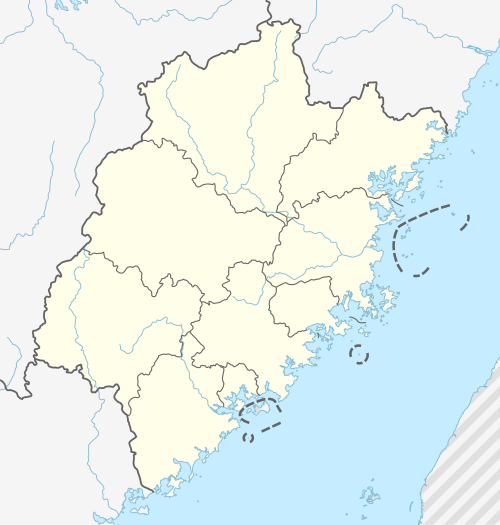
The mechanism runs through Fujian Province, the linguistic and cultural mirror of Taiwan across the Strait. Beijing has issued digital “Taiwan Compatriot Cards” granting Taiwanese citizens access to mainland social services, healthcare, housing, and employment in Fujian, with the new plan emphasizing “full implementation of policies ensuring Taiwan people receive equal treatment” with mainland residents. Specialized cross-strait industrial funds, a Fujian cross-Strait integrated development demonstration zone, and cooperation hubs in Pingtan and Kunshan are designed to tether Taiwan’s high-tech sector — particularly its semiconductor ecosystem — to mainland logistics. The objective is to make decoupling physically and financially impossible long before any kinetic decision becomes necessary.
The IISS has read the plan as a deliberate response to the constraints of the Xi era, balancing self-reliance against continued global integration. Independent analysts have characterized the Taiwan-specific provisions more directly as an “integration to weaken Taiwan” strategy with a 2027 inflection point. Either reading produces the same conclusion: Beijing is building tools whose purpose is absorption, not assault.
The Xiamen–Kinmen Life Circle
The physical landscape of the Strait is being rebuilt to reflect a new reality. The Xiamen Xiang’an International Airport — sited three kilometers from Taiwan’s Kinmen Islands at its closest point — anchors the effort. Basic construction completed at the end of 2025, with opening expected later in 2026.
A 660,000-square-meter terminal, three 3,800-meter runways, and projected capacity of 85 million passengers by 2040 are not the marks of a regional facility. Xiang’an’s own promotional language describes a hub built to “radiate towards Taiwan” and link the Maritime Silk Road. Taiwan’s Civil Aviation Administration has raised significant flight safety concerns about overlapping airspace with Kinmen Airport — roughly 70 percent overlap, with similar runway alignments — but Beijing has not adjusted the timeline.
Beijing’s continued push for the Xiamen–Kinmen Bridge and unified power and water grids extends the same logic. The most recent mainland policy package explicitly supports Kinmen’s use of the new Xiamen airport, tying the outer island’s daily logistics to mainland infrastructure. Once Kinmen’s electricity, water, transport, and aviation depend on Xiamen, the median line is not breached. It is rendered moot.
Transactional Deterrence
The 2026 National Defense Strategy has introduced a new variable: burden-sharing. Washington has moved further from “strategic ambiguity” toward “deterrence by denial,” shifting the onus of initial resistance onto Taipei.
On May 8, 2026, Taiwan’s parliament approved a $25 billion supplementary defense budget — NT$780 billion, well below President Lai Ching-te’s original NT$1.25 trillion ($39 billion) request. The package will fund HIMARS, Javelin, TOW 2B, and M109A7 systems from the December 2025 U.S. arms sale, with a second tranche worth roughly $14–15 billion in Patriot, Hellfire, and counter-drone systems likely to follow. The compromise size — driven by KMT and TPP majorities in a legislature unfriendly to the Lai administration — signals the political ceiling on Taiwan’s indigenous resourcing.
The vote was staged days before President Trump’s May 14–15 summit with Xi Jinping in Beijing, the first U.S. presidential visit to China since 2017. CSIS has flagged that Taipei is “always nervous before U.S.–China summits that its interests will be traded awayto make progress on the issue of the day.” Brookings has gone further, arguing Xi may push Trump toward declaratory shifts on Taiwan’s legal status, restraints on arms sales, or expressed “support” for peaceful unification.
The danger is no longer abandonment in extremis. It is treatment as a bargaining chip in negotiations over AI, tariffs, rare earths, fentanyl, and the war in Iran. Taiwan’s security increasingly depends not on a fixed alliance commitment but on the marginal value of Taiwan in any given week’s negotiation.
Gray Zone as Governance
It is time to stop calling Chinese activity in the Strait a rehearsal. It is governance.
The China Coast Guard has effectively replaced the PLA Navy as the primary actor in the day-to-day life of the Strait. By conducting routine “law enforcement patrols” and boarding vessels, Beijing asserts domestic jurisdiction over what international convention treats as international or contested waters. The U.S. Naval War College’s China Maritime Studies Institute has assessed that Beijing is using its Maritime Traffic Safety Law and Coast Guard Law to enforce expansive jurisdictional claims while staying below the threshold of conflict — a posture explicitly designed to mitigate escalation risk and forestall third-party intervention. Japan’s Ministry of Defense has reached the same conclusion, assessing that the CCG could be employed in a blockade or quarantine framed as an internal Chinese matter.
The capability backing the frame is also growing. The CCG now operates Wing Loong II high-altitude long-endurance UAVs — platforms comparable to the U.S. MQ-9 — for ISR over the Strait, conducting coordinated flights with Hai Jing patrol ships and Y-8 maritime aircraft. As recently as May 8, 2026, four CCG vessels intruded into Taiwan’s restricted waters near Kinmen — the latest in a steady cadence Taipei has labeled gray-zone harassment but cannot reverse without escalating itself.
The objective is normalization. If every day involves an incursion, an ADIZ violation, or a CCG patrol, then formal control, when it eventually arrives, registers less as catastrophe than as the resolution of an exhausting status quo.
The Endurance Test
The central question for the United States and its allies in 2026 is not whether they can sink a Chinese fleet in 2027. It is whether they can sustain strategic coherence longer than Beijing can sustain strategic patience.
The four mechanisms surveyed here — the Five-Year Plan’s integration architecture, the Xiang’an–Kinmen fait accompli, transactional deterrence, and CCG-led gray-zone governance — are not separate lines of effort. They are a single coordinated theory of victory through absorption. They share a common assumption: that the United States cannot or will not sustain a multi-decade systems competition, and that the Indo-Pacific architecture Washington built will erode faster than Beijing’s developmental path will stall.
That assumption is testable, and the test is not military. It runs through industrial policy, supply-chain reshoring, alliance management, semiconductor production, energy resilience, and the political cohesion needed to keep all of those pointed in the same direction across administrations. None of which is what current U.S. Taiwan strategy is principally measuring. The invasion-clock framing keeps producing readiness metrics — ships, missiles, lift, decision timelines — when the relevant metrics are absorptive: how dependent is Kinmen on Xiamen’s grid in 2028? How much of Taiwan’s chip ecosystem still has decoupling optionality in 2030? How much arms-sale execution friction does Taipei still face after the next U.S. transition? Beijing is competing on those questions. Washington is largely not.
A military deterrent that is not paired with systemic resilience deters only the scenario Beijing has already chosen not to run. The harder problem is that the United States is winning the war it is preparing for and losing the one already underway.

