


DeMarco Banter
The nation that breaks the hydrocarbon monopoly rules the twenty-first century.
That line was written in 2008, in a National Security Affairs Fellowship thesis at the Hoover Institution. It sat inside a strategy sketch called Quantum Look, which argued that the United States should treat alternative energy not as an environmental preference but as a grand-strategic imperative—the same way Eisenhower treated science education after Sputnik. Lessen the power of oil, the argument went, and the most unstable regions of the world lose their coercive grip. Whoever owns the energy transition owns the leverage of the next era. The thesis, Wondering Where the Lions Are: Putting Leadership Back into Strategy, and its condensed argument in the Hoover essay May the Best Ideas Win, made the case before the 2008 election that the next president needed a Solarium-style process to think two decades out rather than react crisis to crisis.
The analysis was right. The actor was wrong. The nation that moved to break the hydrocarbon monopoly was not the United States. It was China. And eighteen years later, the leverage that thesis described is real, it is enormous, and it points the other way.
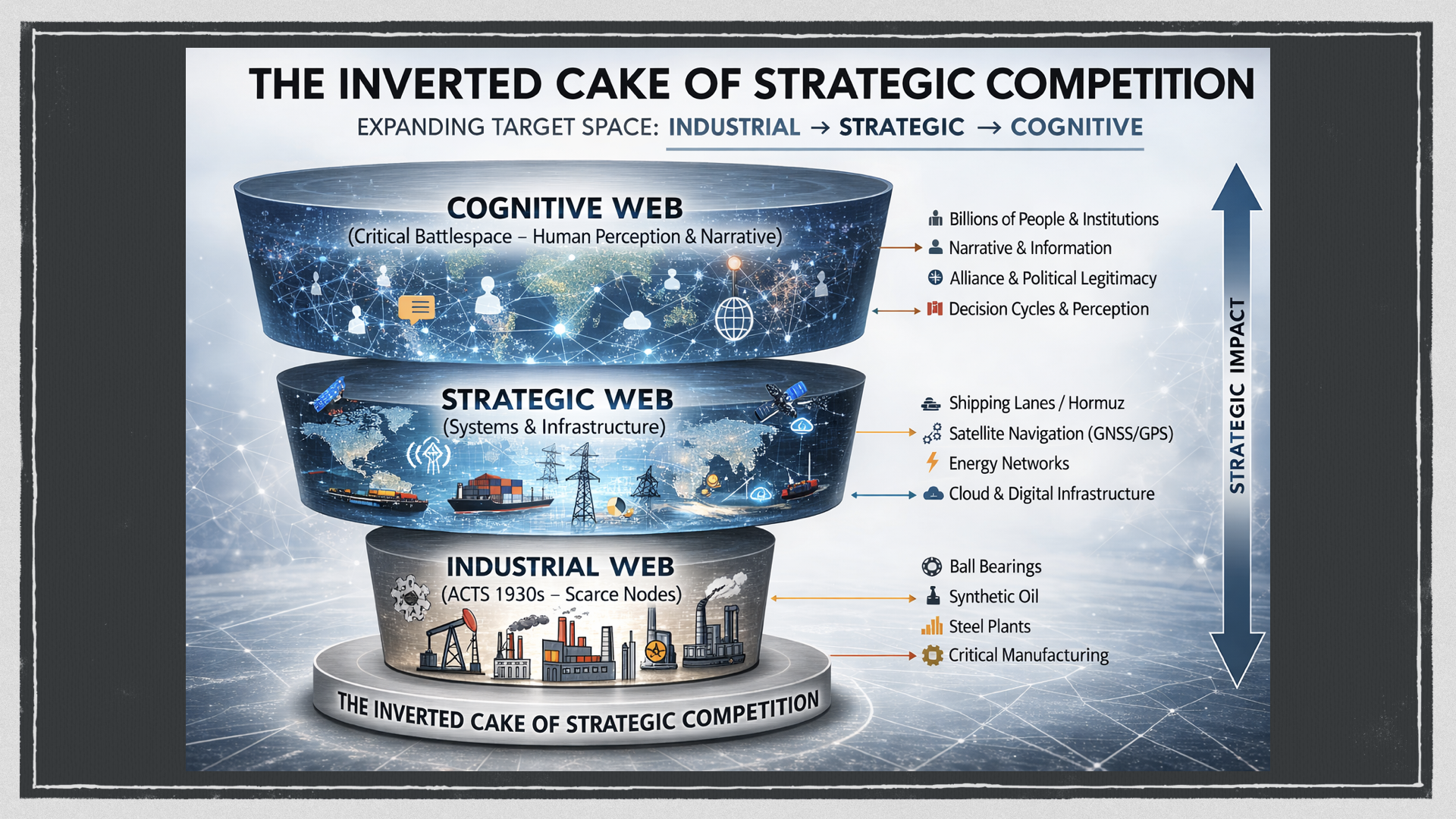
This is not a comfortable thing to revisit. It is, however, the most honest way to read the present moment—because the warning was filed, the logic was available, and the country looked elsewhere. What follows is an attempt to read energy through the three webs—Industrial, Strategic, and Cognitive—and to be pointed about the part that matters most: none of this happened by accident.
The strait that proved the thesis
Start with the news that made everyone pay attention. When Iran moved to close the Strait of Hormuz to shipping, it demonstrated something that strategists have understood in theory and ignored in practice for a very long time: a country can take a geographic pinch point and turn it into an economic weapon powerful enough to negate overwhelming military superiority. Iran could not match American firepower. It did not have to. It had a door, and it closed it.
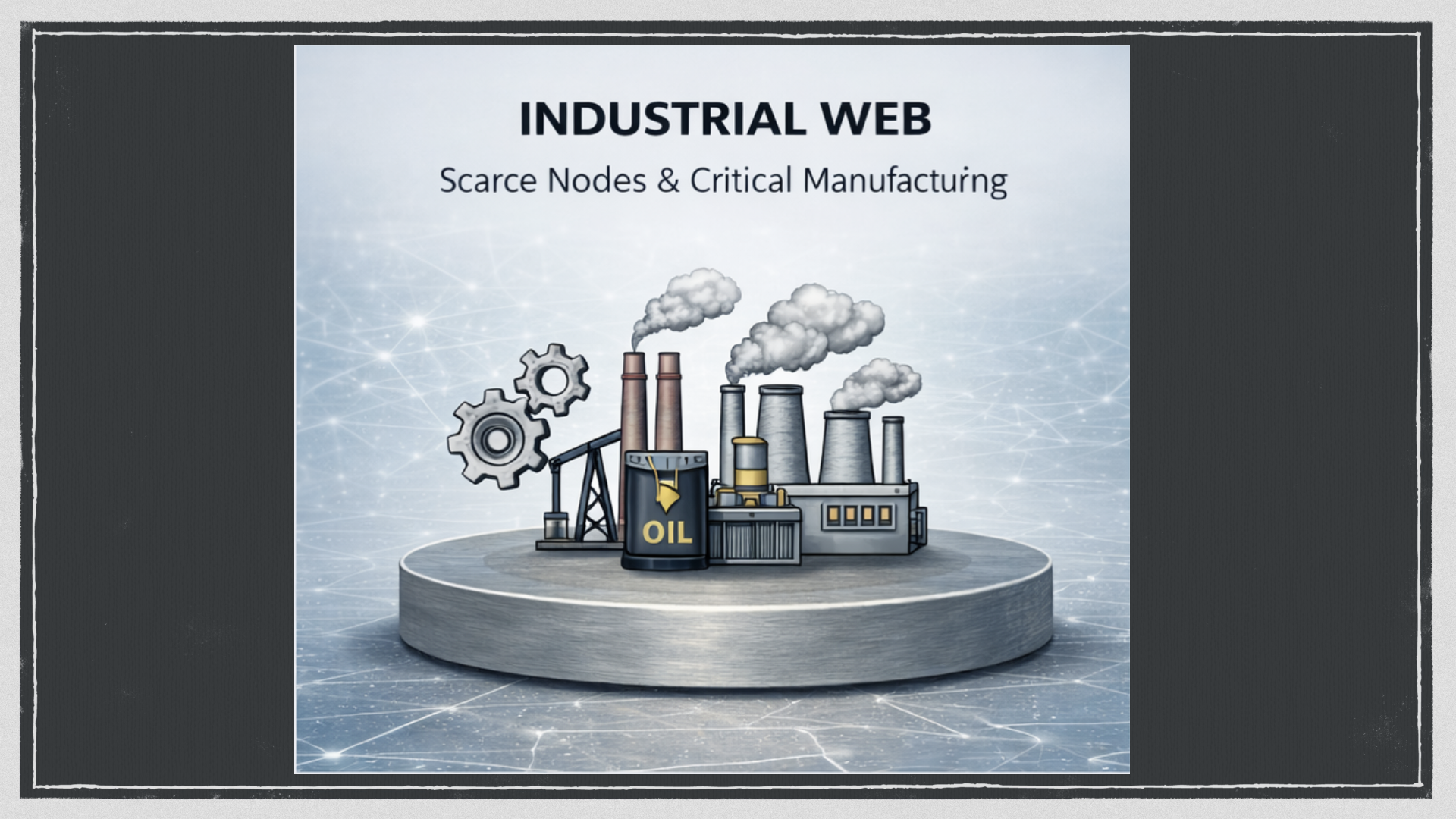
This is the Industrial Web in its rawest form—geography, extraction, logistics, the physical plumbing through which energy and goods actually move. The Industrial Web is where power is built, and it is also where power is most physically vulnerable. A strait, a refinery, a cluster of polysilicon plants in a single Chinese province that feeds a large share of the world’s solar supply: these are the load-bearing walls of modern economic life, and most of the time no one thinks about them at all.
The response to Hormuz has been entirely predictable and entirely Industrial. Build new pipelines to bypass the strait. Rebuild depleted crude reserves. Stockpile naphtha and jet fuel. Consider larger investments in nuclear and renewables so the supply is steadier next time. These are sound ideas. They are also slow, expensive, and—history suggests—likely to lose momentum the moment the crisis recedes and the price of patience comes due. The impetus to see resilience through tends to fade once the immediate pain stops. That fade is not an Industrial problem. It is a Cognitive one, and it returns below.
The pattern is not new—it is a playbook
The mistake would be to treat Hormuz as a one-off, a piece of Persian Gulf brinkmanship. It is better understood as the latest demonstration of a method that has become the defining logic of strategic competition: the weaponization of economic interdependence. NATO’s senior military commander named it directly in Singapore, calling it precisely that and warning that it demands far tighter cooperation between militaries, governments, and industry than the West currently musters.
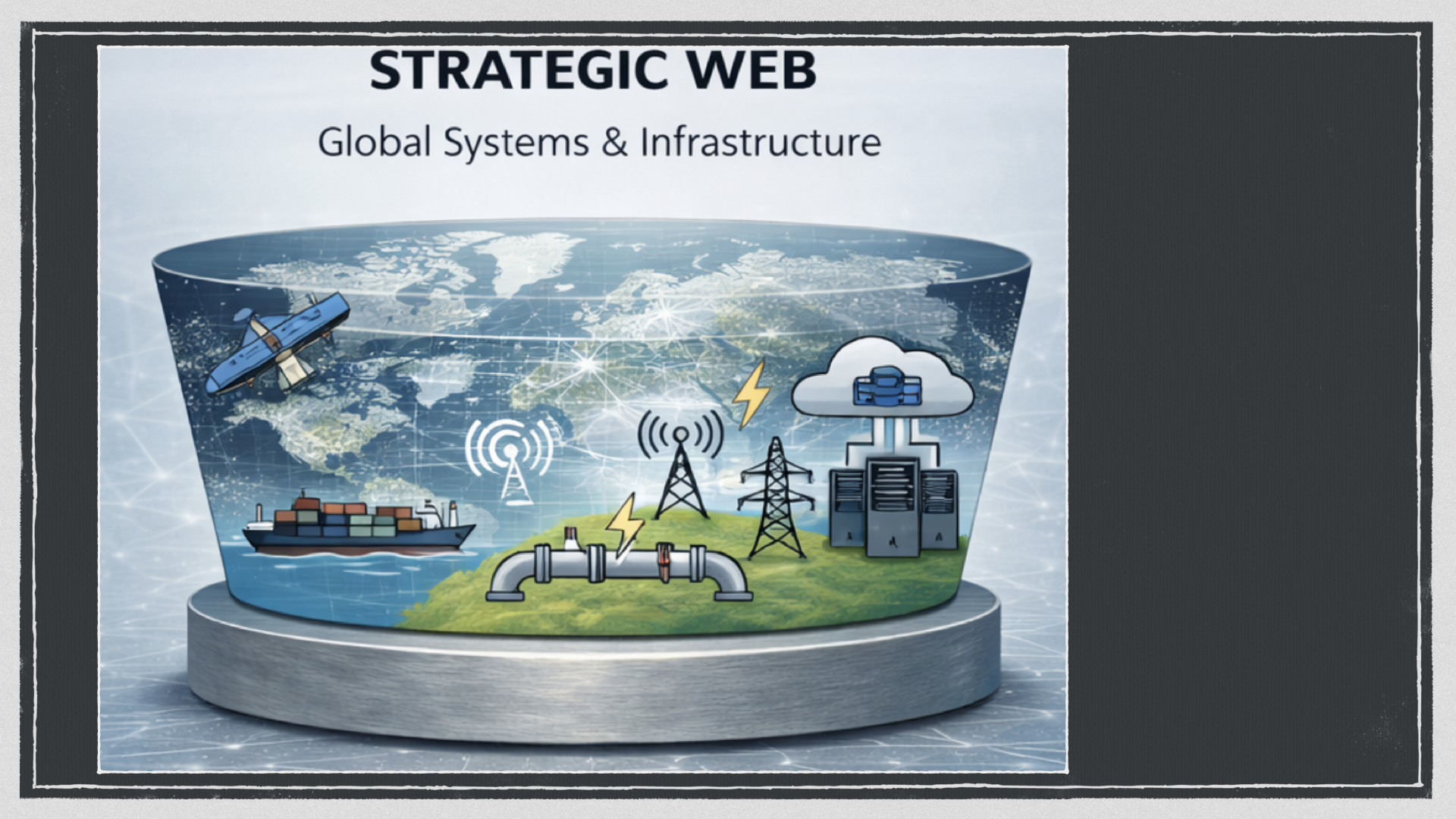
For years the United States was the only serious player at this table. It wielded the dollar and its command of the global financial system to pressure rivals, freeze adversaries out of the plumbing of commerce, and impose costs without firing a shot. Sanctions were the American version of closing a strait. This is the Strategic Web—the layer where industrial advantage is converted into deliberate coercive leverage, where a structural fact about the world is picked up and aimed.
The trouble with demonstrating a method is that adversaries take notes. China studied the American playbook and built its own version, located in a different part of the production stack. Where Washington projected power through control of upstream semiconductor design and the financial system, Beijing built leverage through control of materials, processing, and the licensing systems that govern their export.
And here the record is unambiguous about intent. In August 2024, China imposed export limits on antimony—a material used in ammunition, infrared sensors, and flame retardants. Chinese antimony exports subsequently fell by roughly 97 percent, and global prices for antimony trioxide roughly doubled. That is not the signature of a market adjustment. That is the signature of a calibrated instrument, tested and proven. In December 2024 came an outright directive against exporting gallium, germanium, antimony, and superhard materials to the United States. In April 2025, Beijing added seven medium and heavy rare earth elements to its export-control list, timed in retaliation against new American tariffs.
The architecture of these controls reveals the strategy better than any statement could. The April 2025 measures were written to reach beyond China’s borders—escalating, by the end of 2025, to cover internationally made products containing Chinese-sourced materials or built using Chinese technology, even when traded between two other countries. A magnet refined from Chinese raw material now requires Beijing’s authorization to move. This is jurisdiction projected through a bottleneck, the precise mirror image of the American Foreign Direct Product Rule. As one Chinese analyst put it in domestic media, the point was to ensure that whoever seeks to contain China first understands the cost of doing so.
Then, in late 2025, China suspended much of the regime as part of a trade truce following a Xi-Trump meeting—a one-year reprieve on the October package, even as the core April licensing controls stayed on the books. That suspension is the most revealing move of all. An instrument you can switch off at the bargaining table was never primarily about economics. It was leverage, held in reserve, deployed and withdrawn to shape an adversary’s behavior. That is the Strategic Web operating exactly as designed.
The chokepoint already under construction
Now apply that same reading to clean energy, and the picture turns genuinely sobering.
Begin with the scale, because the scale is the argument. By the IEA’s most recent accounting, China holds around 85 percent of the world’s solar manufacturing capacity and 80 percent of lithium-ion battery supply-chain capacity—and higher still at the chokepoint stages, roughly 95 percent of PV wafers and 97 percent of battery anode materials. A single Chinese province, Xinjiang, accounts for a large share of global polysilicon. China is projected to drive the overwhelming majority of global battery-manufacturing investment across 2025 and 2026—on the order of seven times the American figure, per BloombergNEF tracking—pouring well over $100 billion into battery manufacturing in that window alone. It produces around ninety percent of the world’s high-performance rare earth magnets, the components inside electric motors, wind turbines, and a great many weapons systems.
This was not luck, and it was not merely cheap labor. It was industrial policy executed with patience over more than a decade—subsidies sustained through years of losses, deliberate cost advantages that priced Western competitors out of existence, and a refusal to let short-term margins interrupt a long-term position. By the time the West noticed, the manufacturing base had migrated and the cost gap had become a chasm. A module made in China today runs roughly half the price of one made in Europe and around two-thirds cheaper than one made in the United States. Europe’s own solar-manufacturing alliance has largely failed to launch; its ingot and wafer capacity never took off, and dependence on China persists.
Here is the strategic core of it. The Hormuz weapon disrupts oil flows for a period of months, painful but bounded—oil has alternative routes, strategic reserves, and a deep global spot market. A chokehold on the clean-energy supply chain is a different category of threat. It does not disrupt one fuel; it disrupts the energy transition itself. As fossil dependence slowly declines and renewable dependence rises, the locus of strategic leverage transfers—from Persian Gulf geography to Chinese manufacturing. The new chokepoint is more durable than a strait, harder to route around than a sea lane, and it is being built in plain sight, with applause.
Replicating China’s scale and expertise in rare earths or solar processing, by most sober estimates, would take a decade and probably longer. Japan offers the cautionary data point: it has worked to reduce its rare-earth dependence on China since the 2010 episode—more than a decade of deliberate effort—and still sources a majority of what it needs from Beijing, a reminder the IEA makes in documenting how supply concentration has only intensified. The constraint was never industrial capacity alone. It was the will to absorb cost, year after year, after the headlines moved on.
The transfer already happened—watch it in the oil market
The temptation is to file all of this under forecast: in five or ten years, the leverage transfers. But the transfer is not a forecast. It happened this spring, in plain view, in the one market everyone was watching.
When the strait closed, the consensus prediction was catastrophe—analysts talked openly of oil at $200 a barrel, nearly triple pre-war prices. The closure removed something on the order of ten percent of global oil consumption from the market, by the IEA’s reckoning the largest supply disruption in history. And then the catastrophe did not arrive. Four months into the conflict, crude has stayed below $100. The American pump price has actually eased off its late-spring peak.
A large part of the reason is China. The world’s biggest crude importer cut its purchases by roughly 3.6 million barrels a day—an amount comparable to Japan’s entire daily consumption—which analysts identified as the single largest demand-side offset to the shock, second only to Saudi supply moves. China’s crude imports fell to an eight-year low. It did this through three levers, and the three levers are the whole argument in miniature: it leaned on its rapidly electrifying vehicle fleet and electric rail, it substituted coal for oil in producing certain chemicals, and it eased off the aggressive stockpiling it had pursued in the year before the war.
Sit with what that means. The same decade-long buildout that constitutes the chokehold—the EVs, the batteries, the electrified grid—is also what gave China the slack to absorb the largest oil shock in history without flinching. While Tokyo, Seoul, and New Delhi cut imports out of painful necessity, Beijing cut them from a position of structural insulation, and kept adding to its strategic petroleum reserve while it did so. It was not scrambling for replacement barrels. It had room to choose.
And the byproduct of that choice was that China, more than any other single actor, kept a lid on the price of the war the United States was prosecuting. That is leverage of a kind a strategic petroleum reserve cannot buy. A reserve is a defensive cushion—it absorbs a shock and then it is empty. An exit ramp from oil is an offensive position—it insulates the holder and lets the holder modulate everyone else’s exposure. The country that owns the energy transition got a quiet vote on whether Hormuz became a $100 problem or a $200 problem.
Two honest cautions belong here, because the cleanness of the story is exactly what should make a strategist slow down. First, this is not benevolence, and it should not be narrated as China rescuing the market; China acted in its own interest, and the price stability was a consequence, not a gift. Whether the import cut was consciously calibrated to manage global prices or simply the natural behavior of an economy that no longer needs the oil is genuinely unclear—and the argument does not require the conscious version. The capability is the point, and the capability is undeniable. Second, the analysts are nearly unanimous that it will not last: as inventories draw down and reserves need rebuilding, prices will have to climb. Some of the import cut was ordinary demand destruction from high prices, not strategic maneuver. The leverage revealed this spring is real but not infinite.
None of that softens the core observation. The thesis predicted that whoever broke the hydrocarbon monopoly would hold the leverage of the new century. This spring, the holder of that leverage demonstrated it under live fire, in the most-watched market on earth, and most of the coverage filed it as an environmental success story rather than a strategic event. Which is the cleanest possible illustration of the web that let it happen.
Why we could not see it—the Cognitive Web
Which brings us to the web that does the most work and gets the least attention. The Cognitive Web is the layer of stories, assumptions, and belief structures through which a society decides what counts as a threat in the first place. It is the most powerful of the three, because it determines whether the warnings coming out of the Industrial and Strategic webs are ever heard at all.
For a generation, the Cognitive Web told the West a reassuring story: deep economic interdependence made conflict irrational, and therefore safe. Entanglement was not a vulnerability; it was a peace mechanism. That story actively suppressed the warning signals the Industrial Web was sending. Supply-chain concentration did not look like a loaded weapon. It looked like efficiency. It looked like the market working.

Clean energy got wrapped in a second, even more effective layer of cognitive insulation. Because solar panels and batteries arrive draped in the language of climate virtue and global cooperation, pointing out that the supply chain behind them is a single-nation chokehold has felt, to many ears, like arguing against clean energy itself. The frame made strategic scrutiny sound like bad faith. The urgency of decarbonization—real and serious—became cover for the quiet construction of dependency. This is the Cognitive Web at its most consequential: not lying about the facts, but arranging them so that the dangerous question cannot be politely asked. It is exactly why the spring oil story ran as good environmental news instead of as the strategic demonstration it was.
That is the trap the 2008 thesis half-saw and could not fully name. Quantum Look got the Industrial recommendation right—materialize alternative energy, break the monopoly. What it could not anticipate was that the United States would leave the recommendation on the page, and that a competitor would read the same strategic logic, act on it with discipline, and capture the leverage the thesis hoped America would seize. The gap between knowing and doing is not an Industrial gap or a Strategic gap. It is Cognitive. The lions, to borrow an old phrase from that thesis, were not watching.
The diversification trap
There is a final turn, and it belongs to the scholars who study this weaponization most closely. The instinct, once a dependency is recognized, is to diversify away from it. Good. But diversification done carelessly simply trades one chokehold for another. Russia’s war in Ukraine pushed Europe off Russian gas and onto American liquefied natural gas at a moment of strained relations. China controls not only batteries but the broader supply chain for solar, wind, and grid storage. The honest question is the uncomfortable one: in fleeing a dependency, is the West simply manufacturing a fresh one it will move to weaponize-proof too late?
The answer is not to abandon the energy transition; the transition is coming regardless, and on the merits it should. The answer is not purely Industrial either—more domestic refining, more mines, more gigafactories, though all of that helps and the recent American manufacturing push is real. The answer has to start in the Cognitive Web, because that is where the failure originated. A strategic culture has to be built that can hold two ideas at once: that clean energy is a genuine good, and that the supply chain delivering it is a genuine vulnerability. Until the question can be asked without being heard as heresy, the Industrial and Strategic responses will always arrive a decade late.
The democracy of the dinosaur
George Kennan, the architect of containment, gave this failure mode its most memorable image. Reflecting on how democracies perceive threats, he wrote:
But I sometimes wonder whether in this respect a democracy is not uncomfortably similar to one of those prehistoric monsters with a body as long as this room and a brain the size of a pin: he lies there in his comfortable primeval mud and pays little attention to his environment; he is slow to wrath—in fact, you practically have to whack his tail off to make him aware that his interests are being disturbed; but, once he grasps this, he lays about him with such blind determination that he not only destroys his adversary but largely wrecks his native habitat.
That is the United States on energy. Slow to register the disturbance because the disturbance arrived wearing a friendly face, and at real risk, once it finally registers, of thrashing—tariff war, panic subsidy, scramble—in ways that wreck as much as they fix. The dinosaur problem is not stupidity. It is a nervous system poorly wired to feel slow, structural pain until it becomes acute. The Cognitive Web is that nervous system. Kennan’s warning, quoted in the 2008 thesis, was that the cure is to take a little more interest in what is going on at an earlier date—to see the situation forming and prevent it, rather than proceeding from undiscriminating indifference to equally undiscriminating wrath.
What the file says
The instructive thing about returning to Quantum Look is not that it was prescient. Plenty of people warned about energy dependence in 2008. The instructive thing is the shape of the failure. The analysis existed. The logic was sound. The recommendation was clear. And none of it mattered, because the country’s Cognitive Web was not configured to treat slow, structural, undramatic vulnerability as an emergency. It still is not. Hormuz produced headlines because it was sudden and visible. The clean-energy chokehold produces none, because it is gradual and wears a virtuous face—which is precisely what makes it the more dangerous of the two.
Eisenhower understood that the value of a planning exercise was rarely the plan. It was that the exercise accustomed the mind to the problem before the problem arrived, and quickened the response when it did. The three webs are an exercise in exactly that sense. They will not, by themselves, mine a single ton of neodymium or build a single wafer line. What they can do is force the question the climate frame keeps polite, the question the interdependence story kept buried, the question the 2008 file asked and the country declined to answer:
Whoever breaks the hydrocarbon monopoly rules the century. Someone is doing it. It is not the United States. The question the file asked in 2008 is the question still waiting for an answer: what, exactly, does America intend to do about that?
The warning was filed eighteen years ago. The leverage is built. The choice, as ever, belongs to whoever is willing to watch over the strategy day in and day out—long after the strait reopens and the headlines move on.

