

There are songs that define a generation, and then there are songs that somehow escape the generation that produced them. More than fifty years after its release, Riders on the Storm by The Doors continues to find new audiences. Part of its appeal lies in its haunting simplicity: rain falls in the background, thunder rolls across the speakers, and Jim Morrison’s voice drifts somewhere between narration and warning. The imagery is familiar—a lonely highway, an approaching storm, a killer on the road. While most listeners hear a song about danger, mortality, or perhaps the darker side of America, I hear philosophy. Specifically, I hear the haunting echoes of Martin Heidegger.
That may seem like an odd pairing. Morrison was a rock musician, not a philosopher, though he studied existentialism and literature extensively while at UCLA. Heidegger was one of the twentieth century’s most influential—and controversial—philosophers. Yet one line from Riders on the Storm captures one of Heidegger’s central ideas with remarkable precision: “Into this house we’re born. Into this world we’re thrown.”
For Heidegger, human existence begins with what he called Geworfenheit, usually translated as “thrownness.” None of us chooses the circumstances into which we arrive. We do not choose our parents, our nation, our historical moment, or the technologies that shape our lives; we simply discover ourselves already embedded within a world that existed long before we arrived and will continue long after we are gone. We are, in Heidegger’s words, thrown into existence.
Yet Heidegger did not view thrownness as a sentence to passive paralysis. Its essential counterpart is Entwurf, or “projection.” While we cannot choose where we are thrown, we are entirely responsible for projecting ourselves forward through the choices we make within that unchosen reality. This simple tension carries enormous implications for the very foundation of strategy.
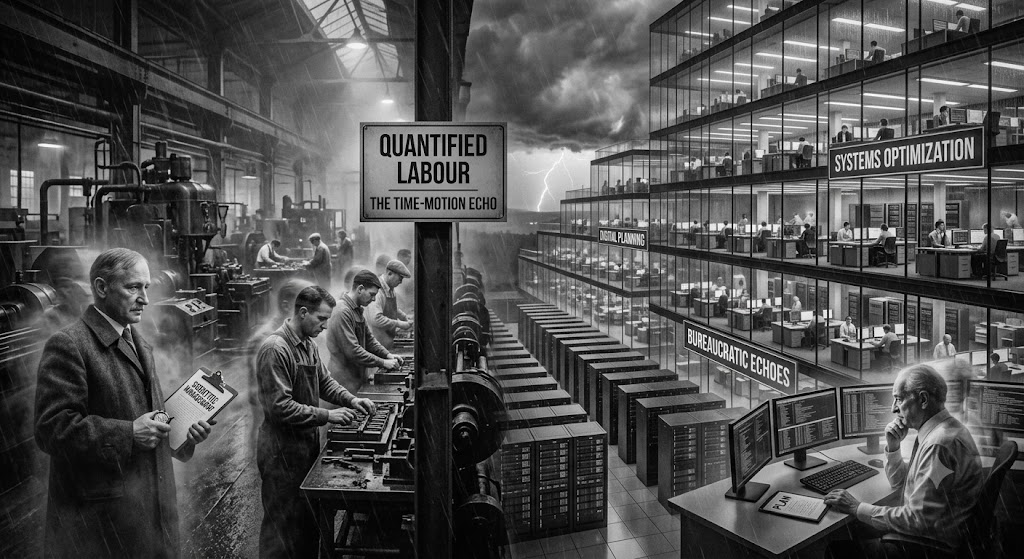
Much of modern strategic thinking, particularly during the Industrial Age, has been built around the illusion that uncertainty can eventually be mastered. Better intelligence, more data, larger staffs, improved planning processes, and increasingly sophisticated models all promise to reduce ambiguity and increase control. From Frederick Winslow Taylor’s scientific management to modern bureaucratic planning systems, the underlying assumption has often remained the same: if we gather enough information and design the right process, the future becomes manageable.
History suggests otherwise. The twentieth century was filled with organizations that believed they had finally mastered complexity. The French Army entered 1940 with one of the most carefully constructed defensive systems ever built. The Soviet Union possessed enormous industrial capacity and one of history’s largest militaries before its sudden collapse. More recently, governments and corporations alike discovered during the COVID-19 pandemic how fragile even highly optimized systems could become when confronted by unexpected shocks. The storm always arrives—or perhaps more accurately, the storm never left.
Heidegger’s notion of thrownness reminds us that uncertainty is not a temporary condition to be eliminated, but the permanent condition of human existence. Strategy, therefore, cannot begin with prediction, because prediction assumes a degree of stability that history rarely provides. Instead, strategy begins by recognizing the world as it actually exists: dynamic, incomplete, contested, and constantly changing.
This insight helps explain why a deeper look at the work of John Boyd is so vital. Boyd’s OODA Loop is frequently misunderstood as a rapid decision-making cycle, but Boyd devoted far more attention to orientation than to observation or action. Orientation represents the accumulated influence of culture, experience, education, genetic heritage, analysis, and previous decisions. It is the lens through which we encounter reality before we ever decide what to do.
Orientation is, fundamentally, Boyd’s practical answer to Heidegger’s existential problem. Both begin from the same premise: we do not confront an objective world with perfect clarity. We inherit assumptions, institutions, languages, traditions, and technologies that shape what we perceive before conscious thought even begins. Every strategic decision is already influenced by the world into which we have been thrown.
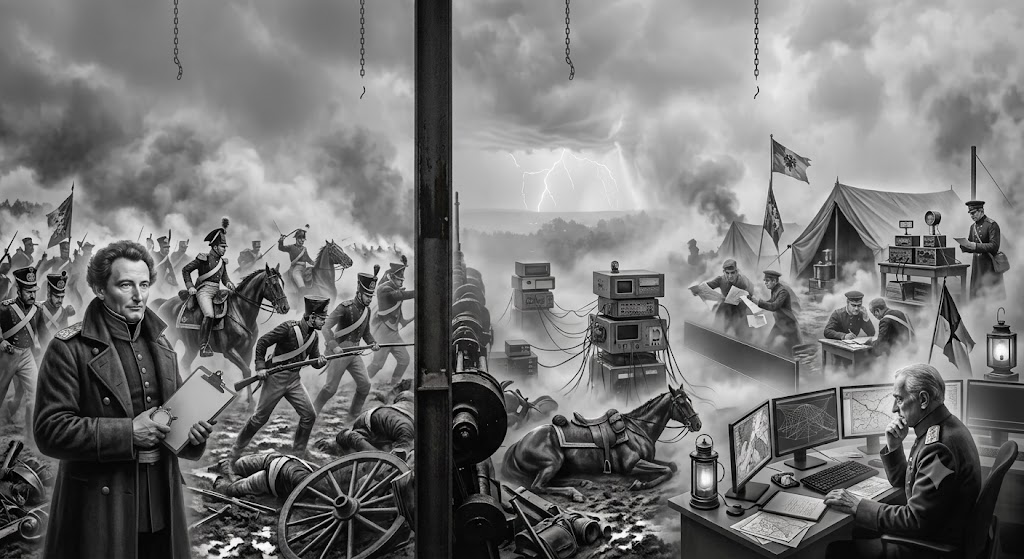
Clausewitz recognized something similar when he described friction. War refused to conform to the orderly plans imagined in peacetime because reality possessed a stubborn habit of disrupting human expectations. Friction was not an anomaly; it was an inherent characteristic of conflict. Likewise, Nassim Taleb argues that randomness and disorder are not rare interruptions but enduring features of complex systems. The organizations that flourish are not those that attempt to eliminate uncertainty, but those that become stronger through continual adaptation.
This realization forces a profound shift in how we evaluate institutional design and competitive environments. As strategic competition shifts from the Industrial Web to the Strategic Web, and now into the Digital-Cognitive Web, the core challenge remains the same: how do institutions respond to a world they do not control?
Too often, the default answer is to pursue greater certainty. We produce thicker strategies, longer planning documents, additional oversight mechanisms, and increasingly detailed requirements. We build systems intended to reduce variation, eliminate ambiguity, and standardize behavior. These efforts frequently improve efficiency, but they rarely improve adaptability. In some cases, they accomplish precisely the opposite, leaving institutions exceptionally good at solving yesterday’s problems while slowly losing the capacity to recognize tomorrow’s.
Innovation suffers from the same misunderstanding. We often speak about innovation as though it were primarily a matter of technology or investment—buy the right software, fund the right laboratory, acquire the next platform. Yet technological superiority alone has never guaranteed strategic advantage. History repeatedly demonstrates that breakthrough ideas emerge where intellectual diversity is tolerated, experimentation is encouraged, dissent is permitted, and learning is valued over compliance. Innovation, in other words, is less about invention than ecology. The healthiest ecosystems do not try to predict the storm; they cultivate the navigators.
Perhaps that explains why Riders on the Storm continues to resonate more than five decades after it was written. Morrison never tells us how the journey ends. He offers no promise that the weather will improve. The rain continues, the road stretches forward, and the danger remains real. Yet the song is strangely calm. It accepts uncertainty rather than attempting to conquer it, and there is immense wisdom in that acceptance.
We spend considerable time discussing resilience, agility, adaptation, and innovation. Each has become something of a buzzword within both military and corporate circles, yet these concepts all rest upon a deeper philosophical foundation. Before organizations can adapt, they must first recognize the true nature of their environment. They must abandon the illusion that stability is the norm and uncertainty the exception. The opposite is true: uncertainty is the norm. The storm is the norm. Everything else is merely a period of unusually good weather.
That may be the most enduring lesson hidden within Morrison’s lyrics. We are not spectators waiting safely beside the highway, watching storms pass in the distance. We are already on the road. We always have been. Every generation inherits its own version of uncertainty—economic upheaval, geopolitical competition, technological disruption, or social transformation. None of us chooses the storm we encounter. Like every generation before us, we simply find ourselves riding through it.
Perhaps strategy has never been about escaping the storm. Perhaps strategy is learning how to ride.