


Part of this week went to rereading Stephen Robinson’s The Blind Strategist. It is a useful book, though maybe not for the reasons Robinson intends. At its core, the book is an attack on John Boyd, maneuver warfare, and a generation of military thinkers who leaned hard on German operational history. Robinson’s argument, stated plainly, is that Boyd and others mistook destruction for maneuver. Germany did not win because it achieved some mystical cognitive advantage. Germany won because it destroyed opposing armies. There is real truth in that critique.
But working through Robinson’s argument, the thoughts kept drifting away from Boyd and toward France. Not the France of the textbooks. The real one: a sophisticated nation with capable leaders, respected universities, deep industrial capacity, and one of the most powerful militaries on earth. How does a society like that get the future so wrong? That question has been sitting around for months.
The standard explanation for the collapse of France in 1940 leans on tanks, aircraft, operational maneuver, and the Ardennes. These factors mattered, but they feel insufficient as explanations on their own. Germany did not defeat an incompetent opponent. France had talented officers, experienced statesmen, and a deep military tradition. The French understood Germany was a threat. They understood another war was coming. They studied the last one closely and prepared accordingly. That may have been the problem. France had become very good at understanding the last war.
The more one reads about 1940, the less it looks like a military failure and the more it looks like an adaptation failure. France did not lack capability. France lacked an accurate enough picture of what was changing around it. The assumptions underneath French strategy no longer matched reality. That feels increasingly relevant today.
For months now, conversations about professional military education, artificial intelligence, innovation, universities, research funding, strategic foresight, and institutional reform have kept circling back to the same place. On the surface these look like separate discussions. Underneath, they are probably one discussion wearing different clothes: how does an organization keep its ability to adapt? The question is old. Rome faced it after Cannae. Britain faced it during the Industrial Revolution. The Soviet Union faced it in the Information Age. Every durable organization eventually meets the moment when the world changes faster than its assumptions do, and the challenge is rarely technological. It is intellectual.
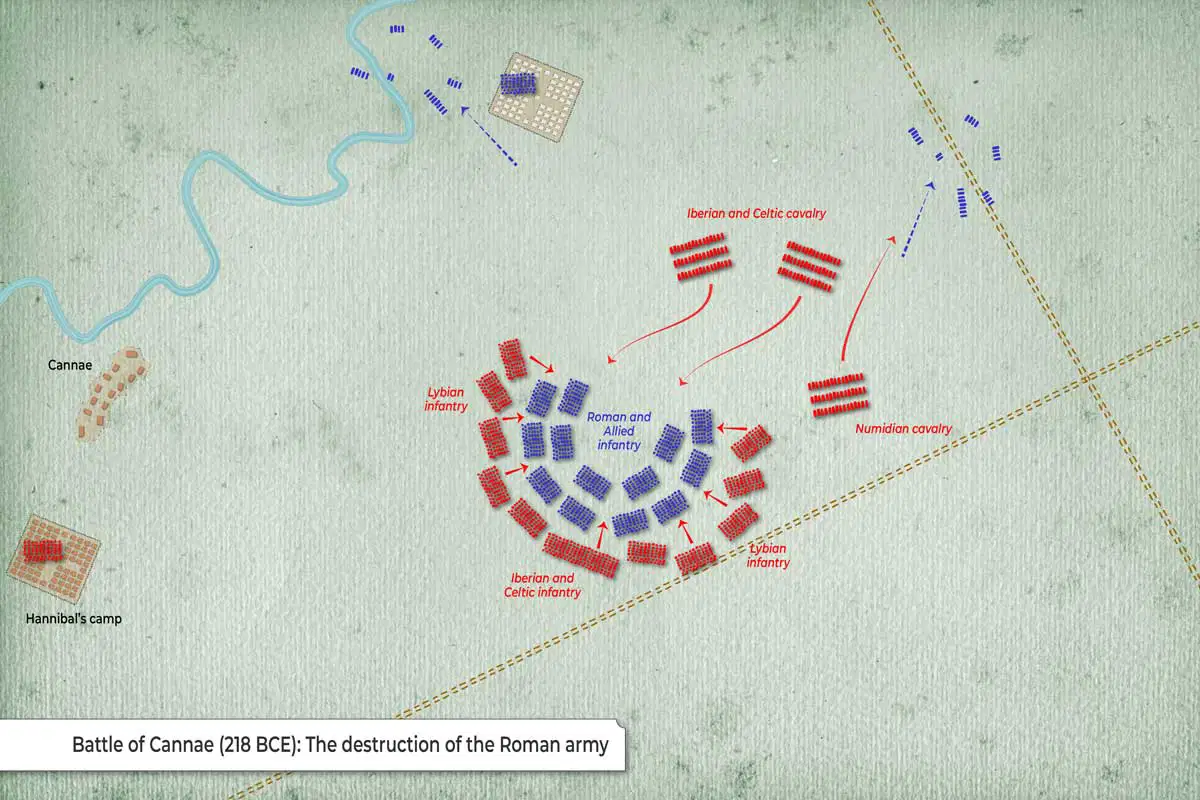
Cannae is worth a closer look. Historians often call it history’s clearest example of annihilation. Hannibal trapped and destroyed a Roman army. Tens of thousands died. The outcome was catastrophic. But fixating on the destruction misses the more interesting part. The Romans did not lose because they lacked courage. They did not lose because they lacked manpower. They did not even lose because Hannibal had superior numbers. They lost because they misread the battle they were fighting. The Romans believed they understood what was happening. They believed they were pressing an advantage. They believed victory was close. They were wrong. The battlefield they thought existed did not exist. The destruction came later. The adaptation failure came first.
That sequence is probably why arguments leaning too heavily on technology, platforms, or resources deserve some skepticism. History is full of powerful societies holding all three and still failing strategically. The French had tanks. The British had battleships. The Soviets had missiles. Technology matters, but it rarely explains strategic adaptation on its own. The harder question is how a society recognizes that its understanding of the world is going stale.
This is where Boyd still earns his keep, whatever one thinks of his other conclusions. His lasting contribution was never really the OODA loop. It was the emphasis on orientation. He understood that people and organizations run on mental models, and those models help interpret reality even as they can blind a person to it. A durable organization is not necessarily the one with the best answers. It is the one that notices when its answers no longer fit the questions. That sounds simple. It is brutally difficult, especially for organizations that are winning. Success reinforces assumptions. Success builds confidence. Success rewards existing behavior. The same things that produce a win can become the barrier to the next adaptation.
That is where these thoughts circle back to institutions. A good chunk of the last several years has gone into thinking about innovation, and a lot of that work eventually settled into what gets described here as an ecology of strategic innovation. The premise is simple: innovation is rarely the product of isolated genius, but comes out of conditions that encourage learning, experimentation, dissent, and adaptation. The variables themselves are not exotic: diversity of thought, intellectual freedom, tolerance for dissent, learning mechanisms, experimentation capacity, resource flexibility, strategic partnerships, adaptive incentives, technology openness.
The interesting part is not the innovation itself. It is what these variables actually measure. Increasingly, they look like measures of adaptive capacity, indicators of whether an organization can recognize reality before reality forces the issue. Seen this way, universities are more than educational institutions. Research labs are more than engines of discovery. Professional military education is more than career development. Think tanks are more than repositories of expertise. They are a society’s adaptation infrastructure, not because they are always right, and not because they are immune to bureaucracy, ideology, or waste, but because they create chances to challenge prevailing assumptions before events do it instead.
That distinction matters. A society can survive bad ideas. What it struggles to survive is failing to notice its ideas have gone bad.
This is part of why comparisons between the United States and China feel both useful and incomplete. China has something a lot of Americans have come to admire: continuity. Long-term plans can run for decades. National priorities can hold steady across generations of leadership. There are real advantages to that kind of consistency. But history suggests continuity alone is not enough. Every centralized system eventually runs into the same problem. Who questions the assumptions? Who raises the uncomfortable possibility? Who tells the emperor he might be wrong? The challenge for democracies has always been persistence. The challenge for centralized systems has always been adaptation. The ideal system would manage both. History suggests that balance is rare.
Which brings this back to the lions. The question behind an earlier piece here has not gone away: where are the lions? It was never really a question about individuals. It was about institutions. The lions are the people, organizations, and communities still willing to challenge assumptions while there is time to act on it. They show up in laboratories, classrooms, war colleges, startups, research centers, and conversations like this one. They are often inconvenient, frequently contrarian, occasionally wrong. They still do essential work. They help a society learn.
That may be the thread running through France, Cannae, Boyd, innovation, universities, and strategic foresight. Great powers rarely fail because they run out of strength. More often, they fail because they lose the ability to adapt that strength to changed circumstances. The danger is not weakness. The danger is becoming very good at solving problems that no longer matter.
That may have been France’s problem in 1940. It could become China’s problem one day. Without care, it could become ours. The real question is whether the institutions capable of telling us the world has changed are still being preserved, because by the time the panzers come out of the Ardennes, the adaptation window has already closed. At that point all that is left is the postmortem.
And the question from whoever comes after:
Where were the lions?
 Mastermind Century Group