


In late April 2026, the Air Force Research Laboratory announced it was consolidating eleven of its organizations into seven. The press release called it “the most significant organizational change for AFRL in nearly 30 years.” AFWERX and SpaceWERX, along with pieces of three other former directorates, were folded into a new Technology Transition Office — described officially as AFRL’s “system integrator,” connecting the lab, mission partners, and industry to the acquisition community to accelerate technology delivery. Secretary Hegseth’s January memo had called for exactly this kind of consolidation, decrying what he called a linear model that “gates progress through sequential stages as if technology matured on a predictable conveyor belt.”
The diagnosis in that memo is not wrong. But the prescription deserves scrutiny, and the AFWERX story in particular deserves an honest telling, because we have been here before.
AFWERX was stood up on the Air Staff in 2017. As an independent entity, outside normal AFRL reporting chains, with its own culture and its own mandate, it had room to be strange — and for a time, it worked. It generated genuine energy with small companies and nontraditional partners who would never have navigated the standard DoD front door. Then it grew, gained momentum, attracted budget attention, and in 2021 was moved from the Air Staff into AFRL. Within a few years it had drifted toward what critics called brokerage: an entity better at matching organizations than disrupting anything. Now, under the 2026 restructuring, it has been absorbed again — this time as a component of a “system integrator” directorate.
A system integrator, by definition, connects things. It coordinates. It does not disrupt. That is the tell.
Order, Chaos, and the Hard Structure
To understand why this pattern keeps repeating, it helps to start with a basic tension that runs through military organizations and, frankly, through any large bureaucracy.
On one side is order: hierarchy, procedure, standardization, accountability. In the military these are not failures of imagination. They exist because the mission is too consequential to leave to improvisation. Rules, checklists, doctrine — these enforce repeatability in crisis, and in crisis, repeatability saves lives. Call this the Yang dimension of the organization: the drive toward control, precision, and coordinated action.
On the other side is creativity: the willingness to experiment, to tolerate failure, to pursue ideas whose value is not yet legible on a budget spreadsheet. Call this the Yin — not as a weakness but as a complementary force, the source of the adaptive energy the organization needs to remain relevant as the world changes around it. The tension between them is permanent and necessary. You cannot run an Air Force on pure creativity any more than you can innovate by committee on the ramp at Kandahar.
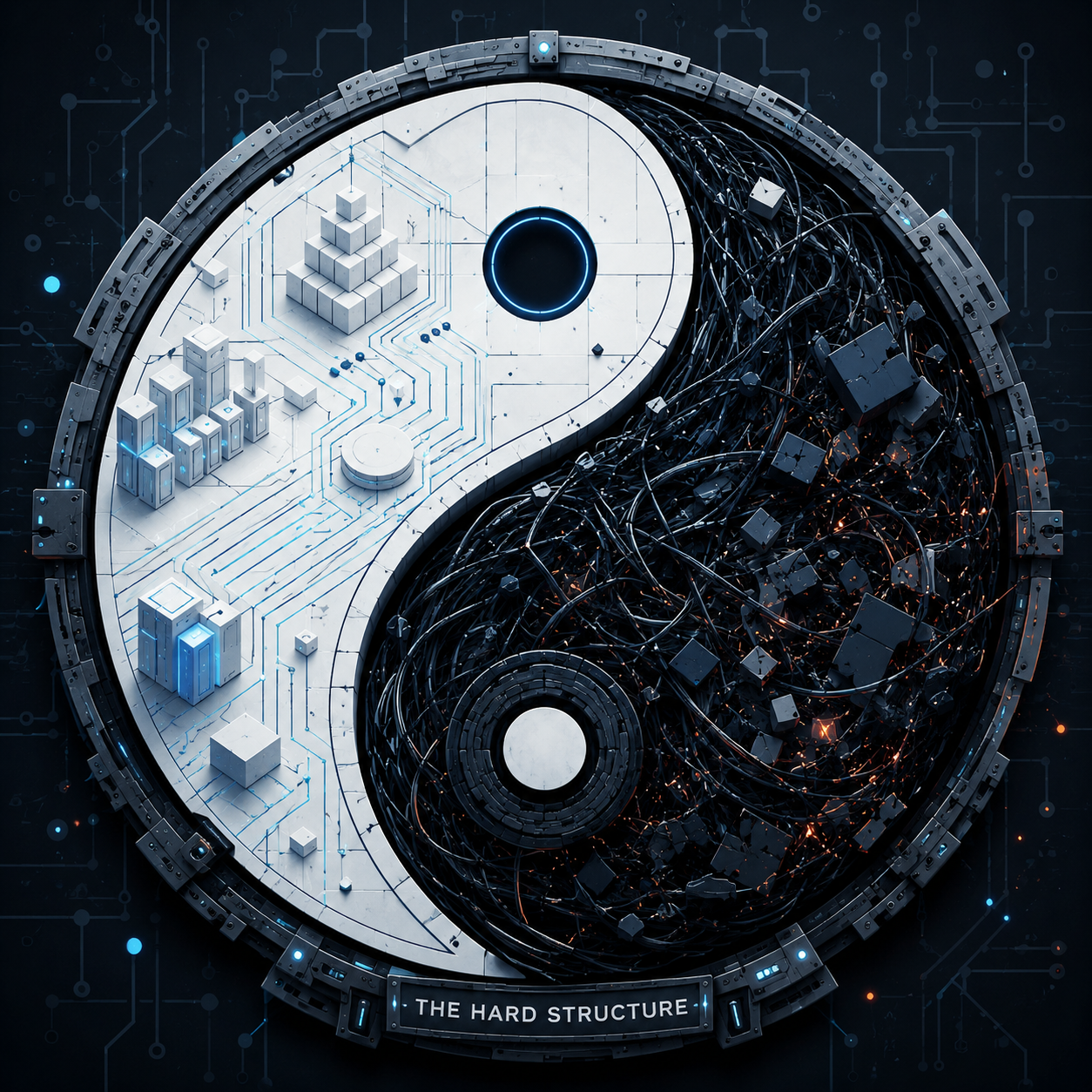
The problem is that hard structures — and the military is as hard as they come — tend to let the Yang overwhelm the Yin. The institution optimizes for what it can measure, repeat, and defend in a program review. Innovation is messy. It fails frequently. It looks, on paper, like waste. So the hard structure does what hard structures do: it absorbs the disruptive thing, gives it a reporting chain, assigns it metrics, and waits. Eventually the thing starts producing results that fit the dominant logic — because that is the only way to survive inside the dominant logic — and what was once disruptive becomes administrative.
There is nothing conspiratorial about it. No one is plotting the death of innovation at a conference table. The process is structural, and understanding why requires sitting with two thinkers most military leaders have not encountered: Hans-Georg Gadamer and Carl Rogers.
What Gadamer and Rogers Teach Us
Gadamer’s central argument in Truth and Method (1960) is that understanding is never neutral. It is always conditioned by what he calls prejudice — not in the pejorative sense, but as the inherited fore-structure of assumptions, traditions, and authorities that shape how we interpret anything new. In an institution like AFRL, those prejudices are deep and, for the institution’s core purpose, largely functional. Scientists and engineers there have spent careers learning what good research looks like, what a credible program looks like, what success looks like at the end of a budget cycle. That inherited structure is not wrong. It is well-adapted to maturing technology through TRL levels and delivering it to acquisition programs. The problem is that it is also perfectly adapted to neutralizing anything that does not fit the model — not out of bad faith, but because the model is the lens through which new things get evaluated.
Gadamer’s four conditions for genuine understanding — confronting your own prejudices, engaging seriously with tradition rather than dismissing it, granting authority based on demonstrated knowledge rather than rank, and practicing real reflection — are not natural behaviors in a hard structure. Tradition becomes doctrine. Authority becomes position. Reflection becomes after-action review. The conditions that enable genuine understanding, and by extension genuine innovation, are exactly the conditions the institution structurally discourages.
Carl Rogers, in Client-Centered Therapy (1951) and On Becoming a Person (1961), contributes the human side of this: the Yin to Gadamer’s Yang. Rogers argued that growth — in a person, and by extension in any group of people — requires psychological safety, unconditional positive regard for ideas that are uncertain and unproven, and tolerance for what he described as the chaos that necessarily precedes new order. When something new challenges the existing picture of how things work, the natural response is anxiety, resistance, or dismissal. Rogers’ fully functioning person — or organization — learns to sit with that discomfort rather than resolving it prematurely by forcing the new thing back into familiar categories.
Together, Gadamer and Rogers describe why the immune response always wins. The host institution does not reject the innovation entity because it is hostile to innovation. It rejects it because the entity, once absorbed, must be evaluated through the host’s inherited prejudices, traditions, and definitions of authority — and measured against Rogers’ framework, the host simply cannot tolerate the sustained chaos that real innovation requires.
The Believer Problem
There is a second force at work that reorganization cannot address: whether the senior leaders controlling resources and careers actually believe in innovation — not in the symposium sense, but operationally.

Believing means protecting a disruptive program when it produces something politically inconvenient. It means letting a team fail visibly and publicly, and funding them again anyway, because failure is part of what the work looks like before it becomes something useful. It means, when the budget gets tight — and budgets always get tight — refusing to let innovation and leadership programs be the first things cut, even though they are always the first things on the table because their outputs are long-cycle and hard to quantify.
That last point is not abstract. Innovation and education programs are uniquely vulnerable precisely because their effects are real but deferred. A POM cycle has no good category for “we changed how 200 officers think about risk and creative problem-solving, and in twelve years some of them will make better decisions as wing commanders.” There is no platform for that. No program of record. No contract. When budgets compress, those programs look like overhead.
The believers — in my experience — tend to be people who were themselves the disruptors at some point in their careers. They innovated against the grain, and someone with institutional authority protected them long enough for it to matter. That experience shaped something in them that the system could not undo. The non-believers are not villains. Many of them are genuinely excellent officers who succeeded by navigating the Yang world well. For them, innovation theater is not cynical — it is genuinely functional. It satisfies the external requirement for innovation signaling without threatening the systems that produced their success.
An org chart cannot fix this. You can restructure AFRL as many times as you like. If the person running the Technology Transition Office reports to someone who does not believe, the integration mechanisms become coordination forums and the pipelines become approval chains.
A Byproduct Worth Naming
One thing missing from most conversations about innovation reform is what happens even when the innovation fails. The byproduct of genuine innovation effort — not the theater version, but the real kind where people are working on hard problems in conditions of genuine uncertainty — is adaptive thinking. Officers who have attempted to innovate inside a hard structure, and been blocked, and tried again, and occasionally gotten through, develop something that is very difficult to produce through any other method: an intuition for how institutions actually work, where the leverage points are, how to move an idea through a system that was not designed to receive it. That capacity does not show up in any metric. It rarely shows up in a performance report. But it shapes how those officers lead when they have their own commands.
This is part of why the absorption of AFWERX into a system integrator directorate is a loss even if the Technology Transition Office is well-run. The people who were doing the hard work of pushing nontraditional ideas through a resistant system were learning something in the process. Put them in a coordination role, give them a reporting chain and a set of deliverables, and the learning stops. The output may improve, at least by whatever metrics the new structure uses. The adaptive capacity atrophies.
What AU Can Actually Do — and What It Cannot
The work at Air University’s innovation enterprise — currently housed under ALPHA BLUE and AUiX — sits at a different layer of the ecosystem than AFWERX or AFRL. The difference is not just organizational; it is functional. AFRL and the Technology Transition Office are working on the acquisition and transition problem: getting technology from labs to operators faster. That is a real problem. But it is downstream of a prior problem, which is whether the people making decisions about what to fund, protect, and kill have the cognitive orientation to make those decisions well.
The work at the AU level is upstream. The goal, at its core, is to develop officers who understand the tension between order and chaos not as a management problem but as a permanent condition of leadership. Officers who, having worked through that understanding before they hold real authority, are more likely to become the believers. Not guaranteed — the institution does work on people over twenty years, and the Yang has real gravity — but more likely. At times that work also produces tangible outputs: prototypes, concepts, tools that find their way into operational use. But the deeper output is a different kind of officer.
The honest answer to “what is the requirement for AUiX?” is that there is no formal requirement — which is itself the challenge. The value is real and the evidence is there, but it arrives on a timeline that does not map to any standard resourcing logic. Every budget cycle, someone asks what the graduate-level innovation work actually produces. The answer is right, but it is never satisfying to the person asking.
That vulnerability is structural, not incidental. PME programs have always been the first cut when resources compress, because their outputs are long-cycle and their defenders are dispersed. The programs that survive are the ones with a clearly articulated requirement and a visible constituency. “We are changing how officers think about creativity and adaptive problem-solving” is true and important and very difficult to defend in a drills-and-budget review.
The Shape of the Problem
The AFRL restructuring may produce some genuine efficiency gains. The consolidation from eleven organizations to seven probably does reduce coordination overhead. The Technology Transition Office may move technology to acquisition programs somewhat faster. None of that is nothing.
But the framing of the problem in Hegseth’s January memo — that the DoD’s innovation dysfunction stems primarily from structural overlap and unclear transition pathways — is incomplete. Structure matters. Culture is what determines whether the structure does what it was designed to do.
AFWERX worked, briefly, when it had independence, leadership that believed, and a culture the host organism had not yet absorbed. It stopped working when those conditions changed. The Technology Transition Office will face the same test. The question is not whether the boxes are arranged correctly. The question is whether the people inside the boxes are believers, whether they have top cover from believers above them, and whether that cover will hold when the budgets get tight and the program produces something inconvenient.
Those conditions are not created by reorganization. They are created by the slow, unglamorous work of developing leaders who understand — in their bones, not just on paper — that the Yin of creativity and the Yang of order are not opposites to be resolved but a permanent tension to be led.
That work is upstream of everything else. It is also the hardest to fund, the easiest to cut, and the least likely to produce a satisfying answer to the question of what, exactly, the requirement is.
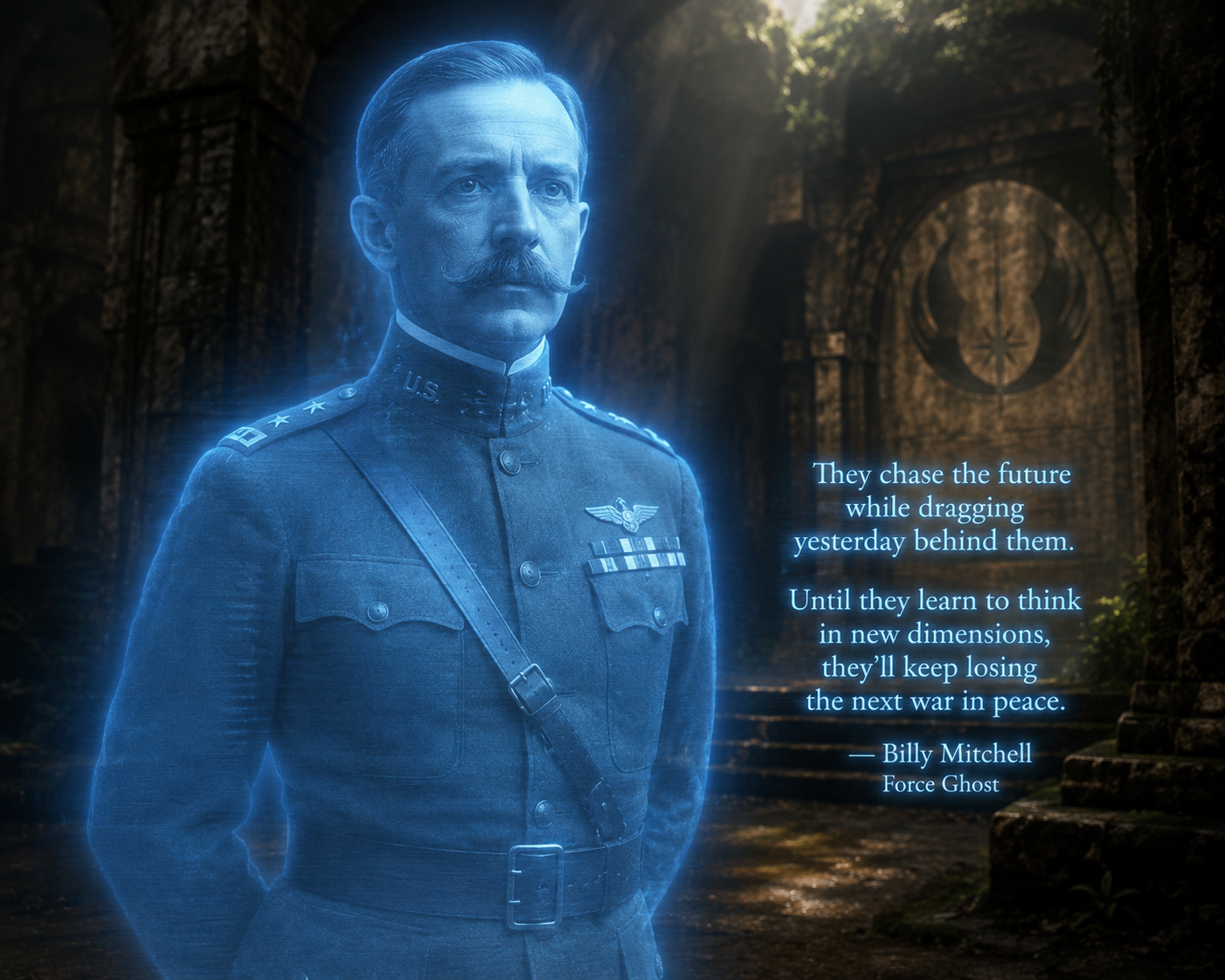
Mitchell’s ghost would recognize the problem.
 Mastermind Century Group