

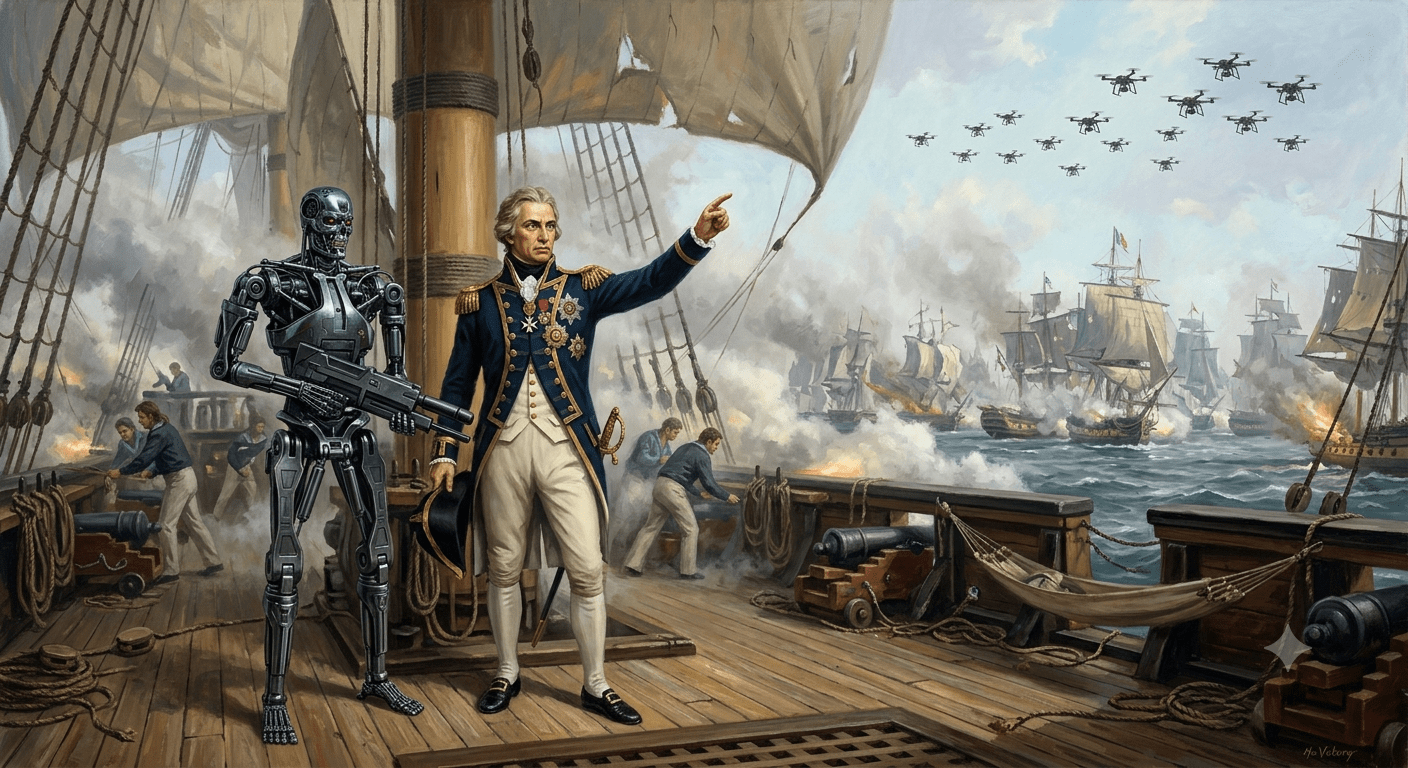
Before the Battle of Trafalgar in October 1805, Horatio Nelson sent a signal to his fleet that has outlived almost everything else about that day: “No Captain can do very wrong if he places his ship alongside that of an enemy.” It reads like a grant of tactical freedom. It was something closer to the opposite. The signal worked because the intent behind it had already been absorbed. Nelson’s captains had trained together, talked through his thinking, and understood the objective before a shot was fired. When the line fractured and the smoke made signals useless, they did not need new orders. They acted inside an understanding they already shared.
Militaries have been studying that logic ever since, dressing it in German, calling it Auftragstaktik, writing it into doctrine, and lecturing about it at staff and war colleges. And then, with remarkable consistency, they have failed to practice it. Today, as artificial intelligence promises commanders something like total battlefield awareness and the Situation Room can watch a raid unfold in real time from seven thousand miles away, the relevant question is no longer whether mission command still matters. It is why nearly every technological and institutional force in the American military system pushes against it, even as the doctrine insists it is essential.
The answer runs through three connected problems. Commanders are not taught how to give intent. The personnel system makes the trust that mission command depends on structurally hard to build. And the force has mistaken increased visibility for increased understanding. None of these make mission command obsolete. Together they make it more necessary than ever, and more endangered.
The Problem of Intent
The doctrinal version of commander’s intent sounds deceptively simple. The field manual tells leaders to communicate purpose, key tasks, and desired end state. AFDP 1-1, Mission Command, frames the Air Force approach as Centralized Command, Distributed Control, Decentralized Execution (CC-DC-DE), which emphasizes commander’s intent, subordinate empowerment, and prudent risk. Write a clean paragraph. Brief it at the commander’s call or push it down in an order. Move on. This misunderstands the nature of the problem entirely.
Intent is not a document. It is a shared cognitive state. When a commander articulates intent, they are attempting to translate a complex mental model, one that holds the operational environment, the enemy, the second and third-order effects, and what success actually looks like, into language that will reconstruct accurately in dozens of minds, each of which arrives with different assumptions, different experiences, and different instincts about what the commander probably means. The gap between what a commander believes they communicated and what their subordinates actually internalized is where mission command dies.
Human cognition does not help here. People hear what their existing mental models prepare them to hear. A subordinate whose understanding of the commander’s priorities is slightly miscalibrated will interpret ambiguous intent in the direction of that miscalibration, in good faith, with full effort, and in ways that will surprise the commander who thought they were clear. Nobody is lying. Nobody is being lazy. The action still diverges from intent.
This is why repetition matters in ways that have nothing to do with memory. Each restatement of intent is a recalibration opportunity, a chance for subordinates to test their internal model against the commander’s actual words and update accordingly. The officer who has heard the commander explain the same intent three different ways, in three different contexts, has a fundamentally more accurate representation of it than the one reading the order cold. The commander who states intent once, in a single brief or an email or a TMT tasker, has not actually communicated it. They have documented it.
Professional military education can address this. It can teach frameworks for communicating intent. It can design exercises where leaders practice giving intent and then watch, in real time, what their subordinates actually do with it, and confront the gap between intended meaning and received meaning directly. That gap, experienced personally and examined carefully, is among the most instructive feedback a developing leader can get. Most officers go through entire careers without ever getting it cleanly.
What PME cannot do is substitute for the cumulative work of relationship and shared experience that transforms stated intent into genuine alignment. That work takes time. And time is exactly what the American military personnel system does not give commanders.
The Rotation Problem and the Incentive Trap
A commander arriving in a new unit with a 24-month clock faces a structural incentive to centralize, not decentralize, even if they are a genuine believer in mission command. The math is straightforward. Mistakes made under mission command are visible and attributable. Mistakes prevented by tight control are invisible. The upside of a subordinate executing bold initiative well accrues modestly to the commander’s record. The downside of a subordinate executing poorly can be career-defining. In a risk-asymmetric accountability culture, the rational response is to keep the decision authority close.
It compounds vertically. The commander above, who also rotated in recently and has not yet built trust with their own superior, is hedging the same way. They start holding decisions instead of delegating them, centralizing what used to be pushed down, or worst of all, pulling decision-making up to the highest levels where it grinds to a halt. That pressure cascades through every layer of the hierarchy. Every echelon is simultaneously being asked to practice mission command and being incentivized not to. The result is a formation that becomes very good at performing compliance with whoever is currently in charge, rather than developing the deep shared orientation that lets it act coherently when the commander is not there to direct it.
This is not a character failure. It is a predictable response to a system that has quietly chosen individual officer development over unit cohesion without ever quite saying so. The rotation system exists for legitimate reasons: broadening experience, preventing insular fiefdoms, developing officers who can operate across joint and combined environments. These are genuine goods. But they are goods for the individual and for the institution’s risk management. Mission command is a good for the unit. The American military has consistently prioritized the former while putting the latter in the doctrine, and has rarely been honest with itself about the tradeoff.
The practical consequence is a trust deficit that cannot be educated away. Trust in the military context is not primarily a feeling; it is an operational capability. A commander who trusts their subordinates can push decision authority down, accept the risk of initiative, and move faster through the decision cycle. A commander who does not know their formation well enough to distinguish a mistake from laziness, or misalignment from incompetence, cannot responsibly extend that trust. And 24 months, minus the first several months of learning the organization and the last several months of preparing for turnover, is not enough time to build it reliably. PME can teach the vocabulary of trust and the conditions that cultivate it. What it cannot do is manufacture the shared experience that makes trust real.
The Visibility Illusion and the AI Question
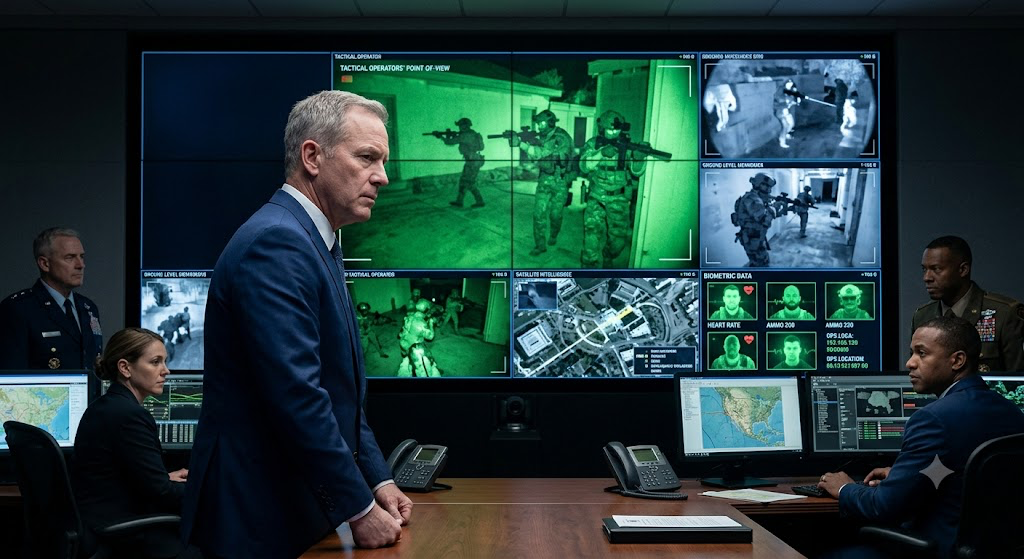
The strongest argument against mission command’s continued relevance runs like this: the original problem was information friction. Nelson’s captains had to carry intent in their heads because once the battle began, communication was impossible. Radio changed that. Satellite changed it further. Persistent ISR, real-time feeds, and global connectivity have reached a point where a President can watch a special operations raid unfold in a room beneath the White House. If the principal can see everything, why distribute the judgment at all?
This argument is coherent, and it has had real operational consequences. The post-9/11 period produced what critics called the thousand-mile screwdriver: senior officials watching drone feeds and intervening in tactical decisions at a level of granularity that would have been operationally impossible a generation earlier. It was not malice; it was technology enabling oversight at a scale that created appetite for that oversight. The capability generated its own demand.
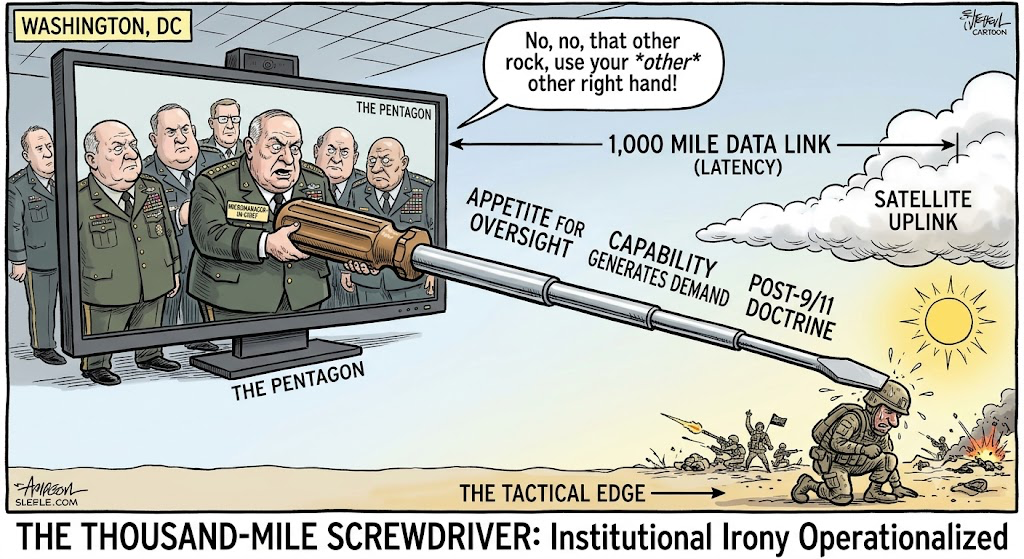
But the argument fails on its own terms. The information environment did not simplify as visibility increased. It exploded. The volume, velocity, and complexity of what needs to be seen and decided has grown far faster than the capacity to process it centrally. A single drone feed is comprehensible. Simultaneous multi-domain operations across contested environments, with cyber effects, electronic warfare, space operations, information operations, and kinetic fires all interacting at once, produce a decision load that no commander at any echelon can fully absorb, let alone one located thousands of miles away with only a camera feed and a radio.
Artificial intelligence sharpens this paradox rather than resolving it. AI dramatically increases the number of sensors, data streams, and decision points that can be monitored. It does not increase the number of humans who can act on that information with judgment, context, and moral accountability. The logical endpoint of the visibility argument, an AI system that can process the complexity and optimize tactical decisions faster than a local commander, runs directly into a distinction that doctrine rarely makes explicit: the difference between decision speed and decision legitimacy.
Even if an AI system could theoretically outperform a local commander on processing speed, there are things a commander in the field does that are not information processing. Reading the human terrain. Maintaining unit cohesion under fire. Making calls that require someone to be accountable for them afterward. These cannot be delegated to a sensor network, however sophisticated. And there is a deeper epistemological problem: AI sees what its sensors and training data allow it to see. The local commander sees the thing that is not in the data. The guerrilla who is behaving differently today. The civilian pattern that suggests something shifted overnight. The piece of context that the system does not know it is missing. The fog of war was never only incomplete information. It is also information that does not know it is absent.
The historical arc bears this out. The First World War showed what happens when industrial-scale planning meets industrial-scale friction and refuses to distribute judgment: four years of attritional slaughter produced by commanders who could not adapt faster than the situation changed. The German Stormtrooper tactics that emerged late in the war were a desperate rediscovery of Auftragstaktik at the squad level, driven not by doctrine but by necessity. The Wehrmacht’s operational success in the early years of the Second World War rested substantially on Auftragstaktik working as designed, not because German commanders were strategically superior, but because their formations could act coherently without waiting for orders. Desert Storm looked like mission command working, but it was also a short, well-resourced operation in open terrain against a centralized opponent; the conditions flattered the culture. The Global War on Terror produced the sharpest split. Special operations forces, operating with genuine trust and shared cognitive frameworks, executed some of the most sophisticated small-unit mission command in American military history, while conventional forces in the same theater were being managed from CENTCOM by drone feed.
The Honest Diagnosis
Mission command is more important now than it was in Nelson’s era, but for a different reason. In Nelson’s day the problem was communication friction. Intent had to live in subordinates’ minds because there was no other way to move it. Now, the problem is cognitive overload at the top and the irreducible value of judgment-in-context at the bottom. The technology that made mission command look less necessary has produced the conditions that make it essential.
The tragedy is that the institutions charged with preparing military leaders understand this intellectually and undermine it structurally. We teach Auftragstaktik in PME classrooms and then place graduates in a rotation system that makes trust difficult to build. We write commander’s intent into doctrine and then evaluate officers in accountability cultures that punish visible failure more than invisible inaction. We proclaim decision authority at the lowest appropriate level and then hand senior leaders real-time feeds that make micromanagement frictionless.
What professional military education can do, and must do, is produce leaders who can name this structural tension plainly rather than just recite the doctrine. Understanding why mission command is hard in the American military system is not a counsel of despair. It is the precondition for changing any of it. A commander who knows they are fighting the rotation clock can be intentional about accelerating trust-building. A commander who understands the visibility trap can choose to step back from the feed. A commander who has been taught what intent actually requires, not a paragraph but a shared cognitive state built through repetition and relationship, can do the harder work of building it.
Nelson did not give his captains a simple order because he was lazy or because he trusted to luck. He gave it because he had spent years building the shared understanding that made it sufficient. The order was the tip of an enormous iceberg of professional development, mutual trust, and cognitive alignment. We quote the order. We should be studying the iceberg.
___

