

A method for seeing connections and scoring them
Some days, unrelated headlines turn out to be related. Every morning an automated agent scans the news and returns a handful of items chosen for relevance to the Air Force, to teaching, and to strategy. The items arrive with separate datelines and separate sources, and most days they read as separate stories. The brief for Sunday, 20 September 2026 behaved differently.
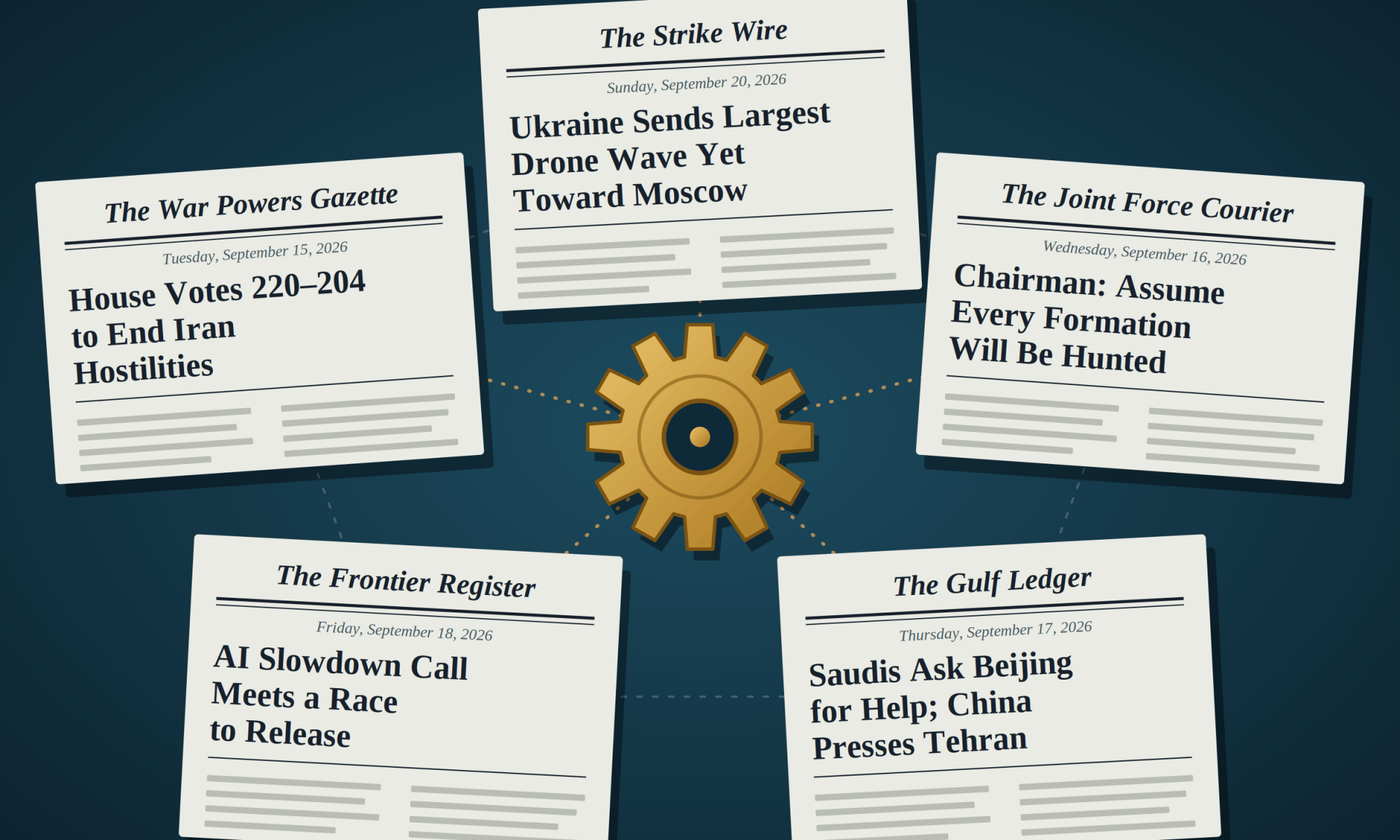
On Sunday, Ukraine launched its largest drone attack yet toward Moscow. Russian officials reported more than 1,000 drones shot down nationwide, about 450 of them headed for the capital (Reuters). On Wednesday, the Chairman of the Joint Chiefs told the Air, Space & Cyber Conference that U.S. forces must assume their formations will be hunted by autonomous systems, jammed across the spectrum, and tracked in real time (DefenseScoop). On Thursday, Reuters reported, citing three Iranian sources, that Saudi Arabia had appealed to Beijing for help restraining the Houthis and that China had privately pressed Tehran in turn (Reuters). On Friday, Reuters reported that Anthropic is considering a new model release to counter OpenAI’s momentum, a week after its CEO called for an industrywide slowdown (Reuters), and that European AI firms led by Mistral had rejected the call to slow down (Reuters). On Tuesday night, the House voted 220-204 to direct an end to hostilities with Iran, the third such vote, in a war nearly seven months old that the CBO estimates has cost about $38 billion (AP).
The domains are airpower, joint force design, Gulf diplomacy, AI governance, and constitutional war powers. The vocabularies barely overlap. Yet the question underneath each one is the same: who acts, on whose authority, and with how much trust?
The Brief as Its Own Example
The daily brief is itself an act of delegation. A leader hands the scanning of thousands of items to a machine, accepts a filtered five, and decides how much weight the filter deserves. That is the problem raised in one of the five stories. Defense One’s reporting from the same conference frames the Air Force’s AI plans as dependent on whether airmen trust agents enough to hand them meaningful decisions (Defense One).
Reading the brief well takes two skills. The first is seeing connections among the items. The second is treating the agent’s own through-line as a claim to be tested. The brief proposed that strategic advantage is migrating toward distributed capability. That is a reasonable hypothesis, and it deserves the same scrutiny given to any analyst’s conclusion.
Delegation Under Speed
Read against the underlying question, the five items line up.
Ukraine has delegated strike capacity to cheap, regenerable mass. Losses are absorbed and replaced, and effects reach deep into a much larger adversary without the traditional prerequisite of air superiority. The Chairman’s warning describes the same phenomenon from the receiving end, where a formation becomes a target set for systems that never tire and rarely cost much.
The Gulf shows delegation in diplomacy. Regional states that struggle to communicate through Washington are routing requests through Beijing. The United States remains the dominant military power in the region while China accumulates influence as an intermediary, and a prolonged war with Iran feeds that redistribution.
Congress is contesting a delegation of a different kind. War power that drifted toward the executive over seven months of conflict is being reclaimed by resolution, and the enforcement mechanism remains weak. Each month without explicit authorization turns an exception into precedent.
The AI race presents delegation in its most awkward form. In the same week that one developer’s CEO called for an industrywide slowdown, the company was reported to be weighing a new release to answer a rival’s momentum, and European firms rejected the slowdown as a bid to lock in American dominance. Each actor would prefer restraint if competitors practiced it too, and none can delegate restraint to the others. Classic security dilemmas were eventually managed with verification and reciprocal commitments, and the same tools may transfer.
The common variable is calibrated delegation under speed. Institutions built to control complexity through deliberate process meet actors built to exploit it through rapid adaptation. The gap between them fills with whoever has already settled the question of trust.
Three Kinds of Link
Connections across headlines are easy to feel and hard to verify. Three labels separate the real ones from the decorative ones.
Causal links show one event changing the conditions of another. Ukraine’s massed drones and the Chairman’s warning belong here, as do the Iran war’s munitions drain and the congressional fight over its authorization.
Structural links show the same logic operating in different domains. The AI race and the security dilemma share a structure. Nothing physical connects them, yet lessons from one may carry to the other.
Thematic links show a shared word or mood. “Distributed versus centralized” ties all five items together and is also the weakest kind of tie. Ukraine’s campaign still depends on centralized targeting and domestic missile programs. China’s Gulf influence flows through bilateral hubs. The theme may reveal more about the observer than about the world.
Delegation under speed sits between structural and causal. It rises above theme because it makes predictions: institutions that resolve trust questions early will hold the initiative, and events can check that claim.
The Method
The method fits any morning’s brief, or any set of headlines from a source trusted to be strategically relevant.
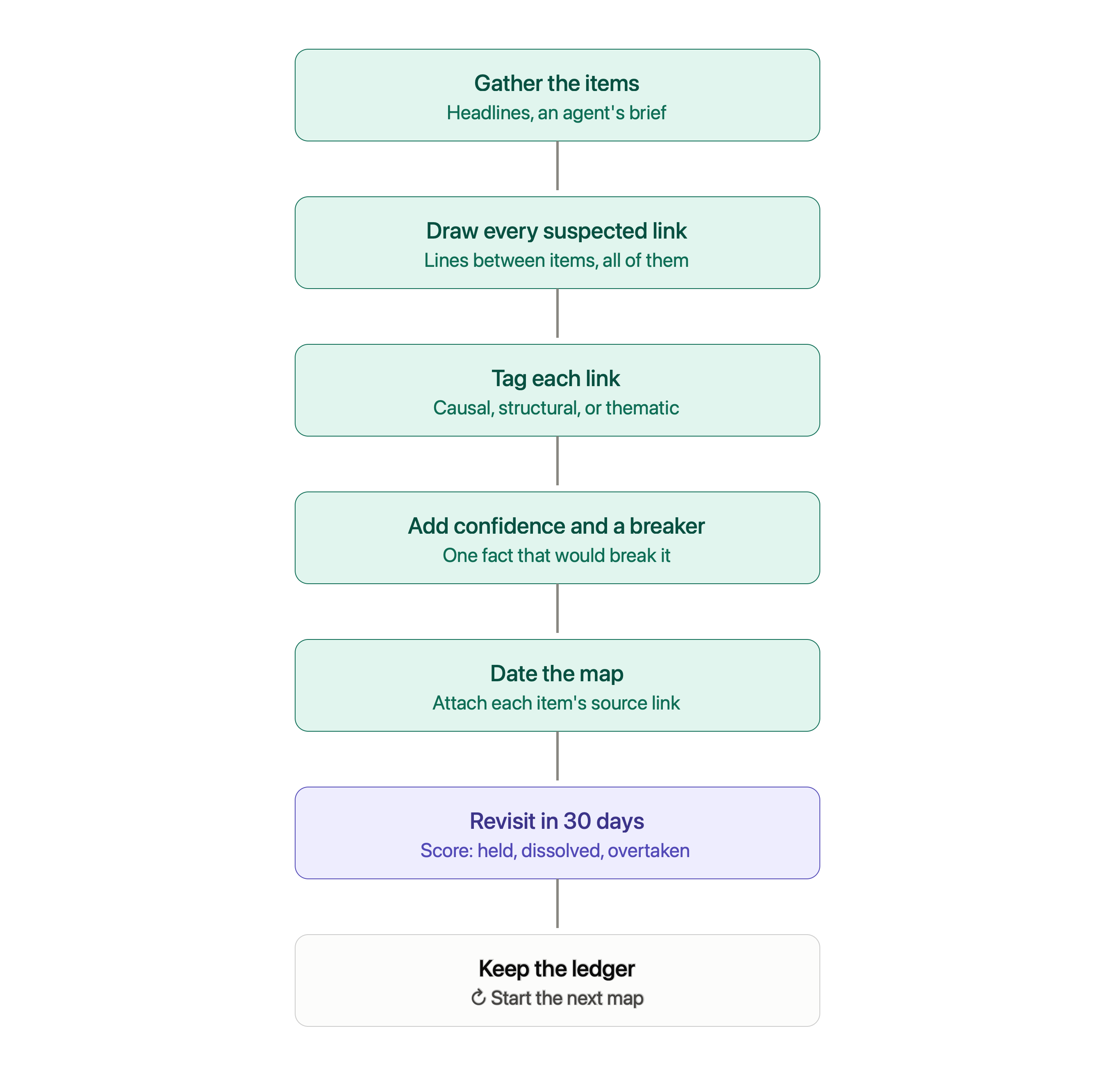
- Gather the items. Five to seven is enough.
- Draw every suspected link. Lines between items, all of them, including the doubtful ones.
- Tag each link. Causal, structural, or thematic.
- Add a confidence level and a breaker. Name the single piece of evidence that would break the link.
- Date the map and attach the sources. Each item carries its original link, because the breaking evidence usually lives in the reporting.
- Revisit in thirty days. Score each link as held, dissolved, or overtaken.
- Keep the ledger. Start the next map.
Running It Outside a Classroom
The method needs a page, a pen, and a month. It works alone at a kitchen table. It works better with two or three people who see the world differently: a spouse, a colleague from another field, a friend who distrusts every pattern. Each person draws a map from the same headlines, and the disagreements show where the assumptions live.
AI can join as another mapper. Give it the day’s items and ask for suspected links, then have it tag each as causal, structural, or thematic and name what would break it. Its map goes on the page beside the human ones. For the more ambitious, an agent can build the daily set, file each map with a date, and return in thirty days with the ledger open. The principle holds at every level of effort. The map is a claim, and claims get scored.
The Ledger in Practice
The ledger is the part that matters. Futures literacy, the discipline developed by Riel Miller and UNESCO, supplies the missing column: the assumption about the future sitting underneath each link. Most pattern claims fail at that layer, and nobody wrote the assumption down.
An entry filed 20 September 2026:
- Link: Ukraine’s massed drone strike and the Chairman’s warning of hunted formations
- Type: causal
- Confidence: high
- Assumption underneath: cheap offensive mass keeps scaling faster than cheap defense
- Breaks if: a large strike on a prepared, defended target fails at low cost to the defender
- Sources: Reuters, DefenseScoop
A second entry:
- Link: The Iran war’s length and China’s rise as Gulf intermediary
- Type: causal
- Confidence: medium
- Assumption underneath: the Washington channel stays strained
- Breaks if: a Gulf state routes a major request through Washington and gets results
- Sources: Reuters
A third entry:
- Link: “Distributed systems are harder to defeat,” the through-line across all five items
- Type: thematic
- Confidence: low
- Assumption underneath: the past month’s pattern continues
- Breaks if: the decisive events of the next thirty days come from centralized systems
- Sources: the daily brief itself
Revisit date: 20 October 2026.
At the thirty-day mark, each entry earns one of three marks. Held means the link still explains events. Dissolved means the breaking evidence appeared. Overtaken means events moved past the map and nobody drew the new development. Three futures-literacy questions follow. Which assumption turned out wrong? What was never imagined? What would the map have looked like with that possibility on the page?
The third mark teaches the most. A dissolved link was at least falsifiable. A map overtaken by events shows the edge of what the mapper could imagine, and that edge is where the next month’s learning sits. Pattern claims about a fast-moving environment have a short half-life. The discipline is to know that in advance and record it, holding each claim firmly enough to act on and loosely enough to revise.
Seeing, Understanding, Deciding, Acting, Learning
The Chairman framed advantage as the ability to see, understand, decide, act, and learn first. Each stage has a characteristic failure. Seeing fails when signals pass through a favored story before they arrive. Understanding fails when a thematic link gets treated as causal. Deciding fails when confidence goes unstated, so that a guess and a certainty look identical to everyone else in the room. Acting fails at both extremes of delegation, where authority is withheld until the moment passes or granted with no basis for trust. Learning fails when nobody scores the prediction.
The agent can surface the headlines and even propose the pattern. Deciding which pattern matters to a particular institution, at a particular moment, under particular risks, remains a human judgment. Those who build that judgment will read tomorrow’s five unrelated headlines and find the thread. Everyone else will read five separate stories.
Try it on this week’s five.

