

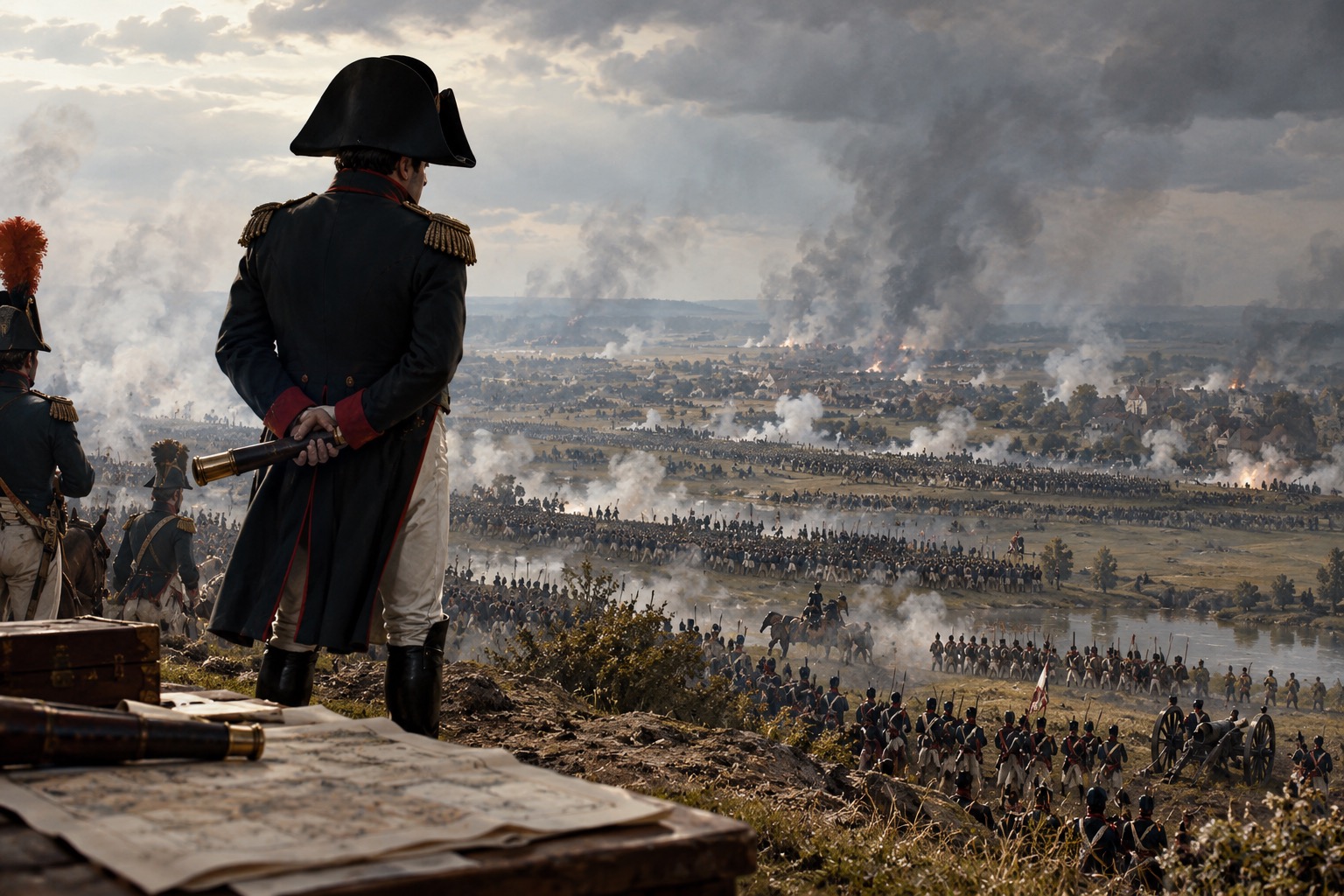
Napoleon commanded the Battle of Borodino.
Or did he?
From Napoleon’s position behind the lines, there was an army to command. Orders went out. Reports came back. Units maneuvered. Artillery fired. Soldiers advanced.
It looked like control.
Move closer to the battlefield, however, and the picture changes. Thousands of people were making thousands of decisions. Officers interpreted orders. Soldiers reacted to fear. Messengers arrived late or not at all. Units became lost. Commanders improvised. Equipment failed. Opportunities appeared and disappeared. And, inconveniently, there was another army on the battlefield trying to impose its own will.
Leo Tolstoy understood this. In War and Peace, he relentlessly pokes at the idea that great men somehow control great events. Napoleon matters. Of course he matters. But Napoleon does not move armies across a battlefield like pieces on a chessboard.
The pieces move themselves.
Carl von Clausewitz saw much the same thing from another direction. He called one piece of it friction, the countless differences between war as imagined and war as actually experienced. Plans encounter weather, fear, chance, incomplete information, personalities, logistics, mistakes, and an enemy who refuses to cooperate.
John Lewis Gaddis brings Tolstoy and Clausewitz together in On Grand Strategy because both point toward an uncomfortable truth:
We influence complex systems far more often than we control them.
And we routinely confuse the two. Leaders who confuse them build organizations designed for a control they do not have.
Complicated Isn’t Complex
We are very good at complicated things. A jet engine is complicated. So is a nuclear reactor. So is a spacecraft. They may contain millions of parts, but those parts operate according to relationships that can be understood. With sufficient expertise, we can take the system apart, repair it, optimize it, and put it back together.
Complex systems are different. Cities are complex. Markets are complex. Organizations are complex. War is complex.
Why?
Because the pieces react.
Change one part of a complicated system and we can often calculate what happens next. Change something important in a complex system and the other participants change their behavior because you changed yours.
Introduce a revolutionary weapon. The enemy disperses. So you change your targeting. The enemy develops deception. You improve your sensors. The enemy attacks the sensors. You decentralize them. The enemy attacks the network connecting them. The problem you originally set out to solve no longer exists. Your solution helped create a new one.
Ukraine offers the live version. Drones and countermeasures there evolve in cycles measured in weeks. Jamming defeated radio-controlled drones, so both sides began flying drones on fiber-optic tethers. Front-line units, volunteers, and small firms drive much of that iteration, and no central requirements process could keep pace with it.
That’s complexity.
And it creates a problem for organizations. When things become uncertain, our instinct is to exert more control. Something isn’t working? Create a process. Outcomes vary? Standardize them. People are taking risks? Add oversight. We don’t understand what’s happening? Demand more reporting. Innovation seems inconsistent? Define it, organize it, measure it, regulate it.
Sometimes those are exactly the right things to do. But sometimes they aren’t, because we may be treating a complex problem like a complicated one.
The Paradox of Control
Complex systems depend on variation. Different people see different things. They try different approaches. Some fail. Some work. Others observe what worked and adapt. That is how the system learns.
Large organizations naturally dislike variation. Variation looks inefficient. It makes outcomes difficult to predict. It complicates accountability. And failure, the inevitable companion of experimentation, is something bureaucracies become particularly good at preventing.
So we standardize. The organization becomes more orderly, more measurable, more predictable, more controllable. And potentially less adaptive.
There is the paradox:
The more tightly an organization attempts to control adaptation, the less adaptive it may become.
That does not mean organizations should abandon standards, hierarchy, accountability, doctrine, or planning. Chaos is not a strategy. The question is where control belongs.
A workable answer: standardize where variation is catastrophic, and free it where variation is how the system learns. Nuclear command and control, flight safety, and the law of armed conflict belong in the first category. Tactics, targeting methods, and the use of new technology at the edge belong in the second. Mission command relocates control into shared purpose, doctrine, and education, built over years and lost quickly.
What Must Change, and What Must Not
We talk constantly about resilience. But resilience and adaptation aren’t quite the same thing.
Robustness withstands the shock. Resilience absorbs the shock and recovers. Adaptation changes because of the shock.
Strategic adaptability goes one step further: change what must change while preserving what must not.
That distinction matters, because change isn’t inherently good. Organizations can adapt themselves into irrelevance. Bureaucracies adapt to protect themselves. Adversaries adapt. The question isn’t whether something can change. It is whether it can change while remaining oriented toward purpose.
That takes us back to Gaddis. Borrowing Isaiah Berlin’s famous metaphor, he repeatedly returns to the fox and the hedgehog. The hedgehog knows one big thing. The fox knows many things. Too much hedgehog and we become prisoners of our theories. Too much fox and we chase every changing circumstance without knowing where we’re going. Strategy requires both.
Purpose should be stubborn. Methods should not be. The hard part is deciding which is which, because institutions routinely defend a method as though it were the purpose.
Purposeful Emergence
Leadership in complex environments is less about controlling everything the organization does and more about creating the conditions under which it can respond intelligently when reality refuses to cooperate.
Set the purpose. Communicate intent. Establish boundaries. Put authority near information. Allow responsible experimentation. Get feedback quickly. Learn. Keep what works. Discard what doesn’t. Repeat.
That sounds remarkably like mission command, and perhaps that’s because mission command is an organizational architecture for complexity as much as a leadership philosophy. Centralized purpose. Distributed sensing. Decentralized action. Rapid feedback. Continuous learning.
Purposeful emergence is the goal, and the purpose is what separates it from chaos.
It requires trust. It requires judgment. And, perhaps most difficult for large institutions, it requires senior leaders to accept that they will not always know precisely what everyone is doing.
They shouldn’t. If everything must travel upward for approval before anything can happen, the organization isn’t adapting.
It is waiting.
The Future Will Refuse to Cooperate
This brings us back to Clausewitz. Theory matters. Plans matter. Doctrine matters. Education matters. Their greatest value is preparing us to recognize when what we thought we should do no longer fits the world in front of us.
That is judgment, and it is what leaders most need developed. Leaders who can spot the moment a plan stops making sense are worth more than leaders who can execute it flawlessly.
Tolstoy warned us about the illusion of control. Clausewitz explained why reality generates friction. Gaddis reminds us that strategy requires holding onto purpose while adapting to circumstance.
Somewhere behind the lines at Borodino, Napoleon watched a battle he could influence and could not control.
The future isn’t going to follow our plan. It never has. Forecasting will keep failing. The skill worth building is what we do when we’re wrong.

