

Danger Room (Wired.com)
September 7, 2012
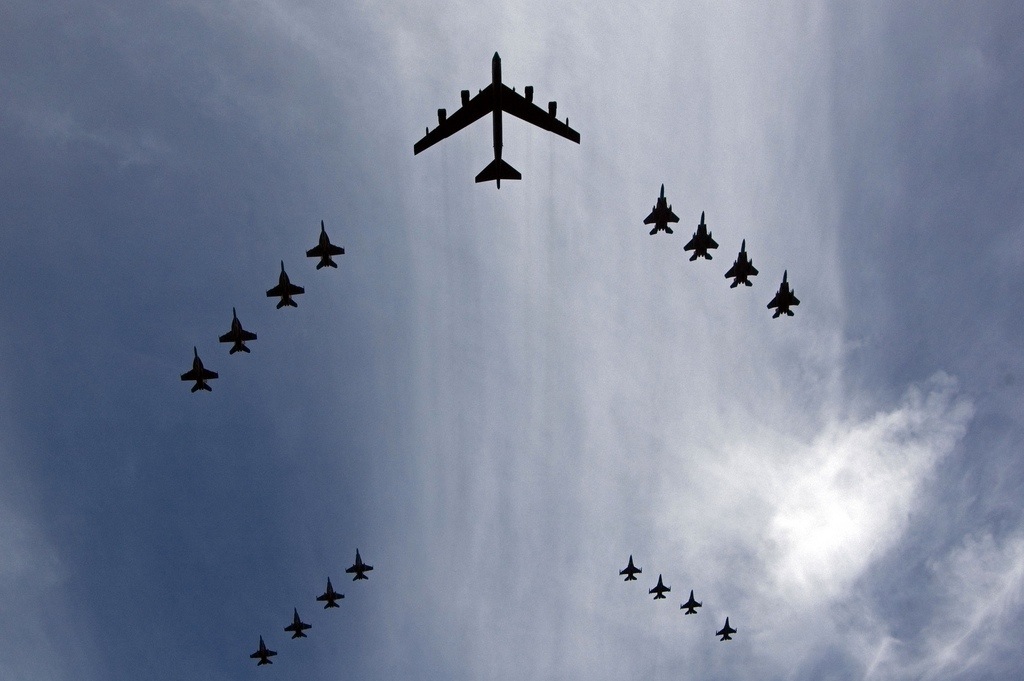
Should the U.S. actually take Benjamin Netanyahu’s advice and attack Iran, don’t expect a few sorties flown by a couple of fighter jocks. Setting back Iran’s nuclear efforts will need to be an all-out effort, with squadrons of bombers and fighter jets, teams of commandos, rings of interceptor missiles and whole Navy carrier strike groups — plus enough drones, surveillance gear, tanker aircraft and logistical support to make such a massive mission go. And all of it, at best, would buy the U.S. and Israel another decade of a nuke-free Iran.
There’s been a lot of loose talk and leaked tales about what an attack on Iran might ultimately entail. Anthony Cordesman, one of Washington’s best-connected defense analysts, has put together a remarkably detailed inventory of what it would take to strike Iran, cataloging everything from the number of bombers required to the types of bombs they ought to carry. He analyzes both Israeli and American strikes, both nuclear and not. He examines possible Iranian counterattacks, and ways to neutralize them. It leads Cordesman to a two-fold conclusion:
*“Israel does not have the capability to carry out preventive strikes that could do more than delay Iran’s efforts for a year or two.” Despite the increasingly sharp rhetoric coming out of Jerusalem, the idea of Israel launching a unilateral attack is almost as bad as allowing Tehran to continue its nuclear work unchallenged. It would invite wave after wave of Iranian counterattacks — by missile, terrorist, and a boat — jeopardizing countries throughout the region. It would wreak havoc with the world’s oil supply. And that’s if Israel even manages to pull the mission off — something Cordesman very much doubts.
*The U.S. might be able to delay the nuclear program for up to 10 years. But to do so, it’ll be an enormous undertaking. The initial air strike alone will “require a large force allocation [including] the main bomber force, the suppression of enemy air defense system[s], escort aircraft for the protection of the bombers, electronic warfare for detection and jamming purposes, fighter sweep and combat air patrol to counter any air retaliation by Iran.”
But the first attack might actually be the easy part, writes Cordesman, an expert at the Center for Strategic and International Studies.
At the same time, the U.S. has to keep Iran from blocking the ultra-important Strait of Hormuz, the 21-mile-wide waterway through which flows around 20 percent of the world’s oil and liquid natural gas supplies. And America has to protect its energy-producing allies in the Persian Gulf, or else there will be no oil or gas to send through the Strait.
That will be no mean task, Cordesman writes: “Iran can cherry pick its targets in an effort to pressure and intimidate the U.S. and Southern Gulf states. It can use long-range conventionally armed missiles or drones against large military or urban targets as terror weapons. It can attack sporadically and unpredictably in a war of attrition or attempt to ‘swarm’ U.S. and Gulf naval forces.”
Some of this defensive work has already begun. To keep the Strait open, the U.S. has kept up a steady patrol of aircraft carriers and stationed gunboats, minesweepers, and robot subs in nearby Bahrain. To spot Iran’s missiles — many of which can hit their targets in as little as four minutes — the U.S. is building a next-generation X-band radar station in Qatar. To knock those short- and medium-range ballistic missiles out of the sky, America has sold billions of dollars’ worth of Patriot and Terminal High Altitude Air Defense interceptors to Saudi Arabia, Kuwait, and the United Arab Emirates. Those anti-missiles will be augmented by U.S. Navy cruisers and destroyers equipped with Aegis ballistic-missile defense systems — one of the most-proven components in the American interceptor stockpile.
But to make sure Tehran’s missiles don’t hit Riyadh or Kuwait City, the U.S. will have to take out Iran’s eight ballistic-missile bases and 15 missile production facilities, and 22 launch facilities if a preemptive strike is ever ordered. America will “need to destroy as many missile launchers as possible … in order to reduce number of incoming warheads,” Cordesman writes. Each target will require two aircraft each — either carrier-launched F/A-18s or F-15Es and F-16Cs flying from nearby air bases — for a total of 90 jets. Auxiliary targets could include Iran’s refineries, its power grid, its military bases, and its roads and bridges.
American jets and fighters will be pretty much free to fire at will — the Iranian air force is a joke, and its air defense systems don’t have the sensors or the networking to seriously threaten U.S. jets. Still, those air defenses and enemy fighters will have to be taken out before they manage to get off a lucky shot.
Drones will be deployed for further intelligence, “deception, jamming, harassment, or destruction of enemy forces and air defense systems.” Special operations forces will conduct “direct action missions, special reconnaissance, and provide terminal guidance for attacks against valuable enemy targets.” Somehow, attacks from Iran’s terrorist allies — including Hamas and Hezbollah — will have to be blunted, as well.
And then, of course, there’s the main attack.
Destroying each of Iran’s five nuclear facilities will require a pair of B-2 bombers flying out of Diego Garcia. Every plane will carry two of the U.S. military next-gen, king-sized bunker-busters, the 30,000-pound GBU-57 Massive Ordinance Penetrator. The “GPS-guided weapon contain[s] more than 5,300 pounds of conventional explosives inside a 20.5 foot-long bomb body of hardened steel. It is designed to penetrate dirt, rock and reinforced concrete to reach enemy bunker or tunnel installations,” writes Cordesman, who believes such bomb can set back Iran’s nuclear ambitions for years.
Israel might — might — be able to pull off a similar strike, but only just barely. It’ll require using a quarter of the Israel Air Force’s fighters, and all of its tanker planes, leaving no aircraft for all these other secondary targets. The jets will have to hug the Syrian-Turkish border before flying over both Iraq and Iran. And that is not exactly friendly territory. “The number of aircraft required, refueling along the way and getting to the targets without being detected or intercepted would be complex and high risk and would lack any assurances that the overall mission will have a high success rate,” Cordesman writes.
And even if the reactors are hit, the ”Iranian retaliation will have a devastating regional consequences,” he adds. You don’t even want to know what the Middle East would look like the day after Israel attempts a nuclear strike on Iran.
Which leaves the American attack option. It may be technically possible. “It’s clear that if the United States did it we would have a hell of a bigger impact,” Defense Secretary Leon Panetta said in the spring. Cordesman would rather see negotiations instead: “The brief shows just how dangerous any war in the Gulf could be to the world’s economy.” Some politicians may be calling for a preemptive strike on Iran. There’s a reason military planners are so wary.

