

By Sydney J. Freedberg Jr.
More missions, less money: That’s the dilemma the U.S. Army faces as it
looks beyond Afghanistan. The service is certainly grateful that the
all-consuming commitments of the last decade are finally winding down, but
it’s still struggling to shift gears on a shrinking budget. After ten years
of optimizing itself for protracted counterinsurgency – a mission explicitly
disavowed by the Administration’s new strategic guidance – the Army has to
relearn how to do a wide range of missions all around the world, from
advisor work to disaster relief to all-out combat against adversaries like
Iran. With limited resources of money, manpower, and training time, there’s
a big debate within the Army over how to prioritize. The intellectual storm
center in this debate is the Army War College in Carlisle, Pennsylvania,
where the service trains its next generation of generals.
“Fiscal austerity requires deep thinking about the purpose of land forces,”
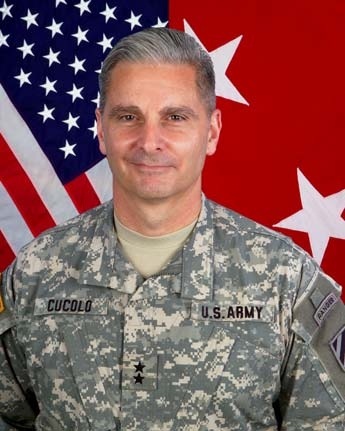
said Maj. Gen. Tony Cucolo, who will take command of the War College in
June. “It kickstarts the mental change that must lead the physical change”
in budgets and equipment that he now oversees as director of force
modernization at the Army’s headquarters staff. Above all, he said in a
recent interview with AOL Defense, “it is grabbing by the lapels and shaking
awake those who might seek the comfort of a single threat.”
Cucolo has seen the dangers of an overly narrow focus first-hand. As a young
officer, he grew up in the Army of the eighties, which fixated on the Soviet
threat and forgot what the previous generation had learned about guerrilla
warfare in Vietnam. As a general, he led troops in both Afghanistan and
Iraq, where a new generation has grown up doing nothing but
counterinsurgency. “You’ve got this group of leaders who’ve grown up now –
the privates are now staff sergeants[,] the lieutenants are now majors,”
said Cucolo. “They need this direction as they head back into an Army that
is on a perhaps slower operational tempo[:] ‘Boss, what do you want me to
train on?”
Like many other officers, Cucolo is convinced that the Army must now rebuild
its big-war capabilities without losing its small-war skills. That requires
institutionalizing the ability to adapt: The Army must do smoothly and
routinely in the future what it did painfully and ad hoc in the 2000s, when
it slowly realized that the wars in Iraq and Afghanistan had not ended with
the defeat of the enemy’s regular forces, only mutated into new and
irregular forms.
For the leaders of the future Army, “the agility you have learned over the
last decade is valuable and will be applied, will be demanded and applied
again and again and again,” Cucolo said. “You have to be prepared to
reinvent yourself.”
An Army unit on a “security assistance” mission, for example, needs to be
attentive to all the nuances soldiers have learned in Afghanistan and Iraq.
You have to “look at a criminal activity in your area of operations and not
assume it’s just bad dudes stealing stuff to make a buck; maybe it has a
[political] purpose,” said Cucolo. But that same unit, perhaps even on that
same mission, must also stand ready “to duke it out with somebody who has
run up and down the aisles of the international arms bazaar with a blank
checkbook and picked up sorts of stuff”: the so-called “hybrid” threat of a
guerrilla organization that’s acquired nation-state firepower, like the
Iranian-backed Hezbollah in Lebanon or for that matter some of the Shiite
cells in Baghdad that were armed with tank-killing “explosively formed
penetrators” provided, again, by Iran.
“I can’t say to you, ‘we’re training for Iran’ [specifically]; we’re not,”
Cucolo said. “We’re preparing to deal with a threat on the ground that they
might present in a certain type of scenario. The service is taking a similar
approach to North Korea, he said. “But we’re not totally focused on one of
those [countries],” he emphasized.” We can’t just focus on one thing.”
So which possibility must the Army prioritize? “You focus on the hardest
one,” Cucolo said. “The hardest one is high-intensity combat operations….
It involves air-ground intensity, it involves intense and adaptable
logistics tails, it involves disciplined, drilled units that can react to
different levels of violence.” Of the many missions outlined by the
President, the Secretary of Defense, and the Chief of Staff of the Army, he
said, “if we focus on ‘deter and defeat,’ I firmly believe we can do almost
anything else.”
But doesn’t that emphasis on the “high-intensity” sound unnervingly like the
pre-9/11 fixation on nation-states, which rested on the assumption that an
Army trained to defeat tank armies could handle “lesser included” cases like
guerrilla war as well – an assumption painfully disproven both in Vietnam
and in Afghanistan and Iraq? “We got smart,” Cucolo said. “In Iraq and in
Afghanistan, you took a general-purpose force, trained for a combat mission,
and you gave them plug-[in] capabilities” for local languages, training
friendly forces, and so on.
Above all, the most important difference in the Army is a new awareness that
the local people are a player to be reckoned with, not just passive
bystanders. When he commanded U.S. forces in northern Iraq, “the most
critical piece of terrain in my area of operations was the human terrain,”
Cucolo said, showing a complex multi-layered map of intermingled
populations: Kurdish, Sunni Arab, Shia Arab, Turcoman, Coptic Christian,
even Yazidi. “My personal opinion, I don’t see us ever being presented with
a situation where the human terrain will not matter.”
What does all this imply for Army force structure and equipment? That’s
Cucolo’s current job, until mid-June: As director of force development on
the Army headquarters staff in the Pentagon, he said, “I’m the caretaker of
the five years of money that’s applied to equip the Army” across the Future
Years Defense Plan. With the emphasis on adaptability, the most attractive
investments for Cucolo are those that apply across a wide range of missions.
Above all, that means “mission command” – upgrading the high-tech
communications networks that Army units use to plan and coordinate their
operations. It also means the reconnaissance and surveillance systems that
commanders use to figure out what’s going on, whether in a combat operation
or a natural disaster: Having relied heavily on drones in Afghanistan and
Iraq, Cucolo said, his first instinct when he was attached to Lt. Gen.
Russell Honoré’s headquarters during the chaos of Hurricane Katrina was “get
the UAVs out.” It also means helicopters, workhorse players to move troops
and supplies in every operation from Katrina to Afghanistan. (Both drones
and manned helicopters are have done well in this year’s otherwise bleak
budget). But that same across-the-board usefulness holds true for humbler,
low-tech items like wheeled tactical vehicles – where the Army is investing
heavily in replacing its venerable and vulnerable Humvees – and gear for the
individual foot soldier.
Rebuilding the Army as a general-purpose force capable of combat and
non-combat operations across the board will be a hell of a challenge, Cucolo
acknowledged. But with the current budget crisis forcing real change, he
said, “I believe we have an opportunity” as well.
 Mastermind Century Group
Great article! What I can’t understand is why the the military brass continues to try to figure out these new ever-changing threats. I am glad that they realize they can’t put all of their eggs in one basket, but I think there is a significant blind spot here. Why aren’t we training our young officers (and enlisted for that matter) to think more creatively? Why are we still telling them what to do instead of telling them what needs to be done and allowing them to develop complex problem solving skills?
I believe that no matter how we prioritize (“the hardest one” seems like a decent strategy), we will not be able to beat tomorrow’s threat with today’s thinking. We have to tap into the incredible resource that is available to us in the form of young, motivated officers and enlisted.
-Capt Curtis Marshall, 512 RQS
Curtis: Preach it! You are reading my mind…and history would say you are correct as well…look at Nelson and Trafalgar…new and different thinking… the Royal Navy sort of got it… but then years later they roll into Jutland… and forgot how to THINK DIFFERENT! History is ripe with these examples, but we don’t NEED to follow that direction at all.
We attempt to do just what your comment imples here at Mildenhall… give the problem to the young BIG thinkers…and they will figure it out. We need to encourage those that have not be assimilated by the BIG DoD entity to do the creative thinking. I would love to tell you I am the most creative guy alive… but sadly… no: I have been assimulated… so I can pass a concept or even a frame work to our Captains and SSgts to let them nug and pull on it for a bit– I have yet to be disappointed by the outcome…usually I am fascinated. We have an office here in the Ops Group called OGC (C for Creative)…we have 3 of our sharpest young guys and girls in there….we pass ideas to them… and they first will tell us if it is feasible… and then come up with a plan to make it so. These guys rock… just a simple way to try to train and encourage folks to be creative. Sadly… this can only impact the Bloody Hundredth…but as these leaders head out into BIG USAF—perhaps it will catch on.
Your OGC office sounds like an exciting place! I only hope it catches on sooner rather than later as I believe many of our most creative thinkers are walking away from the military in search of organizations that will better utilize their talents.
Here is a related article I find unfortunate, but true: http://m.theatlantic.com/magazine/archive/2011/01/why-our-best-officers-are-leaving/8346/
OGC is great, just wish we could expand their Influence. I too share your fear…we need those thinkers to stay and work on this USAF Beast.