


The limits of military adaptation and the pursuit of strategic advantage
For decades, military organizations have pursued speed as a source of competitive advantage. Faster communications, intelligence processing, targeting, and decisions all promise to compress the time available to an adversary. Artificial intelligence extends that promise to nearly every step. Analysis that once took a team of analysts hours now takes seconds, and commanders can review recommendations, weigh alternatives, and initiate action at a pace no previous staff could match.
Embedded in that pursuit is an assumption that processing information faster produces better decisions and, ultimately, better strategic outcomes. An organization can possess extraordinary technology, collect enormous quantities of information, and execute with remarkable efficiency while working from an increasingly inaccurate understanding of its environment. Failure in that case seldom traces to missing data. It traces to an inability to recognize when established assumptions have stopped explaining events.
Artificial intelligence sharpens the problem because it accelerates the environment along with the response to it. New capabilities generate new vulnerabilities, successful innovations invite countermeasures, and operational advantages can expire before doctrine, training, or force structure absorb them. Advantage may come to rest with the force that keeps its orientation accurate and its adaptation purposeful as conditions shift, whatever its processing speed.
The Yom Kippur War of 1973, the American experience in Iraq, and the war in Ukraine each expose a different part of the gap between what military organizations know, what they believe, and what they are capable of changing. Together they point to a threshold beyond which change outpaces an institution’s ability to absorb it.
Evidence Without Recognition
When Egypt and Syria attacked on October 6, 1973, Israel held strong military advantages, a capable intelligence service, and the confidence of its 1967 victory. Israeli military intelligence, led by Maj. Gen. Eli Zeira, read the warning picture through what became known as the Concept: Egypt would not go to war until it could challenge Israeli air superiority, and Syria would not fight without Egypt. Anwar Sadat did not need that capability. A limited crossing of the Suez Canal under a surface-to-air missile umbrella could break the diplomatic stalemate, and a limited war was all his political aims required.
The indicators were there. Egyptian and Syrian forces massed on both fronts, Soviet dependents were evacuated from Egypt and Syria in the days before the attack, and King Hussein of Jordan warned Golda Meir in person. The Concept made each signal look improbable. The Agranat Commission later faulted the intelligence leadership for holding to its framework against mounting evidence. Experience, doctrine, and prior success supply the assumptions through which new information becomes meaningful, and organizations cannot decide under uncertainty without them. The same assumptions become obstacles when the environment moves out from under them.
Once the fighting began, the picture changed quickly. Armored counterattacks in the Sinai on October 8 and 9 ran into Egyptian antitank teams and failed at heavy cost. The IDF restored combined arms, reworked its tactics, and by mid-October had crossed the canal itself. The establishment that could not reorient before the war reoriented rapidly once it started.
Combat supplied what peacetime assessment had not: feedback that was immediate, unambiguous, and impossible to explain away. Burning tanks settled an argument that warning reports had left open. Historians of military adaptation, Williamson Murray and Frank Hoffman among them, have long distinguished peacetime innovation from adaptation under fire, and 1973 shows why the second so often outperforms the first. Peacetime institutions learn within their frameworks and seldom receive a signal strong enough to break one. They keep learning about the environment while missing the evidence that their understanding of it has failed.
The Accumulation of Adaptive Debt
The United States entered Iraq in 2003 with unmatched conventional capability and won the opening campaign quickly. The war that followed turned on political legitimacy, local power structures, sectarian rivalry, and population security, matters the invasion’s operational system had not been built to address.
Units adapted unevenly. In Tal Afar in 2005, the 3rd Armored Cavalry Regiment under Col. H.R. McMaster combined population security, local engagement, and persistent presence in ways that anticipated later doctrine, while other formations continued raid-and-return operations suited to conventional combat. The institution moved more slowly. Field Manual 3-24 appeared in December 2006, more than three years after the invasion, and education, training, and force structure took longer still to follow.
The gap between tactical learning and institutional change can be called adaptive debt: the accumulated distance between what the environment demands and what an institution’s assumptions, processes, and capabilities can deliver. It never appears on a balance sheet. It builds in doctrine that no longer reflects operational conditions, in training for familiar problems, in structures that inhibit cooperation, and in professional assumptions that outlive the conditions that produced them. Units in Iraq kept operating competently while the debt grew, and each local fix concealed the larger pattern that the character of the war had changed.
Paying the debt down meant lessons had to be identified, evaluated, disseminated, trained, and written into doctrine, with each step demanding time, authority, and a willingness to discard practice that had recently worked. Better practice also could not substitute for an Iraqi political settlement. The Surge and the Anbar Awakening created openings that depended on choices beyond American control. Adaptation improves an organization’s odds without guaranteeing an outcome, and tactical, institutional, and strategic adaptation run on different clocks.
Adaptation as Continuous Competition
Ukraine adds a third variation. Since 2022, both sides have fielded, countered, and re-fielded small unmanned aircraft, electronic warfare, distributed sensing, commercial communications, and precision fires in a cycle that has rewritten the relationship among observation, movement, concealment, and destruction. A new drone capability prompts new jamming, operators change frequencies, navigation, or tactics, and the jammers adapt again. Some of these cycles are now measured in weeks.
Fiber-optic-controlled drones illustrate the dynamic. As jamming degraded radio-controlled systems, a physical cable restored control immune to electronic attack at the cost of range, weight, and handling, and it pushed defenders back toward nets, shotguns, and physical barriers. Neither move settled anything. Each reset the conditions for the next.
The competition reaches into manufacturing, logistics, training, and command. A force may design an effective system and fail to produce it at scale, or produce it and lack the organizational agility to employ it. Ukraine exposes a condition that 1973 and Iraq did not: an organization can recognize change, adapt continuously, and still fall behind, because its adversary is adapting too and the cycle has compressed below the pace of requirements, acquisition, and fielding. A capability can be relevant when conceived, dated when fielded, and countered before it reaches the whole force.
The Adaptive Capacity Threshold
Military organizations have finite capacity to recognize change, interpret it, decide, implement, and fold lessons back into practice. The Adaptive Capacity Threshold is the point at which consequential change persistently generates adaptation demands faster than an organization can resolve them (Figure 1). Three rates set it: how fast consequential change arrives, how quickly and clearly feedback reveals that existing assumptions have failed, and how fast the institution can absorb a lesson into doctrine, training, and structure. Israel in 1973 failed on the second, the United States in Iraq on the third, and both sides in Ukraine are straining against the first.
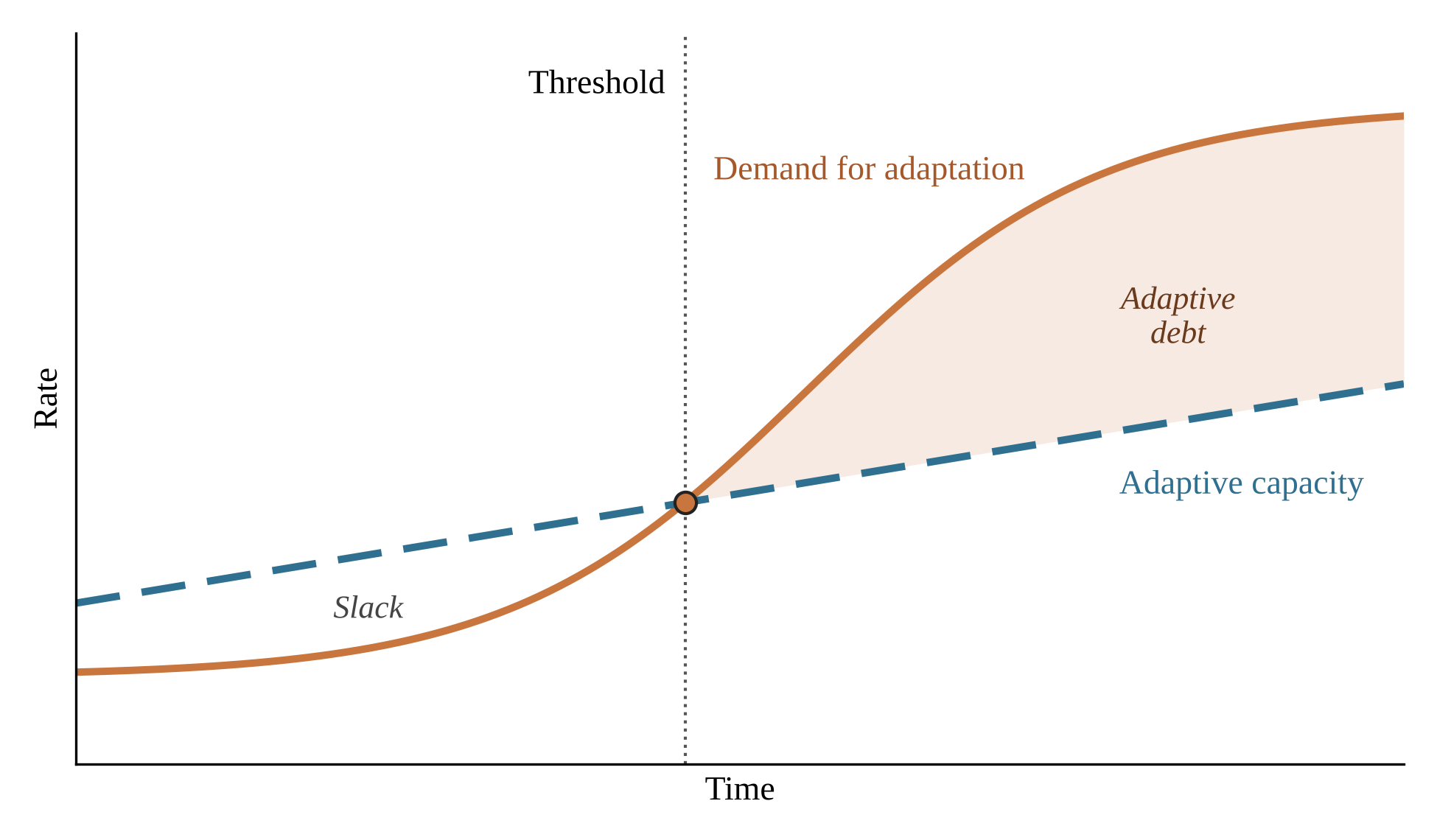
Figure 1. The Adaptive Capacity Threshold. Before the crossing, adaptive capacity absorbs the demand for change with slack to spare. Beyond it, unresolved demands accumulate as adaptive debt. Conceptual illustration, not empirical data.
Crossing the threshold seldom produces sudden collapse. Experience, redundancy, and improvisation keep the organization running while unresolved demands accumulate. Leaders answer the pressure by demanding more information, tightening reporting, centralizing authority, and adding technology. Each response brings short-term relief and a longer-term load on attention, coordination, and judgment. Activity rises while adaptation stalls.
The symptoms are observable to leaders willing to measure them: a lengthening interval between a lesson identified and a practice changed, a growing share of decisions resting on assumptions no one has recently tested, recurring surprises of the same type, and workarounds that harden into permanent procedure.
Processing capacity and adaptive capacity are related but distinct. The first measures how much information an organization can collect, analyze, and distribute, and how fast. The second measures its ability to turn that information into revised understanding and changed behavior. An intelligence staff can produce more assessments without questioning the premises beneath them, a headquarters can accelerate planning without revisiting its operational concepts, and a service can field new technology inside structures that blunt it. All three register as progress on the usual metrics.
Orientation First
John Boyd’s OODA loop is often reduced to a race through observe, orient, decide, and act. Boyd himself put orientation at the center: the mental models, experience, culture, analysis, and synthesis that determine what an organization notices, how it reads what it notices, and which actions seem sensible. An organization working from a flawed orientation can decide quickly and consistently while drifting further from reality, and faster cycling compounds the error.
The force that holds the advantage under accelerating change will spot failing assumptions sooner, revise them more effectively, and turn revised understanding into purposeful action. It will also judge which changes demand a response and which can be watched. An institution that reacts to every development is as exposed as one that reacts to none, so coherence and the capacity to reorient have to coexist.
The Illusion of Adaptive Capacity
Artificial intelligence can expand adaptive capacity across intelligence, planning, logistics, targeting, and simulation. It can also produce the appearance of understanding without the substance.
Picture a headquarters with continuously updated intelligence feeds, automated pattern detection, machine-generated courses of action, and predictive models rendered in polished visualizations. Every conventional indicator improves. Planning timelines shrink, products multiply, and decision cycles shorten. None of those indicators shows whether the models still reflect the environment, whether the data have been manipulated, whether an adversary is feeding the system the patterns it was trained to expect, or whether commanders can still interrogate the logic behind a recommendation.
Mistaking gains in processing and output for gains in understanding is the illusion of adaptive capacity (Figure 2), and it recreates Israel’s position in 1973. Confident, polished output smooths over the ambiguous signals that would otherwise prompt doubt and weakens the second rate of the threshold, the feedback that tells an organization its assumptions have failed. Efficiency can reinforce confidence in an established approach at the moment that approach most needs a challenge.
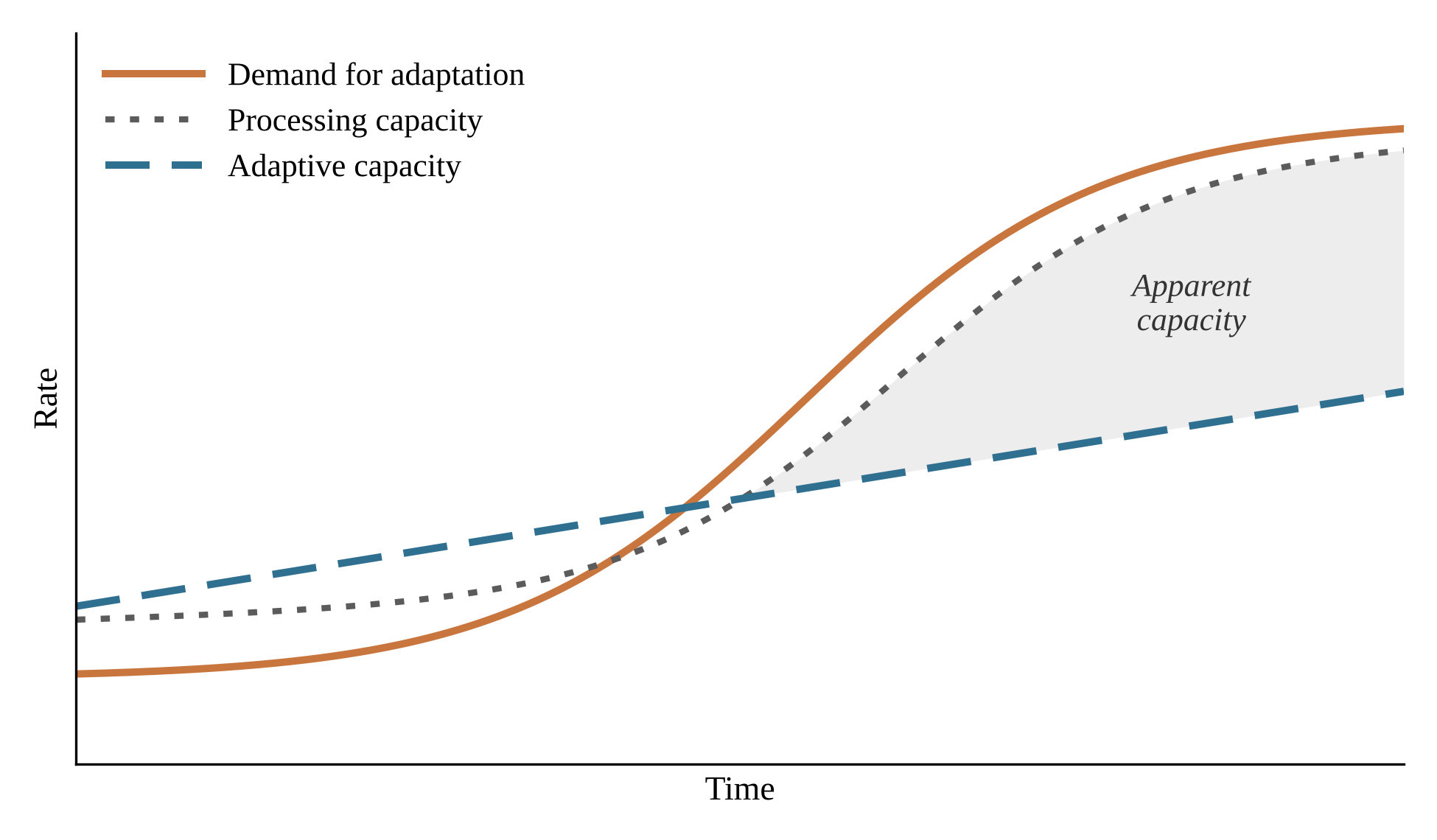
Figure 2. The illusion of adaptive capacity. AI-enabled processing can keep pace with the demand for change while adaptive capacity, the ability to revise understanding and behavior, falls behind. Measured by processing, the organization appears to be keeping up. Conceptual illustration, not empirical data.
Design determines which effect dominates. Systems built to surface uncertainty, test competing hypotheses, flag contradictory evidence, and support experimentation can strengthen adaptation. Systems built mainly to accelerate existing processes will entrench existing assumptions. Poorly integrated, the tools meant to close the adaptation gap can widen it.
The Organization That Can Change Its Mind
Some forces keep the capacity to reorient under accelerating change while others, sometimes with comparable or superior resources, lose it. Structure governs how information moves and who may act on it. Culture governs whether contradictory evidence is welcomed or dismissed. Leadership governs whether experimentation is rewarded and whether assumptions can be challenged without threatening institutional identity. Questioning an assumption is among the highest expressions of professional expertise.
Decentralized authority lets those nearest a problem respond, yet local innovation that never travels stays isolated and temporary. Organizations have to learn in two directions, adjusting methods to circumstances and re-examining the assumptions that made those methods seem right, what Chris Argyris called double-loop learning.
Several mechanisms can make that learning routine. Assumption registers can state the premises behind plans and doctrine, assign each an owner, and review them against outcomes on a fixed cycle. Sunset dates on doctrine and tactics, techniques, and procedures can require affirmative revalidation before anything persists. Red teams can hold standing authority to challenge a plan before approval, with a guaranteed hearing from the commander. Lesson-to-practice cycle time can be measured and reported like readiness, making adaptive debt visible. Professional military education can train officers to detect when a framework has stopped explaining events, a skill procedural competence alone does not build.
Commanders have to set clear objectives and preserve unity of effort while giving subordinates room to recognize emerging problems and act on them. Maintaining discipline and preserving obsolete procedure are different things, and the hardest assumptions to abandon are the ones experience has validated. Israel’s confidence after 1967 and American conventional dominance before Iraq both show how prior success can obscure what success now requires.
The Next Strategic Advantage
Speed will remain central to military competition, and artificial intelligence, autonomy, advanced sensing, and networked command will compress timelines further. In 1973 an established worldview filtered out the evidence of attack. In Iraq institutional change trailed operational reality by years. In Ukraine innovation and counter-innovation move so quickly that even successful adaptation buys only a temporary edge. Each case describes an organization pressed against its Adaptive Capacity Threshold.
The task for military leaders is to build institutions that notice when their understanding is going stale, revise it before failure forces the revision, and carry new knowledge into action. Artificial intelligence can strengthen each of those capacities or hide their decay behind impressive gains in speed. Which outcome prevails will depend on the judgment, independence, culture, and adaptability of the people who employ it.
The future of warfare may depend less on how quickly an organization can act than on how effectively it can change its mind.

