

What Ukraine’s Brave1 teaches about turning battlefield learning into fielded capability, and what happens when an outlaw gets a budget
The Handoff Problem
Every defense innovation office in the West can show you a slide full of ideas. Pitch days, challenge prizes, accelerator cohorts, prototype demonstrations on a sunny range. Ideas are rarely what’s missing.
The trouble lives in the handoffs, in the quiet space between the person who found a gap at the front and the person who can put a fix into a unit’s hands. A requirement gets written in one building. A developer works in another. Test and evaluation sits somewhere else, the money sits somewhere else again, and the operator who first noticed the problem has usually rotated out by the time an answer arrives. Every office in that chain can do its job well and the chain can still fail.
I’ve spent a good part of the last decade working inside that space, and the pattern holds across services and across eras. We are good at generating. We are slow at landing.
On November 6, Ukraine’s Ministry of Defence published a long explainer on Brave1, the defense-technology cluster the Ukrainian government stood up in 2023. Read quickly, it looks like a fact sheet with big numbers attached. Read slowly, it describes an attempt to make the seams themselves the object of design. That makes it interesting, because the seams are where we lose.
What Brave1 Built
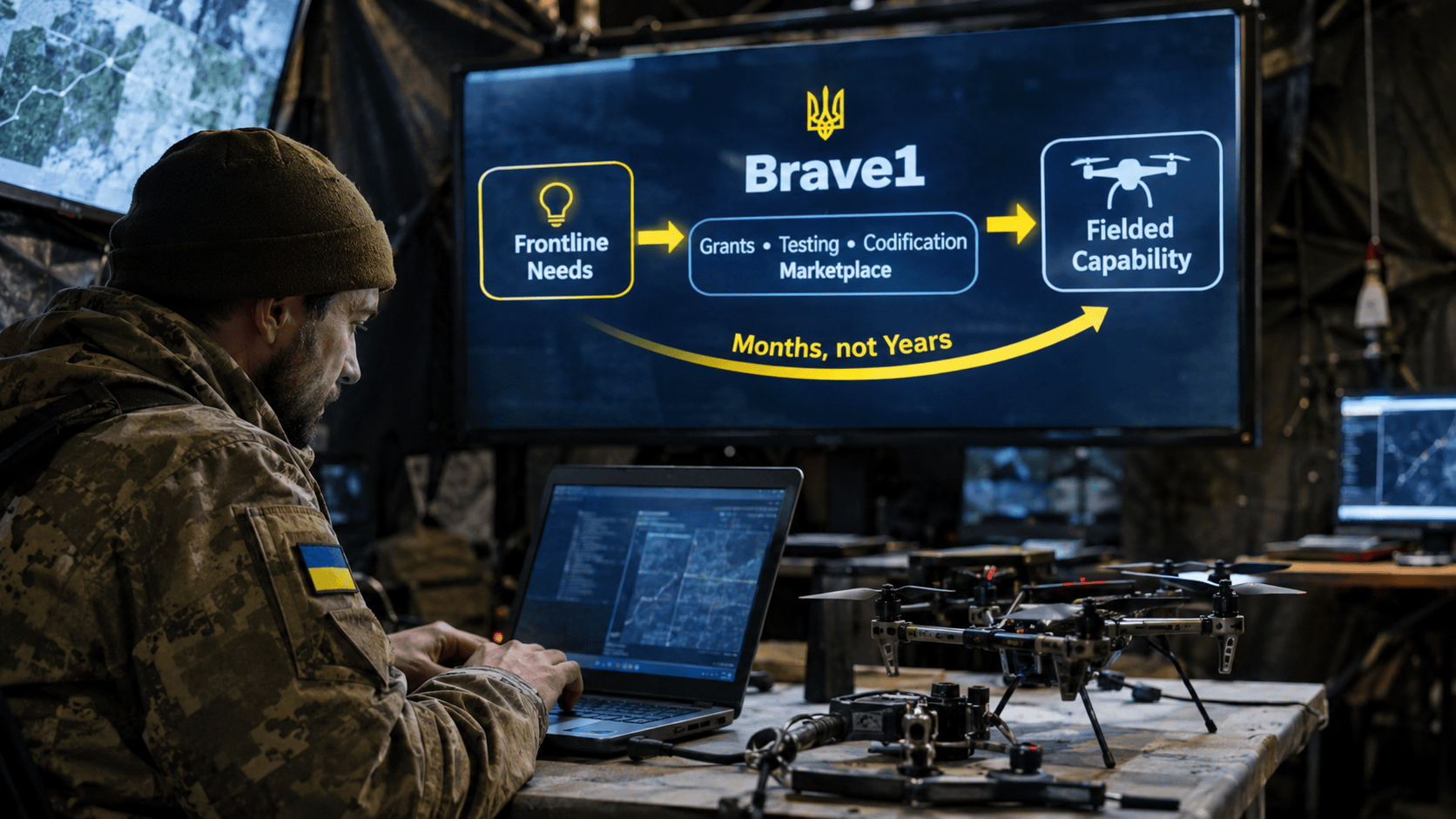
The ministry’s own diagnosis of the pre-war system is blunt. Ukraine’s defense sector ran as a closed shop with long decision cycles, and private engineers and startups had little way to reach the people who needed their work. Brave1’s stated goal is to compress the path from idea to combat use from years to months.
The architecture is simple to describe. Any manufacturer can apply for a grant, for testing, for consultation, or for codification. Service members can submit requests for the technology they need. Priorities are set jointly with the General Staff, the ministry, the intelligence services, the Border Guard, and the National Guard, and they currently span 84 technology areas grouped into nine categories. Grants are non-repayable and run from about $11,000 to $175,400 depending on the maturity of the product. Larger solutions are tested on a range or in combat. More than 600 products have been codified to NATO standards, which lets the state buy them through centralized procurement.
The headline numbers are striking. The ministry reports 2,500 participating companies, more than 5,000 solutions, and over 1,000 grants since 2023. In 2022, seven Ukrainian firms were building drones. The ministry now counts more than 500. Electronic warfare producers went from roughly ten to more than 300, and ground robot makers from a handful to more than 200. The country produces around 10 million drones a year and is aiming for 20 million.
The detail to underline is easy to miss. Each of those 84 technology areas has dedicated managers who gather feedback from troops, organize testing, translate frontline complaints into technical specifications, and chase products until they reach a unit. That job description is the whole game. Brave1 has made a profession out of owning the seam, and assigned a person to every one of them.
A caution belongs here. Every figure above comes from the ministry describing its own program in wartime. The numbers may be right, and the design is still worth studying, but none of it substitutes for independent evidence about what works at the front.
The Unit as Customer
The most radical piece of the system gets a few paragraphs near the bottom of the explainer. In April 2025, Brave1 and Ukraine’s Ministry of Digital Transformation launched Brave1 Market, a defense-technology marketplace for the military. Its catalog now lists more than 7,000 solutions from 955 companies. Some 486 units have placed orders, buying more than 903,000 items worth about $1.39 billion, and roughly 774,000 drones and other pieces of equipment have been delivered.
How units pay is the interesting part. They spend ePoints, which they earn for verified combat results: target hits, reconnaissance, ground-robot logistics and casualty evacuation. They can also spend their own funds. In plain terms, Ukraine has wired its demand signal directly to the front and priced it in battlefield outcomes. A brigade that performs gets purchasing power, and it decides what to buy.
Think about what that does to the classic requirements process. The traditional model asks a headquarters to predict what a unit will need, write it down, validate it, fund it, compete it, and deliver it, often years after the need was real. Brave1 Market lets the unit vote with points every week. The requirement and the purchase collapse into the same act.
The design has risks worth naming. Any incentive system rewards what it can count, and Goodhart’s law will eventually come to collect. Hits and reconnaissance are verifiable on camera. Patience, deterrence, and the attack that never happened are much harder to score. A points economy built on verified kills could tilt units toward the kinds of action, and the kinds of equipment, that produce good footage. It may also compound advantage, since the units already scoring well earn the means to score more.
None of that argues against the idea. It argues for watching it closely, because a market is a model of what an institution values, and models drift.
When the Outlaw Gets a Budget
Here is the question that matters most…. Can a system built to bypass bureaucracy stay fast once it becomes large enough to need one?
The ministry’s own numbers hint at the trajectory. In 2024, Brave1 awarded 289 grants worth $19.7 million. In 2025, it awarded 325 worth $60.9 million. The count rose about 12 percent while the money more than tripled, which means the average award went from roughly $68,000 to roughly $187,000. By early November 2026, it had already passed the 2025 total. Brave1 is also running larger grant competitions in the $1.6 to $2.2 million range, built around defined tactical and technical specifications and run through Prozorro, Ukraine’s public procurement system. Add NATO codification, joint funds with the European Union, and partner programs with half a dozen allies.
Each of those moves is sensible. Bigger bets are how you scale production. Specifications are how you get interoperable kit. Codification is how you reach centralized buying and allied markets. Taken together, they are also the signature of an organization moving from an open door toward defined requirements, from many small wagers toward fewer large ones, and from frontline pull toward institutional push.
I’ve been working on a mechanism I call pathway capture, the way protected channels for heterodox ideas acquire institutional consequence and slowly lose the ability to host the next challenge. Nobody votes for it. It accumulates through reasonable decisions made by competent people, each one solving the problem in front of it. The channel that began as a rebel’s back door becomes the main entrance, with a reception desk.
Brave1 is far from that point, and war is a powerful antidote, because the enemy audits your assumptions every day. The question is what happens when the shooting slows, the coalition money arrives in larger blocks, and the people who built the system are replaced by people who inherited it.
Two Ghosts
We have run this experiment before, at both ends of the scale.
In May 1943, with the Battle of the Atlantic still in doubt, Admiral Ernest King created Tenth Fleet. It had no ships. It was a small headquarters in Washington that pulled together signals intelligence on U-boat movements, the operations researchers studying search and attack, convoy routing, and the authority to act on what they learned. Intelligence, analysis, and operational control sat in the same rooms, and a finding could become a changed tactic or a rerouted convoy within days. When the U-boat threat collapsed, Tenth Fleet was dissolved in 1945. It never had time to grow old.
Sixty years later, the United States faced a different adaptive enemy in the roadside bomb. A small Army task force grew into the Joint Improvised Explosive Device Defeat Organization, which by the end of the decade was spending billions of dollars a year across intelligence, training, and materiel. It fielded a great deal that saved lives. It also drew repeated criticism from the Government Accountability Office for overlapping efforts and for difficulty showing what its spending achieved. In 2015 it was downgraded and folded under the Defense Threat Reduction Agency. The organization built to fuse the seams had grown seams of its own.
The lesson to take from the pair is uncomfortable. Tenth Fleet stayed fast partly because it stayed small and partly because it had a natural end. JIEDDO kept the urgency of its mission long after it had acquired the structure of a permanent agency. Brave1, at 2,500 companies and 84 technology areas, already has JIEDDO’s scale problem. What it still has, and what JIEDDO gradually lost, is Tenth Fleet’s daily contact with an enemy who punishes slowness.
Measure the Days
Notice what the ministry chose to count. Companies, solutions, grants, dollars, items ordered, items delivered. Those are inputs at one end and outputs at the other. The middle, the part Brave1 was designed to fix, goes unmeasured in public.
Here is the proposition to keep coming back to. A defense innovation ecosystem should be judged by the speed and reliability with which operational learning becomes fielded capability. The volume of ideas it generates is a weak proxy at best.
That suggests two measures most innovation organizations never publish. The first is problem-to-field latency: the time from a unit’s first report of a problem to the day a working fix sits in that unit’s hands at useful quantity. The second is reliability: the share of those fixes that arrive, function, and get used. A system with 2,500 companies and a latency of nine months is slower than a system with 50 companies and a latency of three weeks, whatever the press release says.
There is a third measure, and the war in Ukraine has made it impossible to ignore. Call it the counter-adaptation clock, the time it takes the enemy to blunt a fix once it appears. Electronic warfare countermeasures in Ukraine have reportedly turned over in weeks. If your latency is longer than the enemy’s clock, you are fielding yesterday’s answer into today’s fight, and every gain is temporary. Adaptation becomes a race of cycle times, and the side that learns faster across the whole chain holds the advantage, even with fewer good ideas.
If Brave1 published its latency by technology area, quarter over quarter, we would learn more about its health than from any count of companies. The same is true of every innovation office in Washington.
The American Mirror
It would be easy to read the Brave1 story as a Ukrainian curiosity, the kind of improvisation a nation does when its survival is on the line. That would be a mistake. The United States has no shortage of innovation organizations. Every service has one, the department has several, and most of them can produce impressive slides about cohorts, prizes, and contracts awarded. Far fewer can tell you, by problem and by unit, how many days it took to close the loop.
What usually goes missing is ownership. In most of our institutions, nobody owns the time between “we found the problem” and “the fix is in the field.” The requirement has an owner, the program has an owner, the test event has an owner, and the elapsed days belong to everyone and no one. Brave1’s area managers are interesting because they were hired to own exactly that.
So here are the questions to put to anyone in the innovation community who leads an organization that is supposed to adapt.…..Who in your organization owns the days between discovery and delivery, by name?
What would your problem-to-field latency look like if you measured it honestly, and how does it compare to your adversary’s counter-adaptation clock?
Where is your demand signal coming from, and how many layers does it pass through before it reaches someone who can act?
And the hardest one: what is your sunset? Tenth Fleet stayed sharp in part because it was built to disappear. Most of our innovation organizations are built to last, and lasting is how the seams grow back.
Ukraine is running the largest live experiment in military adaptation in a generation. We should study it with the same skepticism we bring to our own claims, and with the humility to admit that a country fighting for its life may have learned something about speed that we have only written about.

