

I’ve been living inside an 18th-century archive for the past few weeks, and I keep coming back to the same uncomfortable thought: we’ve seen this movie before.
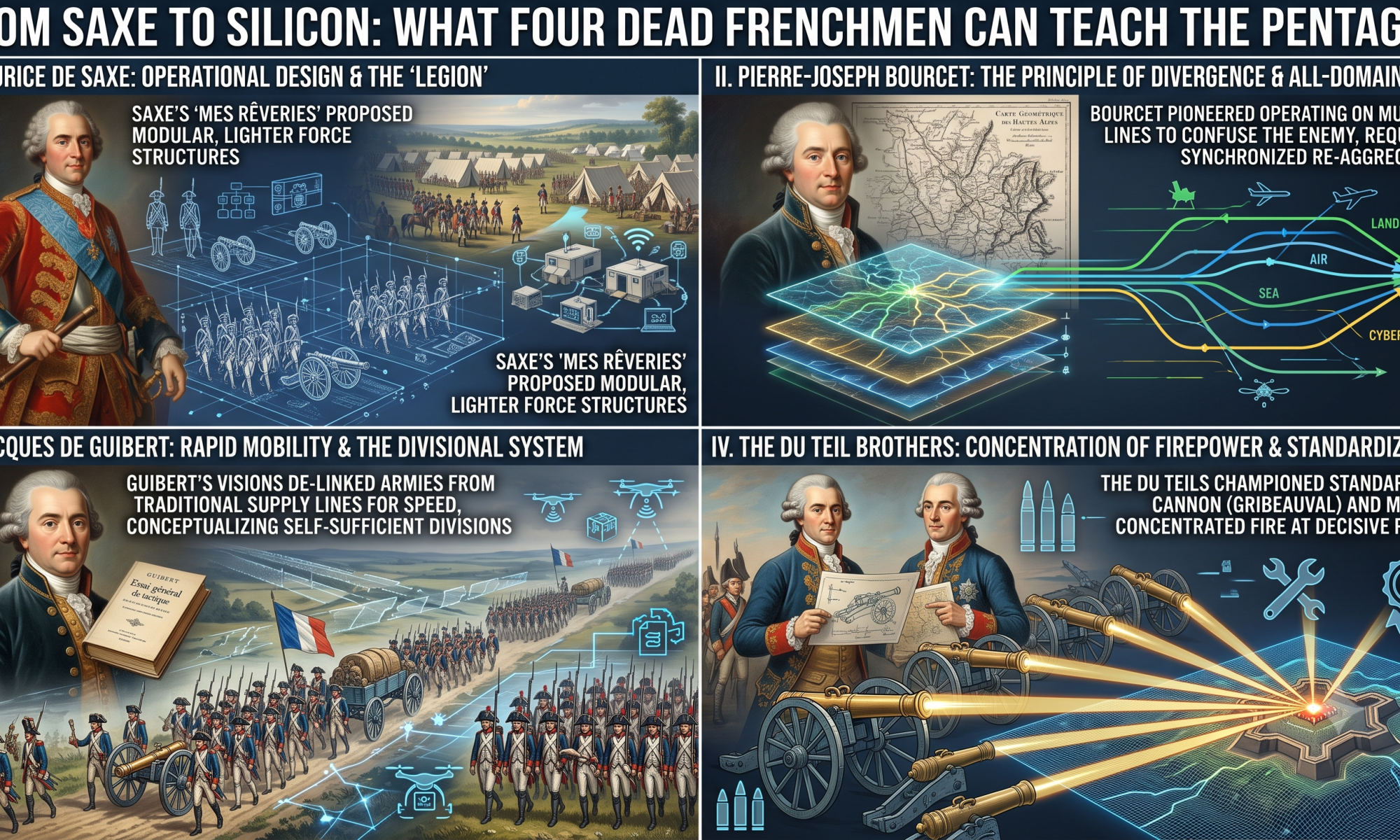
Maurice de Saxe. Pierre-Joseph Bourcet. Jacques de Guibert. The du Teil brothers. Four names most people have never heard, and yet between them they built the intellectual toolkit that let a shattered, half-bankrupt Revolutionary France produce Napoleon. Not the myth of Napoleon — the actual operational machine. Mobility. Dispersed columns that concentrated only at the moment of impact. A nation mobilized behind its army instead of merely paying for one. Massed, mobile fires used to rupture a line rather than just knock down a wall.
That synthesis won a decade of stunning victories. Then it calcified, and calcification is the part of the story nobody wants to sit with.
The Pattern Nobody Wants to Admit We’re In
Here’s the cycle, stripped to its bones: innovation creates advantage, advantage gets institutionalized into doctrine and procurement, institutionalization hardens into orthodoxy, and orthodoxy eventually gets exploited by someone willing to fight differently. Barry Posen wrote about this decades ago — militaries chase certainty through standard operating procedures because uncertainty is organizationally terrifying, and it usually takes an outside shock, or a handful of internal mavericks, to break the habit.
Sound familiar? The U.S. defense enterprise is showing every symptom. A defense industrial base graded, bluntly, as failing. Supply chains so multi-tiered and opaque that units can’t get enough ammunition to train to standard. A force that still gravitates toward big, expensive, “100% solution” platforms — supercarriers, exquisite fifth-gen fighters — built on the same procurement logic that gave Napoleon his eventual undoing: fewer, heavier, harder-to-sustain instruments.
The logistics fragility and the doctrinal rigidity aren’t separate problems. One causes the other.
What Each of the Four Actually Gave Us
Saxe wanted a professional standing army built for effectiveness, not parade-ground geometry — and he cared as much about the psychology of soldiers as their formations. Translate that forward and you get decision velocity: authority pushed to the tactical edge, competence in digital fieldcraft, people trusted to act on incomplete information at speed.
Bourcet is the one operational planners should actually know by name. His mountain-warfare principles — independent columns that could survive on their own but converge the instant it mattered — are a direct blueprint for distributed lethality today. Appear everywhere, mass only at the moment of effect. That’s not a slogan. That’s an operating system.
Guibert gave us the nation in arms — the idea that a mobilized, civically invested population outlasts a hired, finite force. The 21st-century version isn’t conscription. It’s civil-military fusion: industrial surge capacity, a reserve of civilian data scientists and technologists who can be called on when a crisis demands rapid retraining of the systems we depend on.
And the du Teil brothers reframed artillery from a siege afterthought into the decisive arm of the battlefield — mass fires at a single point, keep them mobile, create the rupture the rest of the force can exploit. The modern rupture point isn’t purely kinetic anymore. It’s the enemy’s decision cycle, and the “fires” that break it are cyber, electromagnetic, and informational, synchronized across domains.
Where the Model Broke — and Why That’s the Part That Matters Most
Napoleon didn’t invent any of this. He synthesized it, brilliantly, through the corps system — permanent combined-arms formations that let him apply Bourcet’s dispersion and du Teil’s fires at a scale nobody had managed before. For about a decade, it was close to unbeatable.
Then it stopped adapting.
Spain gave him an enemy that refused to fight his war at all — a guerrilla campaign that inverted his entire logistics logic, forcing him into small, exposed garrisons that bled slowly rather than dying in one decisive battle. Russia gave him something worse: strategic depth. Kutuzov simply declined the battle Napoleon needed, dragged the campaign across distances his logistics couldn’t survive, and let geography and a scorched landscape do what no army could.
I keep circling one line from that history: the failure wasn’t a lack of genius. It was a failure to institutionalize continuous variation. Genius doesn’t scale. Habits of adaptation do, if you build them into the organization on purpose.
We already lived the Spanish version of this — twenty years of irregular warfare that punished a force built for something else entirely. Now we’re posturing for the Russian version. The Pacific is strategic depth. Vast distances instead of a devastated road to Smolensk. Chinese A2/AD capabilities standing in for those flying detachments harassing the line of communications. A logistics enterprise still wired for just-in-time delivery, walking into a theater that demands just-in-case.
Translating the Old Grammar Into the Domains We’ve Got Now
Line these principles up against the actual problem set and the mapping gets almost uncomfortably clean:
Cyber and AI — Saxe’s initiative becomes decision velocity: edge AI, frontier models pushed to the tactical level, a legal framework for surging civilian data talent when a model needs rapid retraining under pressure.
Space — Bourcet’s dispersal becomes proliferated LEO/MEO constellations and layered PNT alternatives, because a handful of exquisite satellites is exactly the kind of fortress that becomes a trap.
Robotics — this is the most direct translation in the whole set. Replicator’s attritable autonomous systems are Bourcet’s independent columns and du Teil’s mobile fires, reborn as drones and uncrewed platforms. The prescription is the same one procurement keeps resisting: open architecture, so the fleet can be upgraded instead of locked to one vendor.
Quantum — both a threat to current encryption and, through quantum sensing, a genuine accelerant for GPS-denied navigation — letting Bourcet’s dispersed robotic columns operate without a signal to jam.
Arctic and Pacific logistics — the two operational problems where this all gets tested for real. Mobile caches instead of fixed fortresses in the Arctic. In the Pacific, contested logistics has to graduate from a planning annex to an actual operational pillar — distributed sustainment paired with distributed lethality, because neither survives alone.
A Dozen Places to Actually Start
I won’t walk through all twelve here, but four are worth sitting with:
Quarterly, live-fire contested logistics exercises — moving real materiel under real jamming — because a doctrine nobody has practiced under pressure isn’t a doctrine, it’s a hope.
Civil surge compacts and a reserve cyber/data corps, which together are Guibert’s nation in arms rebuilt for a democracy instead of a levée en masse — one addressing industrial surge, the other human capital.
Procurement built for variety: multiple interoperable 80% solutions instead of one exquisite 100% solution that takes the better part of a decade to field. This is the one that makes everything else fiscally possible.
And a cross-functional “Napoleonic Corps” of integrators — Posen’s maverick solution, institutionalized, judged on nothing but how fast it can field an integrated capability across domains.
The Real Obstacle Isn’t Technical
I’ll be honest about where I land on this: the barriers here are political and cultural before they’re fiscal or technological. The current acquisition system persists because it offers something valuable to a lot of stakeholders — budget certainty, contract certainty, career certainty. It just doesn’t offer the thing it’s supposed to offer, which is winning.
When an organization gets handed something genuinely hard — reengineering Pacific logistics, walking away from thirty-year procurement cycles — it tends to retreat into what it can control administratively. That’s not cynicism. It’s a pattern Posen described, and it’s a pattern I watch play out in real time.
Saxe, Bourcet, Guibert, and du Teil handed the late 18th century a way out of static, attritional warfare. Napoleon proved the synthesis works. Spain and Russia proved what happens when the synthesis stops evolving. We’re standing at the same fork they stood at — the only real question is whether we treat that as history or as a warning.
 Mastermind Century Group