

I’ve been reading Robinson’s The Blind Strategist (a book I disagree with more than I agree with), and one line in it sent me down a rabbit hole that has nothing to do with Boyd and everything to do with a feeling I can’t quite shake. Something has changed in the nature of war over the last twenty-five years, and we have not yet put our finger on what it is. GWOT. Libya. Syria. The colored revolutions. Ukraine. Now Iran. The pattern that keeps repeating has little to do with the United States losing. It has everything to do with the United States winning the engagement and then discovering, months or years later, that it has inherited a situation of its own making that it has no theory for managing.
This isn’t a policy failure so much as a category error, the wrong game entirely.
Cannae and the Missing Theory of Conversion
Start with Hannibal, he is the cleanest version of the problem. At Cannae, he executed what is still taught as the most perfectly annihilating tactical victory in the Western canon, a double envelopment against a numerically superior Roman force that should be a permanent case study in operational art. And he lost the war. Rome had not out-fought him again; Rome had simply absorbed the shock, because its system was built to absorb shocks: replaceable manpower, an alliance structure that did not defect en masse the way Hannibal had gambled it would, and a political culture with the patience to lose battles for over a decade while it rebuilt. Hannibal had a magnificent theory of tactical destruction and no theory of conversion, no mechanism for turning a battlefield result into a political settlement that would hold.
Libya is Cannae with air power. Syria, in its early phase, is Cannae with proxies. The colored revolutions are Cannae compressed into weeks instead of years: a regime collapses, the tactical objective is achieved cleanly, and what follows is not stability but a vacuum that someone else’s patience fills. The United States keeps proving it can win the battle. It has not shown, in a quarter century of trying, that it has a reliable theory for what comes after the battle is won. That absence may be the actual story of American strategy in this period.
Mahan’s Chokepoints, Multiplied
Mahan gave us a strategic vocabulary built around a small number of physical chokepoints: control the strait, control the trade, control the war. Hormuz still matters enormously, as the last several weeks have demonstrated in the plainest possible terms. But chokepoints have proliferated into domains Mahan never had to think about, because those domains did not yet exist as strategic terrain. Undersea cables. SWIFT and the architecture of dollar clearing. Semiconductor fabrication, concentrated in a handful of facilities that a company the size of a mid-tier defense contractor could meaningfully disrupt. GPS. The recommendation algorithm that decides what a population believes about a war while it is still being fought.
Mahan already told us chokepoints exist. The problem now is that they have multiplied faster than any single power’s capacity to defend all of them at once, while an adversary only has to find and squeeze one. That expanding asymmetry of attention is the genuinely new fact. A blockade used to require a navy. Now it can require a few hackers, a cut cable, or a well-timed sanctions regime, and the effect on an adversary’s position can rival what used to take a fleet.
Clausewitz Assumed a Shape
Clausewitz remains enduring, as he should, but it is worth being precise about what his framework assumes rather than treating him as timeless in every particular. War, in the classical Clausewitzian sense, has a shape: it is declared or at least recognized, it is fought toward a culminating decisive point, and it resolves into a political settlement that both sides acknowledge. The trinity (people, government, army) presumes a reasonably bounded polity whose passions, policy, and violence can be brought into some kind of alignment toward that resolution.
Almost none of what has happened since 2001 respects that shape. Insurgencies do not seek a decisive point; they seek to deny one indefinitely. Colored revolutions and their inverse (the color-revolution-as-accusation that now attaches to nearly every popular uprising a great power finds inconvenient) operate below the threshold that would trigger the mobilization logic Clausewitz describes, on purpose, because staying below that threshold is the entire point. Proxy war lets a state fight without its “people” ever recognizing they are at war, which breaks the trinity at its foundation. Clausewitz isn’t wrong so much as incomplete: he describes one mode of war among several now running concurrently, and the United States keeps applying his logic (mass toward a decisive point, expect resolution) to conflicts that were never designed to produce one.
The Patience of the Materially Weak
This is where Mao and Tukhachevsky earn their place in the same paragraph, because they represent opposite starting conditions solving for the same problem from different ends. Tukhachevsky’s deep battle assumes an actor with enough material strength to mass mechanized force across the depth of an enemy’s defense and win in weeks. It is a theory built for an army with something to spend. Mao inherited nothing to spend. Protracted war (the strategic defensive, the strategic stalemate, the strategic counteroffensive) is explicitly a theory of how the materially weak survive contact with the materially strong long enough to change the terms of the contest. Giap, who took Mao’s framework and had to actually execute an operational-level campaign with it at Dien Bien Phu and again in 1972 and 1975, is probably the clearest bridge between the two traditions: patience as opening strategy, deep-battle mechanics as the closing one.
What ties this to the Hannibal problem and the Mahan problem is the same insight from a third angle. An actor without the material strength to win decisively has no incentive to play the game the way Clausewitz describes it, and every incentive to play a different game entirely: one that rewards time, ambiguity, and the accumulation of small positional advantages over the kind of single culminating engagement a stronger power would win outright. Practiced patiently enough, that rational adaptation to weakness becomes formidable against an opponent still playing for decisive points.
Checkers in a Go Tournament
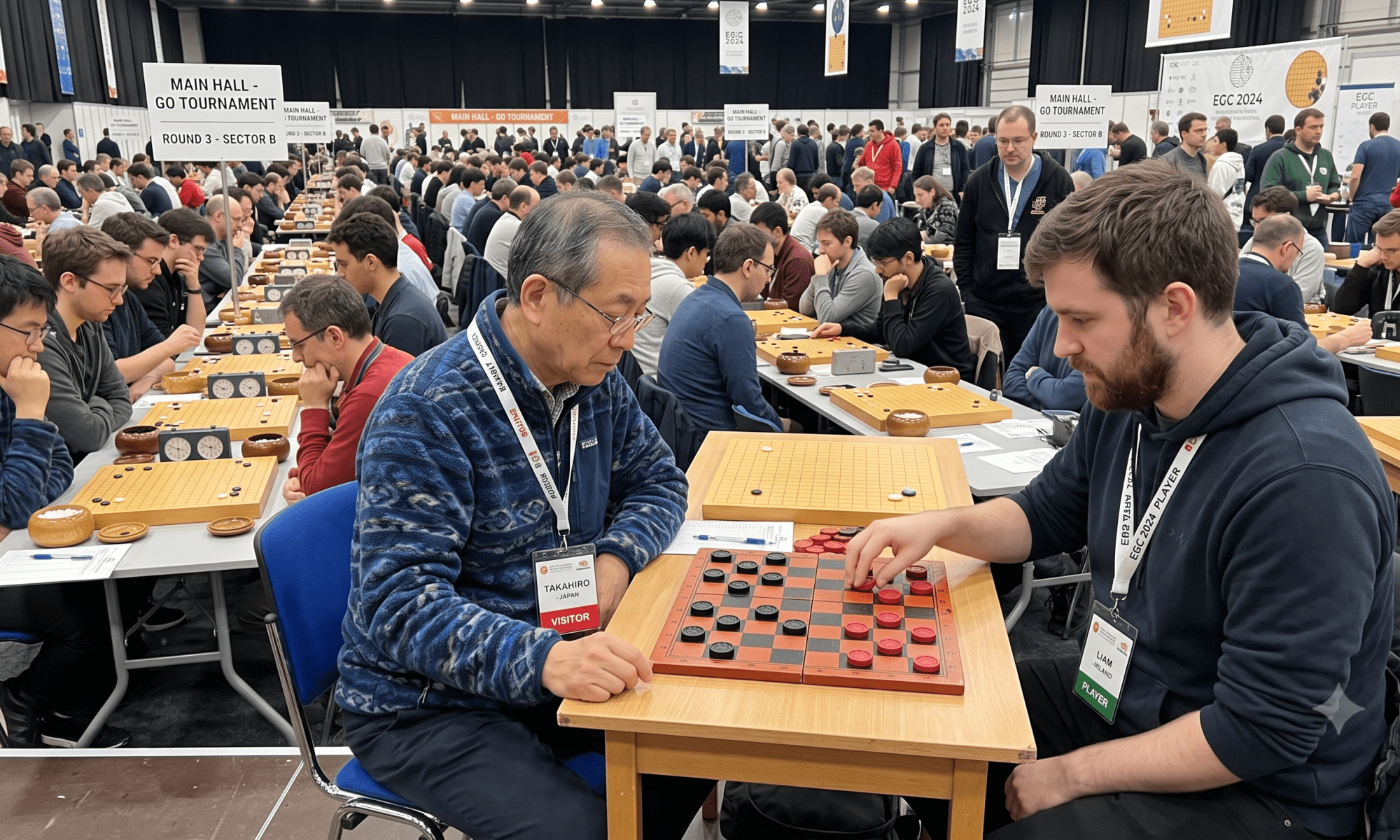
Which gets at the metaphor I cannot put down. Checkers is a capture game: you win by removing your opponent’s pieces from the board, and the game ends in a clean, recognizable result. Go is a territory game: you win by controlling more of the board over time, and a stone left in what looks like an unimportant corner in the early game can decide the outcome forty moves later. The American strategic tradition, built on Mahan’s decisive engagement and Clausewitz’s culminating point, is a checkers tradition. It plays to capture, and it is very good at capturing. Proxy warfare, gray-zone competition below the threshold of declared conflict, colored revolutions and the accusations that now surround them, the slow accumulation of chokepoint leverage across cyber, finance, and information: this is a Go tradition, and it does not need to win a single engagement to win the game. It needs to leave enough stones on the board that the opponent’s options narrow year over year, largely without ever presenting a moment that looks like a battle worth mobilizing to fight.
Iran is the most recent and most legible version of this. A precise, tactically successful strike followed almost immediately by a strategic picture that is murkier, not clearer, than before the strike, because the strike answered a checkers question in a conflict that was never only a checkers game. Ukraine shows the reverse mixture: a grinding, attritional, almost Tukhachevskian contest of material and depth, nested inside a broader Go-shaped struggle over sanctions regimes, energy chokepoints, and information contests that will outlast whatever the battlefield eventually decides.
Where the Strategic Web Fits
This is also, I think, where the Strategic Web belongs in the larger Industrial-Strategic-Cognitive framework, and it may be the piece that needed a live case to become fully visible. The Industrial Web is capacity: the material base a Tukhachevsky needs and a Mao does not have. The Cognitive Web is the moral and perceptual level Boyd spent his career on, the level colored revolutions and information contests are fought at almost exclusively. The Strategic Web is the connective tissue between them: the operational and positional layer where chokepoints get chosen, proxies get activated, and patience gets converted into leverage. What Mahan, Clausewitz, Hannibal, Mao, and Tukhachevsky each illuminate is a different piece of that middle layer, and the reason no single one of them feels adequate to 2026 is that the Strategic Web has expanded to include domains none of them were theorizing about. The web is the same shape. The threads are new.
If there is a single 21st century thesis sitting underneath all of this, it may be simpler than it first appears: war has stopped being an event with a shape and become a condition without one, and the United States keeps arriving with a theory built for the event. Until that changes at the level of strategic culture (not doctrine documents, but the actual instincts of the institutions doing the deciding), Cannae is going to keep happening, and we are going to keep calling each one a surprise.
 Mastermind Century Group