

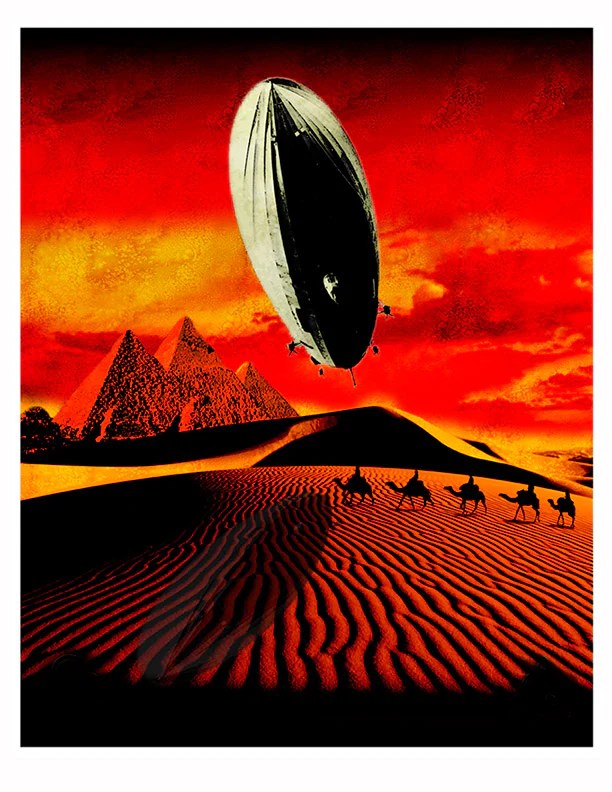
I have to admit, I’m old—but not that old. Led Zeppelin was already well established by the time I started listening to rock music. Still, I vividly remember when In Through the Out Door came out while I was in junior high—just before John Bonham’s tragic death in 1980. That moment marked the end of an era, but it was just the beginning of my own journey into Zeppelin’s catalog. Throughout high school—and still today—I’ve found myself returning to their music, discovering new layers in each listen.
One of those early encounters came not just through the music, but through film. I remember sitting in the theater watching Fast Times at Ridgemont High when Damone delivers his now-legendary “Five-Point Plan” for dating success. His final and most important rule?
“And, five, now this is the most important, Rat. When it comes down to making out, whenever possible, put on side one of Led Zeppelin IV.”
Cut to the very next scene: Ratner, nervous and awkward, driving his date while Kashmir blares from the speakers. The joke is subtle but brilliant—Kashmir isn’t even on Led Zeppelin IV. It’s from Physical Graffiti, released four years later. But this isn’t a continuity error—it’s character-driven comedy. Rat, bless him, messes up the album just like he’s fumbling the rest of the date. And in doing so, he becomes all the more human. It’s a small moment that shows how we often reach for greatness without fully understanding it—and sometimes that’s okay.
And that’s the beauty of Kashmir. The song itself is a monument to ambition and imagination—a bold departure from Zeppelin’s blues-rock roots. Released in 1975 as the centerpiece of Physical Graffiti, it’s a fusion of thunderous rock, orchestral grandeur, and Eastern musical sensibilities. More than a song, Kashmir is a sonic pilgrimage—a journey into mysticism, power, and place.
Origins and Inspiration
Despite its title, Kashmir wasn’t written in the Himalayan region. Robert Plant wrote the lyrics during a long drive through southern Morocco in 1973. As he traveled the desolate desert roads, the stark landscape and meditative rhythm of the journey sparked something deeper—a vision not of a destination, but of transcendence. Plant later noted that the song was less about geography than about the vastness of human experience.
Musical Structure
Jimmy Page called Kashmir one of Zeppelin’s most definitive tracks. Built around a droning riff in DADGAD tuning—a nod to Eastern musical traditions—the song hypnotizes rather than hurries. John Bonham’s drums in 4/4 time clash with the implied 3/4 or 6/8 feel of the guitar, creating a tension that propels the piece forward. Orchestral arrangements by John Paul Jones elevate it further, making it feel less like a rock song and more like a cinematic saga.

Lyrics and Themes
Plant’s lyrics evoke surrender to something greater than the self:
“All I see turns to brown, as the sun burns the ground / And my eyes fill with sand, as I scan this wasted land…”
This is both an external journey and an internal reckoning. It’s a meditation on wonder, on spiritual hunger, on what it means to be disoriented in pursuit of meaning. The desert becomes not just a setting, but a metaphor for the soul’s vast and unpredictable terrain.
Legacy and Cultural Impact
Kashmir remains a pillar of Led Zeppelin’s legacy:
- It was a staple in their live performances, often used to close shows with grandeur.
- Jimmy Page has said it might be the one song that best captures what Led Zeppelin was about.
- It’s influenced artists across genres—from classical fusion to metal to hip-hop (see Puff Daddy’s “Come With Me” from Godzilla, which samples Kashmir).
- Its sound has become shorthand for majesty and mystery in trailers, commercials, and campaigns.
But beyond the accolades, Kashmir offers something deeper—something strategic, even philosophical.
Kashmir as a Study in Leadership, Innovation, and Strategy
Leadership: Vision, Risk, and Synthesis
1. Vision Beyond Convention: Led Zeppelin could’ve coasted on what worked. Instead, Kashmir declared: “We’re not here to repeat—we’re here to explore.” It was leadership through artistic courage. Page and Plant ventured into unfamiliar sonic and thematic territory, bringing the whole band with them—even without certainty.
Lesson: Great leaders see what others can’t. They guide teams into ambiguity with clarity and conviction.
Innovation: Cross-Pollination and Creative Tension
2. Fusion Across Boundaries: Kashmir melds Western rock with Eastern scales, orchestral textures, and polyrhythmic friction. Bonham’s drums and Page’s guitar don’t sync; they collide, then reform, creating something entirely new.
Lesson: Innovation thrives in tension. True creativity often emerges when you fuse opposites and embrace discomfort.
3. Prototyping the Unknown: Page carried the riff for years before it became Kashmir. The song was built layer by layer, across time and experimentation.
Lesson: Innovation isn’t always a flash. Often, it’s slow, deliberate iteration—requiring patience, persistence, and faith in the process.
Strategy: Orientation, Distance, and the Sublime
4. Strategic Use of Distance: Kashmir is about a journey—but more importantly, about distance: spiritual, emotional, and physical. The song doesn’t arrive; it wanders, seeks.

Lesson: Strategy isn’t just about ends—it’s about maintaining perspective. The best strategists navigate toward the meaningful, not just the measurable.
5. Embracing the Sublime and the Uncontrollable: The song humbles you. It reminds you that the world is vast and your place in it small.
“Let me take you there…” isn’t a command—it’s an invitation to awe.
Lesson: Strategy without awe becomes sterile. The best leaders leave room for emergence, intuition, and mystery.
Application: Kashmir in Your Organization
- Leadership → Are you bold enough to explore new domains—and honest enough to admit you don’t have all the answers?
- Innovation → Do you create environments where friction and fusion can happen, or are you stuck polishing the familiar?
- Strategy → Are you focused only on metrics, or are you also cultivating the kind of perspective that allows vision to emerge?
Kashmir reminds us: the journey matters. That beauty can arise from complexity. That leadership is less about control, and more about navigating tension, mystery, and movement.
And sometimes, like Rat in that awkward car ride, you might get the album wrong—but the song still plays, and the journey still counts.

 Mastermind Century Group
Hi Bill,
Ah yes, Kashmir…. one tune, a really good one at that, in a quite remarkable album set. I thought the jacket was innovative as well. Which window are we seeing the world through? Does the view change if you move the record(s)? I’ll have to drag that one out again and listen all over.
Thanks,
Ben
Thanks Ben, obviously I was listening to it the other night and had to do some thinking about it (hence the post)