

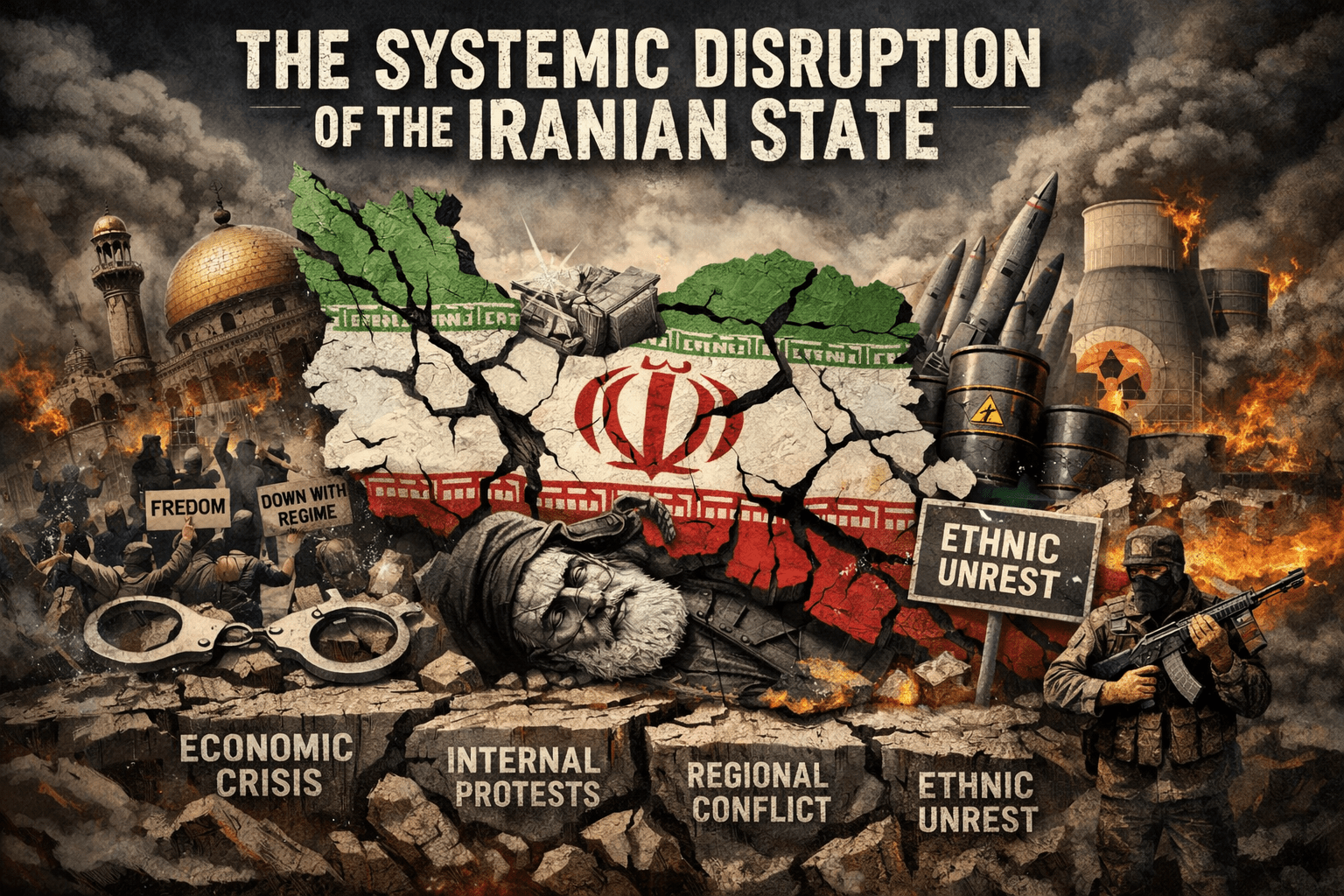
The Strategic Paradigm of Modern Systemic Warfare
(Piece written on 5 April, prior to the 7 April “cease fire” will be interesting to see how this shapes up.) The initiation of Operation Epic Fury at 1:15 a.m. ET on February 28, 2026, marked a definitive shift in the application of Western airpower and economic statecraft within the Middle Eastern theater.1 This conflict, conducted as a joint United States-Israeli endeavor, was not designed as a campaign of territorial acquisition or deterrence. Instead, it was conceived as a systemic intervention aimed at the comprehensive dismantlement of the Iranian regime’s security apparatus.2 The overarching campaign design utilized the “enemy-as-a-system” logic, a framework deeply rooted in the Air Corps Tactical School (ACTS) and the “Industrial Web” theories of the early 20th century, updated for a environment where digital, financial, and cognitive nodes are as critical as physical infrastructure.3
Operation Epic Fury, also referred to in various intelligence contexts as Operation Lion’s Roar or Operation True Promise 4, represents the most lethal and complex aerial operation in history.4 The initial strike package targeted a coordinated set of Islamic Revolutionary Guard Corps (IRGC) command-and-control facilities, integrated air defenses, and strategic missile and drone launch sites.5 By striking these nodes simultaneously, the coalition intended to induce a “system-level” paralysis, stripping the Iranian state of its ability to coordinate a response or sustain its internal security architecture.6
This campaign occurred against a backdrop of intense regional instability and perceived internal fragility within Iran. Following popular protests that began on December 28, 2025, the Trump administration and the Netanyahu government identified a strategic opportunity to reshape the geopolitical landscape.7 The timing of the operation was calculated to exploit this internal discord, with the ultimate objective of providing the Iranian people with the opening required to overthrow the theocratic government.8
As the conflict extended into April, it exposed the profound realities of this modern strategic paradigm. First, it proved that warfare functions as a coupled contest across multiple systems: kinetic military operations, maritime-economic infrastructure, and digital-cognitive arenas. True success cannot be measured solely by isolated air campaigns if vital systemic nodes like maritime insurance, energy flows, and GPS integrity remain operationally blocked or degraded.Second, the conflict has exposed a massive cost asymmetry disadvantage for advanced militaries. By leading with older, cheaper missile systems and low-end Shahed drones, Iran has forced coalition forces to deplete extremely scarce, multi-million dollar air defense interceptors in a war of attrition. This “burn rate” demonstrates that an adversary can target an advanced military’s logistical supply chains as a primary strategic vulnerability.
The Mutation of the Industrial Web
Classic 20th-century Industrial Web theory was largely predicated on adversaries sharing similar integrated, highly centralized economies, assuming that the destruction of specific physical nodes would cause a predictable, cascading collapse across the entire system. However, the 2026 Iran conflict makes a strong case that the Industrial Web theory is fundamentally altered—or at least limited—when applied across highly divergent economies and cultures. When facing a decentralized, ideologically driven adversary that leverages asymmetric and dispersed capabilities, the kinetic destruction of fixed physical targets no longer yields the expected system-wide paralysis.
Instead, thinking about modern systemic warfare requires evolving from the traditional physical web to a “Digital-Cognitive Web”. In this paradigm, the most critical “operational nodes” are not factories or power grids, but cognitive variables: the risk perception of commercial shipowners and insurers, the narrative legitimacy that guarantees host-nation political tolerance for basing, and the psychological orientation of adversaries. Success in this web is determined by targeting these mental models under uncertainty, rather than relying strictly on industrial-scale destruction.
Defining the Three Webs of Modern Warfare
To assess and build an effective strategy prior to combat operations, planners must first define and map the three interdependent webs of modern systemic warfare:
- The Industrial Web: Rooted in early 20th-century Air Corps Tactical School (ACTS) theory, this treats the enemy as a complex physical system of interdependent nodes (e.g., factories, power grids). Disruption of these centers of gravity produces cascading physical and economic collapse. Historically, this model operates best when applied against symmetric, centralized industrial states.
- The Strategic Web: This represents the hard military campaign, including weapon stockpiles, force projection capabilities, and the combat geography. It involves managing counter-salvo suppression against missile infrastructure and defending distributed bases against retaliation.
- The Digital-Cognitive Web: This reflects the shift toward perception and information dominance. In this web, the critical operational nodes are mental models and psychological variables: the risk perception of commercial actors, narrative legitimacy, and the psychological orientation of adversaries and allies under political strain.
Kinetic Execution: The First 100 Hours of Conflict
The opening phase of the war was characterized by an unprecedented volume of precision-guided munitions (PGM) employment. Within the first four days, U.S. Central Command (CENTCOM) and Israeli forces conducted more than 2,000 strikes using over 2,000 precision munitions launched from air, land, and sea platforms.9 This high-tempo campaign focused on decapitating the Iranian leadership while systematically degrading its retaliatory capacity.
Comparative Intensity and Historical Context
The scale of Operation Epic Fury is statistically unprecedented when compared to major historical air campaigns. In the first 24 hours, the coalition delivered nearly double the firepower scale of the “Shock and Awe” opening of the 2003 Iraq War. This intensity was maintained through the first 72 hours, during which the volume of precision-guided munitions deployed was twice that used in the entire opening phase of the 2003 conflict.10
When viewed against the 1991 Gulf War, the technological and operational shift is stark. While only 9% of coalition munitions in Desert Storm were precision-guided, Operation Epic Fury represents an “industrial-scale precision bombing” effort with nearly 100% PGM employment.11 Furthermore, an analysis by Airwars found that the coalition hit more targets in the first 100 hours of this conflict than were struck in the first six months of the campaign against the Islamic State.12 The daily target throughput of approximately 1,000 strikes per day is more than double the average rate seen during the high-intensity Gaza campaign of 2023, which averaged 478 targets per day.13
The Decapitation of the Iranian Leadership
In the early morning hours of February 28, a coordinated strike targeted the Supreme Leader Ali Khamenei’s compound in Tehran.14 Subsequent intelligence updates confirmed the death of Khamenei, along with several of his senior aides and key political and military figures.15 This decapitation event was a central pillar of the “Epic Fury” strategy, intended to create immediate succession instability and reduce the bargaining space of the regime.16
The removal of the central authority figure triggered a succession moment that consolidated around Mojtaba Khamenei, the son of the late Supreme Leader.17 This transition coincided with the physical destruction of sovereign institutions, including the Assembly of Experts’ building and the national broadcasting headquarters (IRIB) in Tehran, further hampering the regime’s ability to project domestic authority.18
Strike Statistics and Operational Progress
As of the conclusion of the first 100 hours, military assessments indicated a significant degradation of Iranian power projection:
| Metric | Value |
| Total Strikes Conducted | > 2,000 |
| Precision Munitions Used | > 2,000 |
| Iranian Naval Vessels Sunk | > 20 |
| Reduction in Drone Launches | 73% |
| Reduction in Ballistic Missile Launches | 86% |
| Confirmed U.S. Fatalities | 8 |
| Reported Iranian Fatalities | > 1,000 |
Strategic Target Analysis: Nuclear and Missile Infrastructure
The primary strategic justification for Operation Epic Fury was the permanent neutralization of Iran’s nuclear and long-range missile programs.19 Although IAEA and U.S. intelligence evaluations had previously suggested that Iran had not resumed enrichment activities, the administration argued that the regime was rebuilding its infrastructure and developing missiles capable of reaching European and American territory.20
Neutralizing the Nuclear Complex
Coalition strikes targeted the core of Iran’s nuclear production and research facilities. Significant damage was reported at the Natanz facility, a primary site for uranium enrichment.21 Other targets included the Parchin explosives testing site and various facilities around Isfahan.22 Notably, high-risk targets such as the Bushehr nuclear reactor were excluded from the strike list to avoid radioactive incidents and collateral damage involving Russian technical staff.23
Dismantling the Missile and Drone Industry
The destruction of the “missile industry” required targeting not only launch silos but also production plants and logistics hubs.24 A key success was the strike on the Khorramabad underground missile base, where imagery confirmed that the tunnel access had been destroyed.25 Drone capabilities were also a priority; the Konarak Air Base suffered extensive damage to its hangars and runways to prevent the launch of one-way attack drones.26
Succession Dynamics and Regime Stability
The political fallout of the decapitation strikes has been profound. The transition to the leadership of Mojtaba Khamenei represents a consolidation of power within the hardline security apparatus.27 Mojtaba’s close ties to the IRGC suggest a “retaliatory rigidity” that may complicate efforts for a rapid de-escalation.28
Internal Fragility and the Role of Kurdish Groups
The U.S. and Israel have sought to capitalize on Iran’s internal fragility by supporting opposition movements. Kurdish groups along the Iran-Iraq border have emerged as a strategic element.29 Kurdish leaders have reportedly been in contact with Israeli and American officials to discuss the possibility of fighters crossing into Iran to weaken territorial control and trigger popular uprisings.30 However, this strategy faces hurdles, including pushback from Türkiye and historical Kurdish skepticism of Washington’s long-term commitment.31
The Maritime-Economic Subsystem: The Battle for the Strait of Hormuz
The most strategically consequential development of the first week was the collapse of commercial maritime traffic through the Strait of Hormuz.32 Although no formal legal closure was declared, the interaction of kinetic hazards, GNSS/GPS interference, and the withdrawal of maritime insurance created an “operationally restricted” environment.33
The Standstill of Tanker Traffic
Data derived from ship-tracking services revealed a total cessation of tanker transits within days of the conflict’s start.34 Typical daily transits of approximately 37 tankers fell to zero by March 5.35 This collapse had an immediate impact on the global energy market, with Brent crude reaching intraday highs of $111.04.36
War-Risk Insurance and the Maritime Gate
The primary functional “gate” on maritime traffic was the global insurance market. Following the initial strikes, the Gulf region was designated a listed area subject to war-risk premiums, which surged by more than 1000%.37 To address this, the U.S. government took the step of financially underwriting maritime risk, with the International Development Finance Corporation (DFC) announcing a maritime reinsurance facility of up to $20 billion.38
Upstream Production Curtailment
The closure of the Strait created a massive second-order effect in Iraqi oil production, which collapsed by approximately 70% (falling from 4.3 million to 1.3 million bpd) due to the exhaustion of storage capacity.39 This represents the most serious operational oil crisis for the Iraqi state in decades.40
The Information and Cognitive Frontier
Operation Epic Fury was accompanied by a sophisticated campaign in the cyber sphere aimed at degrading regime resilience.41
Cyber-Enabled Operations and Internet Disruptions
Coordinated cyber operations began simultaneously with the opening strikes on February 28.42 Iranian apps and websites were hacked, and nationwide internet connectivity dropped sharply.43 The Iranian response included DDoS attacks against Israeli defense entities and water management systems, as well as a physical attack on an AWS data center in the UAE.44
Regional Retaliation and Proxy Dynamics
The Iranian response involved its ballistic missile arsenal and network of regional proxies.45
Strikes on U.S. Bases and Partner Infrastructure
Iran launched retaliatory fires against U.S. bases in Kuwait, Qatar, and Bahrain.46 The Ali Al Salem base in Kuwait was reportedly struck by Shahed drones and declared “completely disabled” by the IRGC.47 Economic infrastructure was also targeted, including Saudi Aramco’s Ras Tanura facility and the Jebel Ali port in Dubai.48
Multi-Front Escalation: Hezbollah and the Levant
Hezbollah opened a northern front from Lebanon on March 1, firing missiles into Israel and triggering a broad Israeli response.49 Spillover violence also affected Iraq and Syria, with explosions rocking U.S. facilities in Erbil and rocket attacks targeting the U.S. Embassy in Baghdad.50
The Evolution of the Conflict: Status as of April 5
By April 5, 2026, the character of the conflict has transitioned. While the core military targets originally identified inside Iran were reported as all but gone—with U.S. forces hitting over 12,300 targets and defense assessments estimating over 15,000 targets struck—combat operations have continued amidst severe weapons depletion and escalating threats on both sides.
The coalition has established uncontested air superiority over vast stretches of Iran, allowing large, non-stealth B-52 Stratofortress bombers to execute direct overland missions. However, localized risks to coalition assets have remained present. On April 3, a U.S. Air Force F-15E Strike Eagle was shot down by enemy fire over Iran, representing the first known combat loss of a manned American jet in the conflict. Combat search and rescue operations recovered one crew member, while efforts remain active to find the second. On that same day, an A-10 Thunderbolt II was lost in the Persian Gulf region, though its pilot was successfully rescued in Kuwaiti airspace. The coalition has also suffered the loss of 16 uncrewed MQ-9 Reaper drones over the course of the campaign.
This phase of the campaign has severely impacted the enablers and connective tissue of U.S. airpower. Low-cost drones and missile barrages have targeted regional bases, causing damage to thin fleets of specialized airborne systems. On March 27, a missile and drone attack on Prince Sultan Air Base in Saudi Arabia damaged a U.S. Air Force E-3 Sentry AWACS, likely leaving the critical battle management platform unrepairable. Refueling capabilities have also sustained significant attrition. Eight KC-135 Stratotanker refueling aircraft were damaged or destroyed on the ramp at Prince Sultan Air Base across attacks on March 13 and March 27. In the air, another KC-135 Stratotanker crashed in western Iraq on March 12 following a midair collision with a second tanker during a combat mission, tragically claiming the lives of all six airmen aboard. With a cumulative total of nine tankers removed from the operational equation, the geographic radius within which the U.S. can sustain its campaign has been heavily compressed.
Furthermore, high-intensity systemic warfare has consumed precision weaponry at an unsustainable rate. In the first four weeks, U.S. operations consumed more than 1,000 stealthy, long-range JASSM-ER cruise missiles. To maintain combat momentum, the Pentagon is preparing to commit nearly 82% of its global inventory of JASSM-ERs to the theater, structurally draining the strategic reserves a nation requires to maintain global deterrence across other regions.
Plausible Futures: Scenarios for the Next 30–120 Days
| Scenario | Probability | Energy/Finance Profile |
| Containment and Reopening | 30–45% | Oil remains elevated but drifts down as transits resume and insurance stabilizes. |
| Regional Escalation | 20–35% | Oil spikes above first-week levels; inflation concerns rise; credit spreads widen. |
| Protracted Systemic War | 15–30% | Oil stays structurally high; IMF‑type inflation/growth effects become likely; emerging markets face acute stress. |
| Rapid De-escalation | 10–20% | Oil drops sharply but remains above pre-war baseline due to residual risk premiums. |
Indicators and Decision-Relevant Thresholds
| Indicator | Containment Threshold | Escalation Threshold |
| Tanker Transits | Returns to double-digits for ≥7 days | Near-zero for ≥14 days |
| Maritime Risk Level | Advisory language softens | Sustained “CRITICAL” risk |
| GNSS Interference | Becomes localized | Persistent; causes collisions/accidents |
| War-Risk Insurance | Coverage remains in place; re-priced | Widespread cancellations |
Conclusion and Recommendations for Airpower Doctrine
The 2026 Iran War demonstrates that air superiority is a means, not an end. Strategic success is decided by the ability to translate air control into the reopening of critical economic nodes.51
- The Maritime Triad: Success requires a synthesis of kinetic suppression, escort transits, and financial reinsurance.52
- Inventory-Aware Salvo Competition: Planners must balance the use of expensive standoff munitions against the need for sustained suppression of low-cost drone production.53
- Water-Energy Interdependence: Civilian infrastructure, particularly desalination plants, represents a strategic center of gravity that creates acute civil stability risks if damaged.54
- Pre-Combat Multi-Web Assessment: To effectively address the challenges of system disruption, coalition planners must assess and build strategies for the Industrial, Strategic, and Digital-Cognitive webs prior to engaging in combat operations. Planners must anticipate how pulling a kinetic lever in the strategic web will trigger immediate shocks in the industrial web (such as insurance premium spikes shutting down commercial shipping) and the digital-cognitive web (where cyber-disrupted communications and legitimacy narratives govern coalition access). To avoid strategic paralysis, multi-web off-ramps must be actively engineered in advance rather than as a reaction to systemic fallout.
Notes
- U.S. Central Command, “U.S. Forces Launch Operation Epic Fury,” February 28, 2026.
- Pete Hegseth, “Secretary of War Briefing on ‘Epic Fury’ Goals,” March 4, 2026.
- Air University Press, “Warden and the Air Corps Tactical School: System Disruption,” 2017.
- CENTCOM Video Release, “The First 100 Hours of Operation Epic Fury,” March 5, 2026.
- “Operation Epic Fury Chronology,” March 2026.
- CSIS Assessment, “System-Level Confrontation in the Iran War,” March 8, 2026.
- “Trump and Netanyahu’s Iran Gambit: Strategic Calculations,” Doha Institute, March 5, 2026.
- Truth Social Address, President Donald J. Trump, February 28, 2026.
- “US Releases Video of First 100 Hours of Operation Epic Fury,” Times of India, March 5, 2026.
- “Pentagon Says US-Israel Forces Control Iranian Airspace,” Vision Times, March 7, 2026.
- “Desert Storm’s Unheeded Lessons,” Air & Space Forces, 2021.
- “Record Pace of Strikes in Iran: Bombing Campaign Analysis,” Airwars, March 2026.
- Ibid.
- “Flashpoint: March 2026 Conflict Updates,” Flashpoint, March 4, 2026.
- “US-Israeli Strikes Kill Khamenei,” Reuters, February 28, 2026.
- Doha Institute, “Strategic Calculations behind Epic Fury,” March 5, 2026.
- “Iran Says Mojtaba Khamenei Has Been Named Supreme Leader,” AP News, March 8, 2026.
- “Infrastructure Warfare Escalation,” Flashpoint, March 2, 2026.
- “Hegseth Says ‘Epic Fury’ Goals are ‘Laser-Focused’,” U.S. Department of War, March 4, 2026.
- “Operation Epic Fury: Washington’s Contradictory War Aims,” Doha Institute, March 5, 2026.
- “IAEA Envoy Says Natanz Was Hit,” Iran International, March 3, 2026.
- CSIS Transcript, “Epic Fury Campaign against Iran’s Missile/Nuclear Infrastructure,” March 5, 2026.
- Ibid.
- “Secretary Pete Hegseth and Gen. Dan Caine Briefing,” U.S. Department of War, March 4, 2026.
- CSIS Target Imagery Analysis, March 5, 2026.
- Ibid.
- “Iran Defies Trump, Elevates Khamenei’s Son Mojtaba,” Reuters, March 8, 2026.
- Ibid.
- “Role of Kurdish Groups in Operation Epic Fury,” Doha Institute, March 5, 2026.
- Ibid.
- Ibid.
- “Tanker Traffic in the Strait of Hormuz Comes to a Standstill,” Reuters, March 5, 2026.
- UKMTO/JMIC Advisory Note, “Navigational Risk in the Strait of Hormuz,” February 28, 2026.
- “See How Tanker Traffic Collapsed in the Strait of Hormuz,” Reuters, March 6, 2026.
- Ibid.
- “Oil Prices Surge 20% on Supply Fears,” Reuters, March 8, 2026.
- “Maritime Insurance Premiums Surge as Iran Conflict Widens,” Reuters, March 6, 2026.
- “DFC Announces $20B Plan for Maritime Reinsurance in the Gulf,” DFC, March 6, 2026.
- “Iraqi Oil Production Collapses with Strait of Hormuz Blocked by conflict, sources say,” Reuters, March 8, 2026.
- Ibid.
- “The Escalating Cyber and Information Front,” Flashpoint, March 4, 2026.
- “Hackers Hit Iranian Apps, Websites after US-Israeli strikes,” Reuters, March 1, 2026.
- “Iran Internet Shutdown Violates Rights, Escalates Risks,” Human Rights Watch, March 6, 2026.
- “Detailed Timeline of Kinetic and Cyber Events,” Flashpoint, March 5, 2026.
- “Regional Retaliation and Proxy Dynamics,” Al Jazeera, March 8, 2026.
- “Iran Retaliates by Striking Jebel Ali Port and Camp Arifjan,” Flashpoint, February 28, 2026.
- “IRGC Claims Waves 7 and 8 of Operation True Promise 4,” Flashpoint, March 1, 2026.
- “Drones Strike Saudi Aramco’s Ras Tanura Facility,” Flashpoint, March 2, 2026.
- “Hezbollah Opens Northern Front from Lebanon,” Reuters, March 1, 2026.
- “Katyusha Rockets Target US Embassy Baghdad,” Reuters, March 7, 2026.
- Air Command and Staff College (ACSC) Teaching Recommendations, March 2026.
- “The Maritime Gate Triad,” ACSC Discussion Paper, 2026.
- “Inventory-Aware Strategy and Salvo Economics,” U.S. Joint Staff Briefing, 2026.
- “Water-Energy Infrastructure as a Strategic Center of Gravity,” AP News/ACSC, 2026.
 Mastermind Century Group