


Great powers do not run one war at a time. They run a portfolio of risk. The binding constraints are not courage or rhetoric; they are magazine depth, industrial replenishment speed, alliance cohesion, and senior-leader attention. A U.S. campaign against Iran therefore cannot be evaluated in isolation. It must be assessed against the broader risk budget that includes the pacing challenge posed by China, the ongoing war in Ukraine involving Russia, the deterrence problem on the Korean Peninsula with North Korea, and the fragile political transition in Venezuela. In this environment, Iran is not merely a theater; it is a volatility tax—an unpredictable drain on scarce enablers that compounds risk elsewhere.
To see why, it helps to apply a simple but brutal analytic triad: attrition, maneuver, and moral warfare. Most U.S. public debate about Iran defaults to strike effectiveness (attrition) or escalation ladders (maneuver). But the decisive effects—and the strategic danger—are primarily moral and systemic, with attritional consequences that spill into other theaters.
As Carl von Clausewitz reminded us, war has its own “grammar.” The grammar of sustained expeditionary campaigns is consumption.
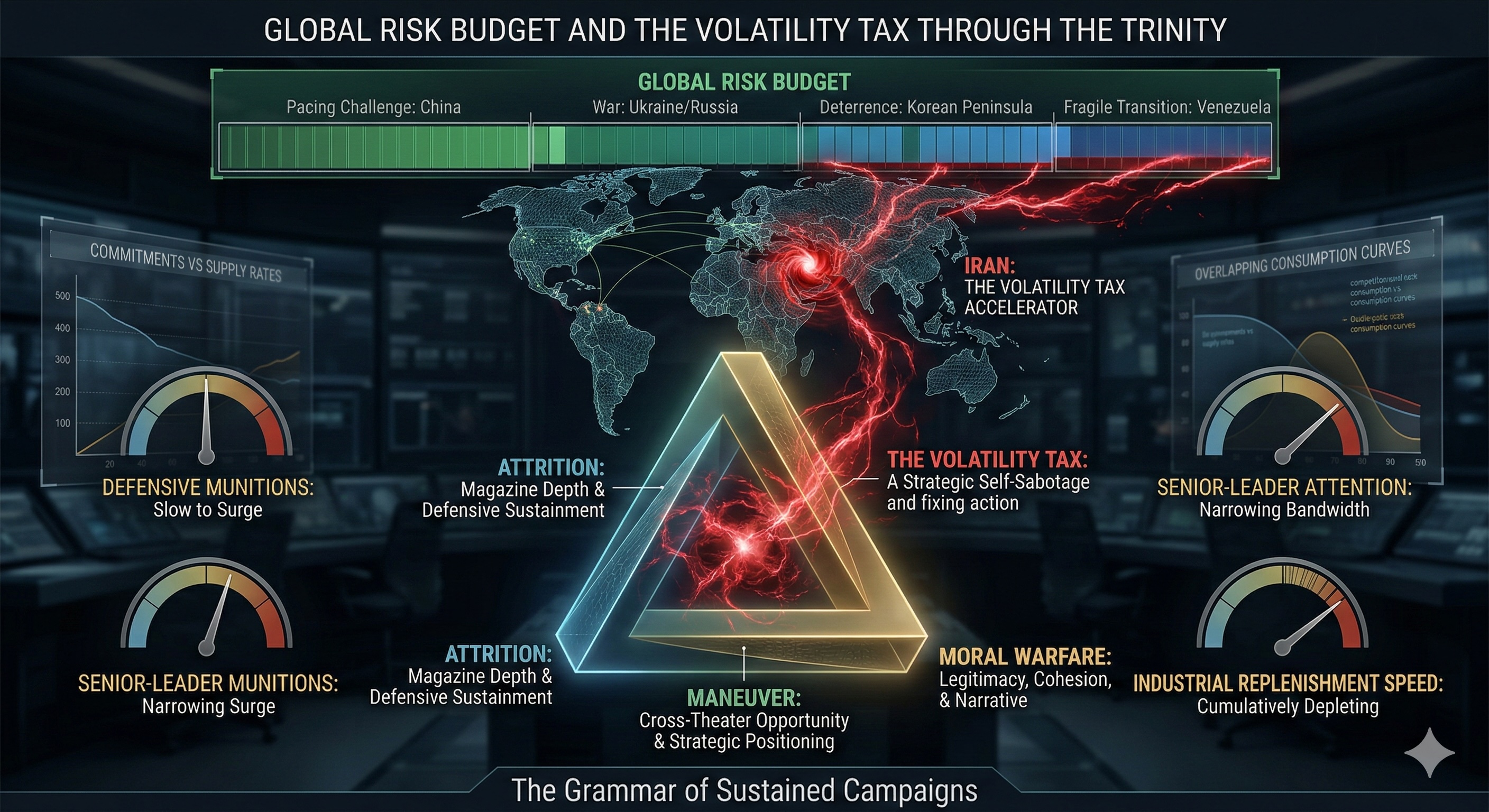
Attrition: Magazine Depth Is the Hidden Center of Gravity
Magazine Depth and the Defensive Munitions Trap
The most binding constraint is not strike capacity but defensive sustainment. Sustained operations against Iran—especially in the face of missile and drone reprisals—consume high-demand defensive interceptors and air-and-missile defense assets that are central to Indo-Pacific and European contingencies. Defensive munitions are expensive, slow to produce, and difficult to surge at wartime rates. If consumption outpaces replenishment, deterrence credibility erodes not only in the Middle East but globally.
This is the core asymmetry of the volatility tax: adversaries can impose disproportionate cost by forcing the United States to defend widely dispersed assets. Even absent “boots on the ground,” force protection, base defense, ISR, tankers, and electronic warfare assets become tied down. Those same enablers are precisely what would be required in a Taiwan contingency or to reinforce NATO’s eastern flank. The risk is not immediate defeat; it is cumulative depletion.
Recent reporting underscores that this is not theoretical. According to the Wall Street Journal, America’s top general warned the president that interceptor stockpiles would be a binding constraint in a prolonged campaign. U.S. forces are now racing to destroy Iran’s missile and drone forces before defensive inventories are depleted. As Stimson Center fellow Kelly Grieco put it bluntly, “We’re using them faster than we can replace them.” The same THAAD, Patriot, and Standard Missile interceptors being expended in the Gulf are required in South Korea and Guam to deter North Korea and China. Magazine depth is no longer an abstract planning factor; it is an operational clock.
Gen. David Petraeus once asked of Iraq, “Tell me how this ends.” The harder question in 2026 may be: tell me how this sustains.
Historical lens: why attrition logic punishes the expeditionary power
When the U.S. is pulled into open-ended operations, it does not just expend troops—it expends time, attention, and inventory. In Iraq and Afghanistan, the strategic bill was not only in casualties or dollars; it was in modernization opportunity costs and the slow erosion of readiness and stockpiles. Attrition in the Middle East has a unique way of becoming attrition against U.S. optionality.
This is also why “bombing to regime change” almost never works. Airpower can degrade and signal; it struggles to produce decisive political collapse unless a regime is already fracturing and there is a viable ground or political alternative. Political scientist Robert Pape’s work on coercive airpower is instructive: bombing succeeds when it threatens the opponent’s military strategy, not when it merely punishes infrastructure. Without that leverage, you drift into repeated strike cycles—punishment without decision, attrition without resolution.
Maneuver: Cross-Theater Opportunity Is the Real Battlefield Geometry
The Attention Constraint
Strategy runs on attention. Senior decision-makers can only manage so many high-intensity crises simultaneously before latency creeps into other theaters. When Iran escalates, planning cycles compress, diplomatic bandwidth narrows, and cross-theater coordination slows. Competitors do not need to launch major offensives to benefit. They can probe, posture, advance influence campaigns, or make incremental gains while Washington is absorbed.
Sun Tzu observed that “the supreme art of war is to subdue the enemy without fighting.” In a portfolio environment, competitors do not need to defeat the United States in open battle. They simply need it distracted.
This is maneuver warfare’s political cousin: not armored breakthroughs, but strategic positioning while the opponent is fixed. Iran’s volatility tax functions as a fixing action against U.S. global agility.
Ukraine as the Consumption Baseline
The war in Ukraine already represents a steady draw on Western munitions and industrial capacity. Supporting Kyiv is not episodic; it is a grinding logistics and production challenge. Introducing a sustained Iran campaign on top of that baseline compounds strain. Even if theaters are geographically distinct, the industrial base is not. Production lines for precision weapons, air defense interceptors, and advanced systems are finite and often fragile.
The risk is not simply “two wars.” It is overlapping consumption curves that outrun replenishment, creating a condition of multi-theater insolvency: commitments that exceed sustainable supply rates. Under such conditions, strategy becomes reactive rather than deliberate.
China remains the pacing challenge because it defines the force design problem. Indo-Pacific deterrence requires long-range fires, resilient command-and-control, maritime and air superiority capabilities, and deep magazines. Any campaign that materially degrades these enablers must be judged against the Taiwan scenario.
A bounded Iran operation—rollback of nuclear capability, delay of breakout timelines, coercive bargaining—may be acceptable if it preserves Indo-Pacific readiness. An unbounded campaign that drifts toward regime capitulation risks cannibalizing the very forces required to deter the larger contest. The volatility tax becomes strategic self-sabotage.
The Iraq and Afghanistan era offers the clearest recent example of this pattern. The mechanism was not battlefield defeat. It was strategic fixation. While the United States fought grinding campaigns, competitors gained space to modernize, expand influence, and harden regional advantages. That is maneuver by the adversary—enabled by distraction.
Moral Warfare: Legitimacy, Cohesion, and Narrative Are the Decisive Effects
Attrition drains inventories. Maneuver shifts posture. But campaigns ultimately turn on moral factors: legitimacy, cohesion, will, alliance unity, and credibility.
Venezuela offers a cautionary sidebar. The headlines faded, but the fragility did not. Following the January capture of Nicolás Maduro, interim President Delcy Rodríguez has consolidated control within the ruling apparatus while selectively releasing political prisoners and promising reform. Inflation remains high. Elections remain uncertain. Key security structures remain intact. The regime may be retreating, but it is not relinquishing power. That is transition without transformation.
The Venezuelan experience underscores a broader principle: the most dangerous phase of intervention is often not the initial strike but the after-phase. Removing a leader is an event. Building durable political order is a process. The former is fast. The latter is slow, contested, and resistant to airpower.
Kosovo is frequently cited as proof that coercive bombing can compel outcomes. But even there, bombing produced a political concession, not immediate regime collapse. Libya demonstrates the other moral warning: external force can help topple a regime without producing governance. Iraq’s “shock and awe” achieved rapid tactical dominance, yet the moral and political order that followed proved far more decisive than the opening strikes.
As T.E. Lawrence warned, “Do not try to do too much with your own hands.” Regime change is political architecture, not kinetic engineering.
Bombing your way to the capitulation of the current Iranian regime is historically thin. Coercive punishment may just as easily harden survival instincts, polarize elites, rally nationalism, and complicate coalition unity. Moral warfare cuts both ways.
Boundedness as Strategic Discipline Across the Trinity
Against this backdrop, the criteria for acceptability sharpen—not as bureaucratic guardrails, but as strategic control measures across the trinity.
First, bounded objective. The governing aim must be rollback or delay of nuclear capability—not rhetorical capitulation. Regime change expands the political requirement set beyond what limited air and maritime power can reliably achieve and increases the regime’s incentive to treat the conflict as existential.
Second, bounded duration. Campaign timelines must be explicit. Open-ended operations invite consumption creep and escalation by inertia, fixing U.S. posture and gifting maneuver space to competitors.
Third, explicit non-consumption. Certain capabilities—Indo-Pacific long-range fires, key air-defense inventories, NATO reinforcement assets—must be designated as reserved and protected. Strategy requires not only deciding what to use, but what to withhold.
Empires rarely collapse from losing battles. They erode from losing balance.
The Sustainability Question: When Does the Risk Portfolio Break?
How long can the United States sustain volatility taxes of this sort? Only as long as consumption rates remain below industrial replacement rates and coalition cohesion holds. When those curves invert, time favors competitors. The United States can absorb short, sharp campaigns. It struggles when operations become chronic drains.
The Iran question therefore cannot be reduced to tactical success. The true metric is whether the campaign preserves strategic solvency across attrition, maneuver, and moral domains.
Can defensive inventories be sustained without hollowing deterrence elsewhere?
Does Iran fix U.S. posture while competitors gain advantage in the Indo-Pacific and Europe?
Does the campaign preserve legitimacy, alliance unity, and credible off-ramps—or drift into existential narratives that harden resistance?
If the campaign degrades nuclear timelines while safeguarding Indo-Pacific and European deterrence, it fits within the risk budget. If it metastasizes into a protracted coercive effort with ambiguous political ends, it recreates the Iraq effect in contemporary form: not occupation necessarily, but distraction, depletion, and opportunistic advancement by rivals.
Conclusion: Strategy as Portfolio Management Under the Trinity
Great-power strategy in 2026 resembles portfolio management under scarcity. The United States faces a pacing challenger in China, an active war in Europe involving Russia, a volatile Korean Peninsula, and fragile transitions in the Western Hemisphere. In such an environment, every additional conflict must be evaluated not only for its intrinsic merits but for its opportunity costs.
The measure of success is not whether Iran absorbs punishment. It is whether the United States emerges with its global deterrence posture intact—in inventory, in positioning, and in legitimacy.
That is the difference between coercion as discipline and volatility as self-inflicted attrition.
 Mastermind Century Group