

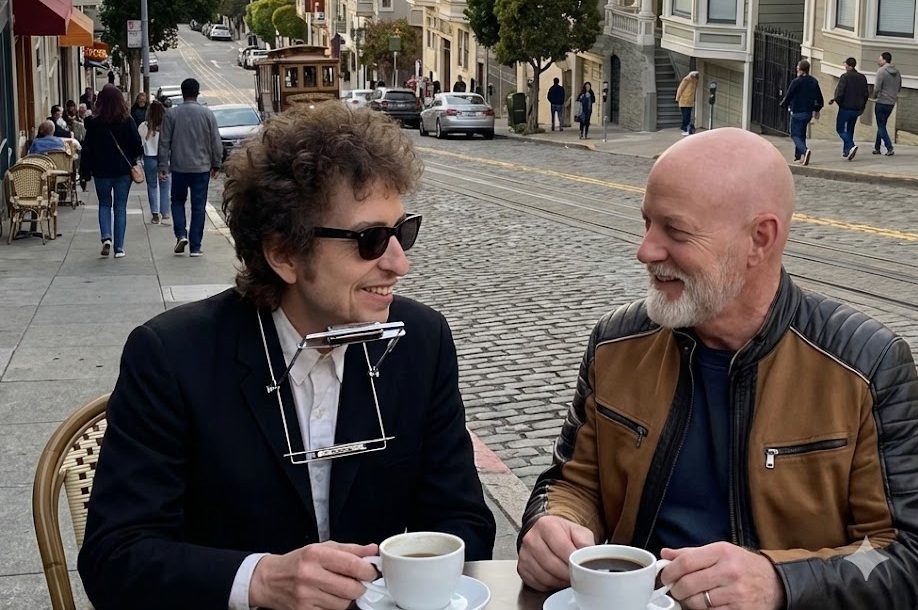
I listen to a lot of Bob Dylan–I totally understand, it’s old, but it’s enduring. There is a through-line that runs through several songs from All Along the Watchtower through No Time to Think, Political World, and Everything Is Broken, and arrives—quietly, defensively, and almost against its own will—at Most of the Time. Or maybe it’s the whiskey….
It is really not a political argument in the narrow sense, nor a protest against particular leaders or policies. It is something more unsettling: a diagnosis of moral and cognitive collapse experienced not as crisis but as environment.
In Watchtower, the collapse is sensed before it is understood. The song opens in medias res, with figures who know that something is wrong but cannot locate either its origin or its resolution. There is no beginning, no end—only the awareness that time is short and that the structures meant to provide meaning—trade, authority, reason itself—no longer cohere.
No Time to Think sharpens this condition by introducing a crucial intermediary stage: not ignorance, but saturation. The problem is no longer lack of awareness; it is the impossibility of reflection. Information pours in, demands accumulate, obligations multiply, and the inner life is crowded out by motion. Thought itself becomes a liability, something there is literally no time for. Where Watchtower captures the moment of dawning unease, No Time to Think captures what happens next: the conversion of unease into distraction, the channeling of anxiety into activity, the substitution of busyness for judgment.
By the time Dylan reaches Political World, that condition has hardened into recognition. Power has become detached from love, rules from justice, and speech from truth. This is not corruption as deviation but corruption as operating system: a world in which cruelty is normalized, innocence is punished, and moral language survives only as parody.
Everything Is Broken widens the lens further still. The failure is no longer confined to politics or leadership; it has metastasized into language, relationships, memory, and meaning. Things do not merely fail—they fail to connect. The song’s relentless inventory suggests not apocalypse but entropy, the slow unmaking of coherence itself. Taken together, these songs do not describe a society on the brink of collapse so much as one that has already crossed the threshold and learned how to live there.
What makes this arc compelling—and uncomfortable—is that it refuses both nostalgia and remedy. There is no implied return to a golden age, no faith that exposure alone will bring reform. Dylan is not offering protest; he is offering orientation. The posture is closer to prophecy than politics, though stripped of prophecy’s consolations. The prophet here does not promise redemption. He stands at a distance, naming what is, aware that naming alone does not heal.
This is why Most of the Time, often read as a personal love song or a moment of emotional retreat, belongs fully within this sequence rather than standing apart from it. Where the earlier songs describe external breakdown and cognitive overload, Most of the Time turns inward and reveals the psychological mechanism that allows that breakdown to persist without revolt. The refrain is not confidence but containment. “Most of the time” signals a form of managed self-deception—an admission that clarity exists, but only intermittently, and that life continues by keeping that clarity at bay. The narrator (Bob) insists he is unaffected, untroubled, unmoved—but the insistence itself betrays fragility. The song does not contradict the diagnosis of collapse; it completes it. A broken world does not survive on despair alone. It survives because individuals learn how to function inside contradiction, how to tell themselves partial truths that are sufficient for endurance if not for transformation.
Read this way, Dylan’s late-modern worldview is neither nihilistic nor reformist. It is diagnostic. The danger he identifies is not sudden catastrophe but paralysis—activity without progress, speech without hearing, motion without reflection. No Time to Think becomes the fulcrum of this diagnosis: the moment when the capacity for judgment is crowded out by velocity, when moral agency is not crushed but starved. People talk incessantly, bargain endlessly, posture morally, yet nothing fundamentally changes. This is collapse rendered stable. It is the condition in which systems no longer need to be defended because they no longer need to be believed; they persist through habit, distraction, and exhaustion. The watchtower remains manned, but it is too late to warn anyone. The political world hums along, emptied of love but rich in incentives. Everything is broken, yet nothing quite stops. And most of the time, we tell ourselves we are fine. The brilliance—and the discomfort—of this sequence lies in its refusal to flatter the listener. There is no outside vantage point from which to condemn the system without also implicating the self. The same evasions that keep the narrator upright in Most of the Time are the ones that allow the political world to remain intact despite its hollowness. Self-deception is not merely personal; it is functional. It keeps the machinery running.
Seen together, these songs form a single meditation on what it means to live after moral certainty has collapsed but before meaning has been rebuilt—if it ever will be. They trace a progression from unease, to saturation, to normalization, to psychological accommodation. The tragedy Dylan sketches is not that the world breaks, but that people adapt to its brokenness so thoroughly that repair no longer feels imaginable. What remains is a thin, resilient illusion: that reflection can be postponed, that truth can be rationed, that one can live well enough by being honest only intermittently. Most of the time.
 Mastermind Century Group