

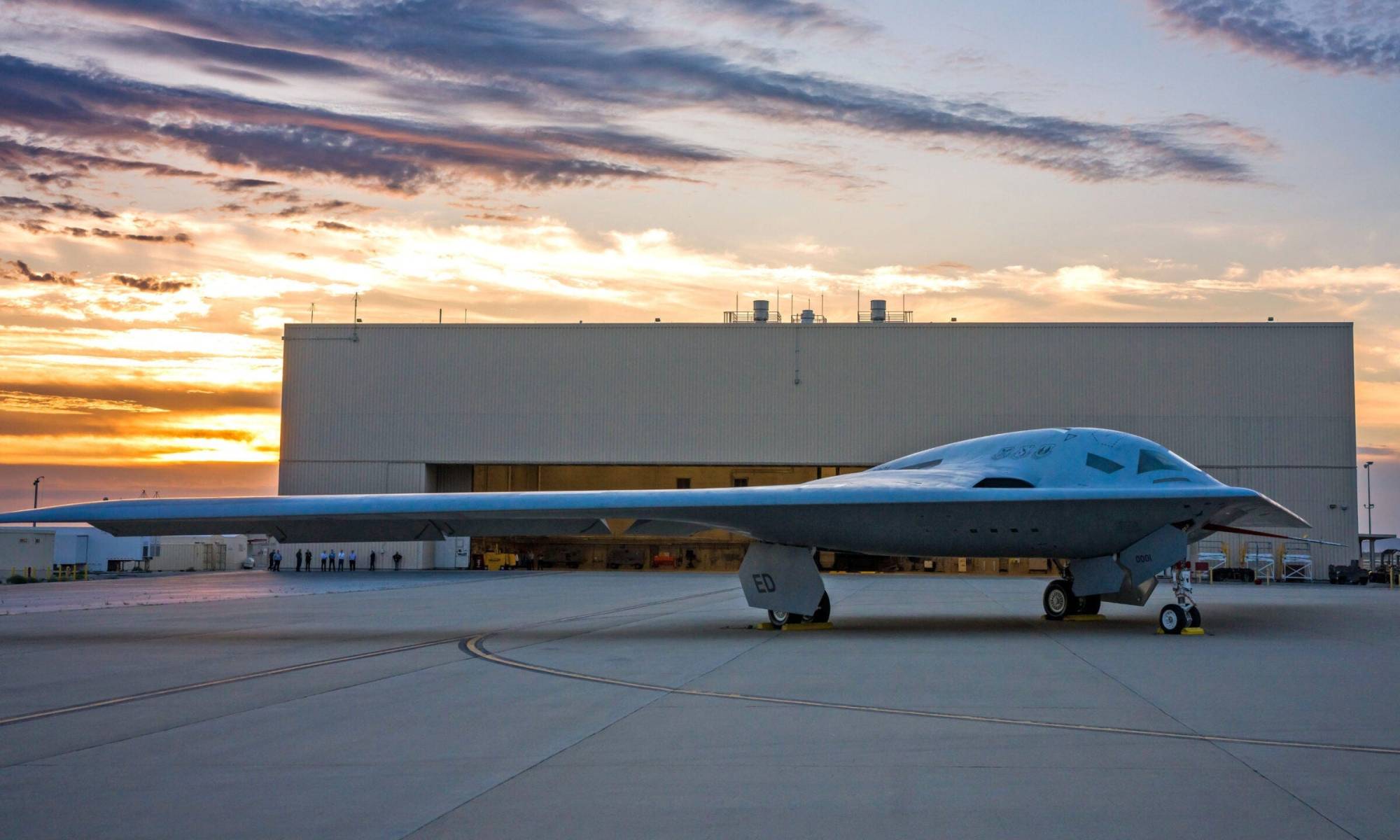
In a hardened shelter at a forward operating location in the Indo-Pacific, a B-21 Raider crew runs through final pre-flight checks. The mission is straightforward by contemporary standards: penetrate contested airspace and neutralize a critical node in an adversary’s anti-access network. The aircraft—stealthy, networked, and exquisitely lethal—represents the apex of American airpower.
The mission is scrubbed.
Not by enemy fighters or missiles, but by a cascading set of non-kinetic failures. A commercial cloud outage freezes a logistics system supporting the strike package. Data links degrade as undersea cables in the region go dark following a “maritime accident.” An AI-enabled targeting system begins producing corrupted outputs, likely poisoned months earlier. Then comes the political shock: host-nation approval evaporates after a deepfake video ignites domestic unrest.
The bomber remains on the ramp—intact, lethal, and strategically irrelevant.
This is not a futuristic fantasy. It is a plausible portrait of modern conflict—and a warning. The United States has unmatched platforms, but it no longer possesses a clear theory of victory suited to a world where power flows through data, infrastructure, and cognition rather than massed formations and firepower.
The Platformer’s Paradox
The U.S. military, and especially the Air Force, is doubling down on exquisite platforms: the B-21, Next Generation Air Dominance, Collaborative Combat Aircraft. These systems are defined not only by performance, but by dependence—on data fusion, cloud computing, AI, and global connectivity.
This creates what might be called the Platformer’s Paradox: the more advanced and networked a system becomes, the more vulnerable it is to disruptions beyond the battlespace. Lethality increasingly depends on commercial infrastructure the Department of Defense does not own, cannot fully defend, and does not control.
Current operational concepts acknowledge this reality—but stop short of addressing it strategically. Multi-Domain Operations recognizes interdependence but offers no theory of how systems collapse. Agile Combat Employment improves survivability through dispersal, yet assumes adversary targeting cycles remain slower than ours—a dangerous assumption in an AI-accelerated environment.
These concepts optimize how we fight. They do not explain how we win.
A Forgotten Lesson from American Airpower History
This is not the first time American strategists have confronted such a dilemma. In the 1930s, a small group of officers at the Air Corps Tactical School (ACTS) asked a radical question: What if victory did not require destroying armies, but collapsing the systems that sustained them?
Their answer—the industrial web theory—reframed war as a problem of systems disruption rather than battlefield attrition. Industrial nations, they argued, were fragile networks of interdependence. Strike the right nodes, and the system would fail.
Early applications were costly and imperfect. The Schweinfurt ball-bearing raids nearly broke the bomber force—not because the theory was wrong, but because the node was misidentified. Germany adapted. Substitutions emerged. Resilience proved higher than anticipated.
Then came the strategic oil campaign.
Synthetic fuel plants were non-substitutable. Persistent, focused attacks did not defeat German forces directly; they immobilized them. Aircraft sat idle. Tanks moved by horse and cart. The system collapsed from within.
The lesson was clear: strategy succeeds or fails on target selection grounded in ruthless systems analysis.
From Industrial Webs to Digital–Cognitive Systems
The contemporary equivalent of the industrial web is not physical manufacturing alone. It is a digital–cognitive web, with three interdependent pillars:
- Semiconductors – the strategic material of the 21st century
- Digital infrastructure – data centers and undersea cables
- Cognition – trust, perception, and political will
These are not abstract economic concerns. They are operationally decisive.
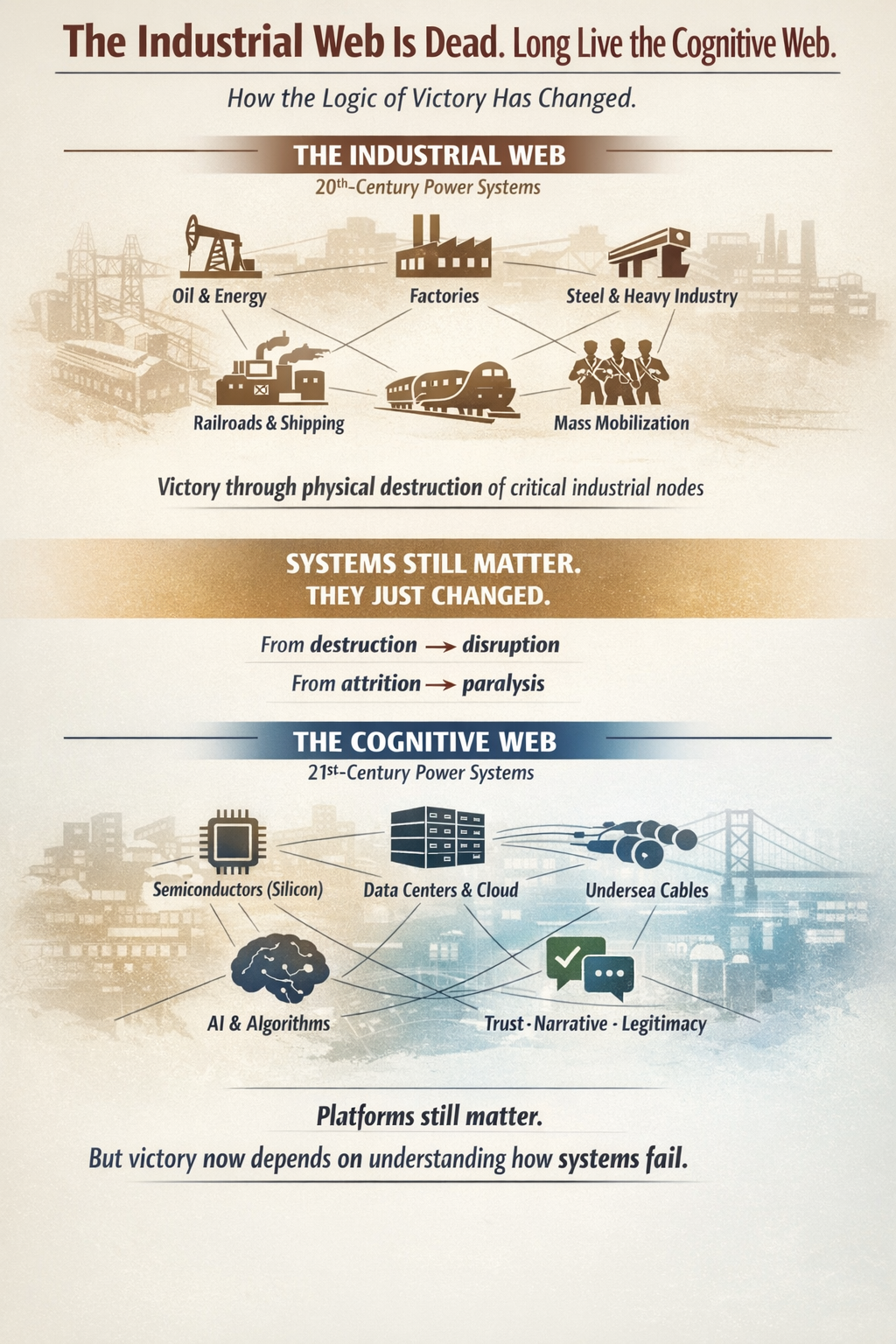
Semiconductors underpin every advanced military system. Their production is concentrated in a handful of geographic and technological chokepoints. Disruption would halt weapons production, degrade AI capabilities, and cripple modernization overnight.
Data centers and undersea cables are the factories and railroads of the information age. Over 99 percent of global data flows through cables resting, unprotected, on the seabed. Cloud infrastructure—now integral to command and control—has demonstrated single-point vulnerabilities capable of global disruption without a single shot fired.
And then there is cognition.
Trust—within societies, between allies, in institutions—has become a non-substitutable fuel for democratic power. Without it, decision-making stalls, alliances fracture, and escalation becomes politically impossible. Artificial intelligence has weaponized this domain at scale: deepfakes, narrative manipulation, and precision-targeted disinformation now operate continuously, below the threshold of armed conflict.
These domains are not separate. They reinforce one another. Cognitive disruption can alter export policy. Semiconductor shortages degrade digital infrastructure. Infrastructure failures amplify political instability. The system is recursive—and fragile.
Victory Without Battle
Here lies the uncomfortable truth: modern conflict increasingly favors actors who can paralyze rather than destroy.
Strategic success may not come from defeating an adversary’s military forces, but from rendering them unusable—politically constrained, informationally blind, logistically frozen, and cognitively disoriented.
This is not a call for mirror-image information warfare. It is a recognition that strategy must account for how systems fail, not merely how platforms perform.
The danger is not that adversaries understand this logic. They already do. The danger is that we continue to organize, invest, and educate around industrial-era assumptions while fighting in a digital-cognitive reality.
The Institutional Gap
Historically, the Air Corps Tactical School existed to solve precisely this kind of problem. It was not a training center; it was an intellectual engine. Officers were given time, space, and license to think heretically—yet loyally—about the nature of future war.
Today, that function is fragmented. Wargames explore possibilities but lack unifying theory. Doctrine reacts to technology rather than shaping its strategic use. Professional military education teaches domains but rarely integrates them into a coherent theory of victory.
What is missing is not talent or effort, but mandate.
A 21st-century equivalent of ACTS is required—not to replicate strategic bombing theory, but to recover the habit of deep systems thinking. Its mission would be to map the digital-cognitive web, identify true chokepoints, test assumptions through wargaming, and translate insight into doctrine, education, and strategy.
Why This Matters Beyond the Military
This challenge is not uniquely military.
Corporations depend on the same digital infrastructure. Democracies rely on the same cognitive foundations. Supply chains, financial systems, and public trust now form a shared strategic terrain.
The question facing leaders—military, political, and corporate—is no longer simply how to optimize performance, but how to ensure systemic resilience in an era where disruption is cheap, deniable, and continuous.
Platforms still matter. Deterrence still matters. But without a theory of victory suited to the systems that actually govern power today, they risk becoming artifacts of a bygone era—impressive, expensive, and insufficient.
The Real Strategic Imperative
The B-21 on the ramp is not a failure of engineering. It is a failure of strategy. The industrial web once defined how nations rose, fought, and fell. Steel, oil, factories, and rail lines formed the backbone of power, and victory came from collapsing those systems faster than an adversary could adapt. That world is gone. What has replaced it is a cognitive web—a tightly coupled system of silicon, data, infrastructure, and human perception in which disruption travels faster than destruction and paralysis can be more decisive than firepower. In this environment, platforms remain necessary but insufficient. Without a theory of victory grounded in how digital–cognitive systems actually fail, even the most advanced military risks strategic irrelevance. The task ahead is not to abandon power, but to rethink it—to recover the intellectual courage once shown by earlier strategists who dared to look past the battlefield and see the system beneath it. The industrial web is dead. Long live the cognitive web.
 Mastermind Century Group