


As a squadron commander, I spent countless hours with our team in Air Operations Centers around the world, developing strategy, writing operational plans, wargaming, and wrestling with the ambiguity that defines modern conflict. We were serious about our craft—so much so that we garnered a nickname: The Masterminds. It wasn’t a boast, but a reflection of how deliberately we tried to outthink our adversaries.
I was always searching—scanning doctrine, devouring leadership books, hunting for any edge to help us think better, faster, and more creatively. One day, one of our majors, a sharp and relentlessly curious officer, walked into the office and dropped a small, worn book on my desk. “Sir, I think you’ll appreciate this,” he said.
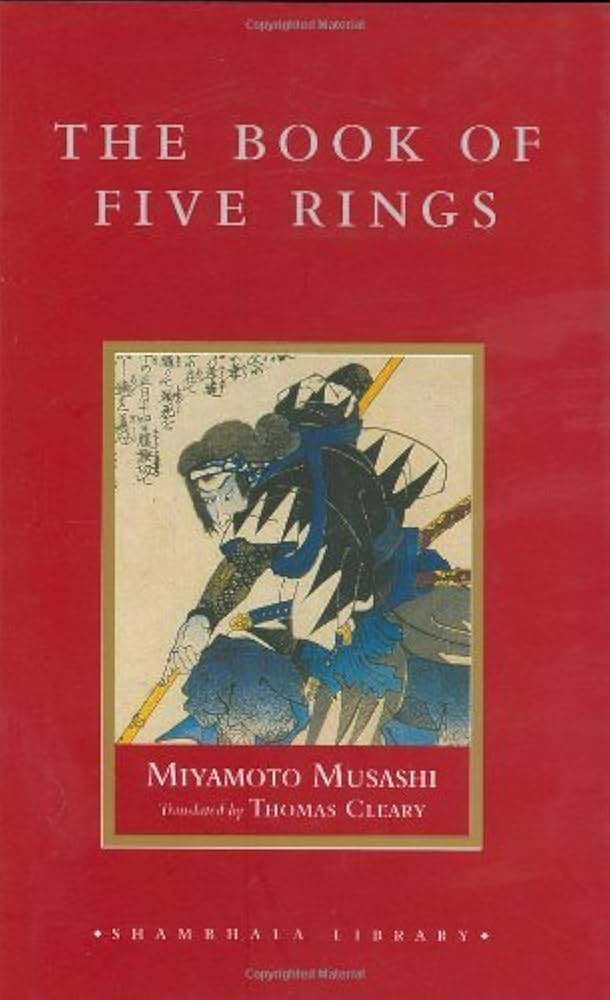
The book was short, cryptic, and oddly structured. It wasn’t Clausewitz. It wasn’t a Joint Publication. It was The Book of Five Rings by Miyamoto Musashi—a 17th-century Japanese swordsman, philosopher, and rōnin (a masterless samurai who lived and fought outside the traditional feudal system). I read it quickly. At first, it didn’t click. The metaphors were strange. The tone was minimalist.
But then something happened.
As we deployed to support operations across multiple theaters, from kinetic strikes to partner-building efforts, Musashi’s words began to take root. In the chaos of real-world operations—in the ambiguity of global strategy—I began to see what he was saying. He wasn’t just talking about sword fighting. He was talking about strategy as a way of being. And that changed everything.
What follows is not a book review. It’s a reinterpretation—an attempt to translate Musashi’s elemental philosophy into a framework for Department of Defense leadership and national security strategy in an age of uncertainty.
Miyamoto Musashi (c. 1584–1645) was not merely a legendary swordsman. He was a philosopher of war, an artist, a strategist—and perhaps one of the earliest proponents of what we today call “multidomain thinking.” Though he is best remembered for his undefeated record in over sixty duels, Musashi’s legacy reaches far beyond the battlefield. In the twilight of his life, he retreated to a cave in Kyushu and wrote Go Rin No Sho (The Book of Five Rings), a treatise that has become essential reading not only in martial arts but in leadership, business, and now, national security.
Today, in an era of persistent gray zone conflict, multidomain operations, and rapidly accelerating technological change, Musashi’s fivefold framework offers a powerful lens for understanding the strategic challenges facing the DoD. The elements—Earth, Water, Fire, Wind, and Void—serve not only as metaphors for combat, but as elemental principles for resilient, adaptive, and future-ready leadership.
Musashi the Warrior-Philosopher
Musashi was born into a samurai family and began fighting at an early age. At 13, he reportedly killed a grown man in his first duel. Over time, he developed the Niten Ichi-ryū (“Two Heavens as One”) sword style, wielding both the katana and wakizashi simultaneously—a bold departure from the orthodoxy of the time. Musashi’s unorthodox style was grounded in real-world experience, not inherited dogma. This is key: Musashi was not a traditionalist. He was a tactician of fluidity, a disrupter who saw form as a guide, not a constraint.
His Book of Five Rings, written in 1645, is divided into five elemental books:
- Earth (Chi) – Foundation and discipline
- Water (Mizu) – Flexibility and responsiveness
- Fire (Hi) – Conflict and initiative
- Wind (Fū) – Competitive intelligence
- Void (Kū) – Intuition and innovation
These five elements offer a conceptual framework for analyzing contemporary defense leadership and strategic practice within the Department of Defense.
Earth (Chi): Foundation, Doctrine, and Discipline
“In strategy it is important to see distant things as if they were close and to take a distanced view of close things.” — Musashi
Earth is the most literal of the five. It is the terrain, the ground you stand on, the doctrine that organizes your thinking. For the DoD, Earth represents the institutional foundation—doctrine, organizational structures, ethical frameworks, and force design. Without a coherent Earth, no amount of tactical agility will suffice.
Strategic Translation:
This is where we locate concepts like Integrated Deterrence, the foundational concept tying together military, economic, cyber, and diplomatic tools into a cohesive posture. It also includes the values-based leadership taught across PME institutions and embodied in joint publications like JP 1.
Leadership Implication:
Leaders must be grounded in the mission and able to articulate a compelling “why.” Just as Clausewitz spoke of Zweck(purpose) in war, Musashi’s Earth is about clarity of intention and principled execution. Without it, tactical brilliance is wasted effort.
Warning from Musashi:
If your foundation is misaligned or outdated, no tactics or weapons will save you. Organizations that rely too heavily on outdated paradigms collapse under modern pressures.
Water (Mizu): Flexibility, Jointness, and Adaptation
“Water adopts the shape of its container. In the same way, a warrior must be flexible.” — Musashi
Water flows, adapts, and finds the path of least resistance. In today’s defense environment, Water represents jointness, interoperability, and the agility to respond across domains. It represents the ability to move forces quickly, integrate across services, and shift focus as the environment demands.
Strategic Translation:
Initiatives like JADC2, Agile Combat Employment, and Special Operations Forces’ global posture all reflect the water principle—modularity, decentralization, and rapid adaptability.
Leadership Implication:
DoD leaders must foster cultures that value speed, collaboration, and mission command. Organizational rigidity is a liability. Leaders must encourage decentralized execution and multi-functional integration.
Void Check:
Are our processes over-structured? Are our teams unable to pivot? Water warns against bureaucratic inertia, especially in the face of cyber threats, AI disruption, and adversaries who move faster than traditional planning cycles allow.
Fire (Hi): Tempo, Conflict, and Seizing the Initiative
“The way of the warrior is resolute acceptance of death.” — Musashi
Fire is the essence of conflict. In the Five Rings, Fire is not just destruction—it is initiative, tempo, and the controlled application of force. Fire is what drives tempo in the Boydian sense—it is the control of the OODA loop, the ability to dictate the pace of engagement.
Strategic Translation:
Fire is found in operational art, campaign planning, and lethality. Concepts like Mosaic Warfare, overmatch, and multi-domain fires are expressions of Fire: complex, tempo-driven, and meant to disorient and overwhelm.
Leadership Implication:
The strategic leader must not only respond quickly but act preemptively. Musashi teaches that one must strike before the opponent has decided to act. In military parlance, this is left-of-boom operations and proactive shaping of the battlespace.
Musashi’s Warning:
Do not confuse recklessness with boldness. Fire must be disciplined and purposeful. Aggression without clarity becomes self-defeating.
Wind (Fū): Competitive Intelligence and Strategic Awareness
“Know your enemy, know his sword.” — Musashi
Wind is about knowing the techniques, cultures, and strategies of others. Musashi critiques competing schools not to belittle them, but to understand their worldview. For today’s strategic leader, Wind is intelligence, red teaming, cross-cultural awareness, and adversary emulation.
Strategic Translation:
Understanding China’s Unrestricted Warfare doctrine, Russia’s reflexive control, or the hybrid warfare tactics of non-state actors—these are Wind disciplines. So are the efforts of the Defense Intelligence Enterprise, the
Minerva Research Initiative, and PME institutions that teach adversary-centric war gaming.
Leadership Implication:
Do not operate in a vacuum. A failure to understand adversary intent, culture, and doctrine is a failure to prepare. Empower dissent, avoid echo chambers, and cultivate humility.
Caution:
Musashi warns against assuming your way is best because it is familiar. Wind calls leaders to cultivate strategic empathy and resist intellectual insularity.
Void (Kū): Innovation, Intuition, and Strategic Foresight
“By knowing things that exist, you can know that which does not exist.” — Musashi
Void is the most elusive and profound of the elements. It is not emptiness, but pure awareness—the capacity to act without hesitation, to see emerging patterns before they are visible, to anticipate without overthinking.
Strategic Translation:
Void is futures literacy, emergent technology adoption, and cognitive dominance. It includes early investments in AI, quantum, and biotech. It includes Project Maven, the DARPA AI Futures Office, and AU’s ALPHA BLUE—initiatives born not from current needs but from strategic intuition.
Leadership Implication:
Musashi’s Void demands leaders who are not only well-informed but future-minded. They must tolerate ambiguity, act decisively amid uncertainty, and cultivate “weak signal” detection.
Musashi’s Warning:
The Void cannot be systematized. Bureaucracy often kills the void by demanding certainty where there is only flux. To lead from the void is to accept risk—and potential greatness.
A Strategic Operating System
When combined, Musashi’s elements form a holistic operating system for defense leadership and national strategy:
| Element | Function | Example in DoD |
| Earth | Foundation & Doctrine | JP 1, Integrated Deterrence |
| Water | Agility & Jointness | JADC2, ACE, SOF |
| Fire | Tempo & Lethality | Mosaic Warfare, Overmatch |
| Wind | Competitive Awareness | Red Teaming, Intelligence |
| Void | Innovation & Intuition | DARPA, ALPHA BLUE, Futures Planning |
The genius of Musashi’s system is that none of these elements operate in isolation. Just as a great swordsman flows between stance, strike, and space, the great strategist blends Earth’s discipline, Water’s flexibility, Fire’s momentum, Wind’s awareness, and Void’s insight.
Conclusion: The Way is in the Training
In The Book of Five Rings, Musashi writes, “You must understand that there is more than one path to the top of the mountain.” This ethos—humble, rigorous, and open to innovation—is perhaps what the Department of Defense most needs today.
As strategic competition with peer and near-peer adversaries intensifies, as the speed of change outpaces traditional acquisition and doctrine cycles, and as emerging technologies transform the character of war, Musashi reminds us that victory is not won by size, firepower, or orthodoxy alone. It is won by adaptability. By mastery. By knowing yourself, your enemy, and the terrain—and then transcending all three.
The modern strategist would do well to study the old swordsman. In an age of satellites, semiconductors, and cyber strikes, it turns out that the path of the blade still has something to teach us.
 Mastermind Century Group