

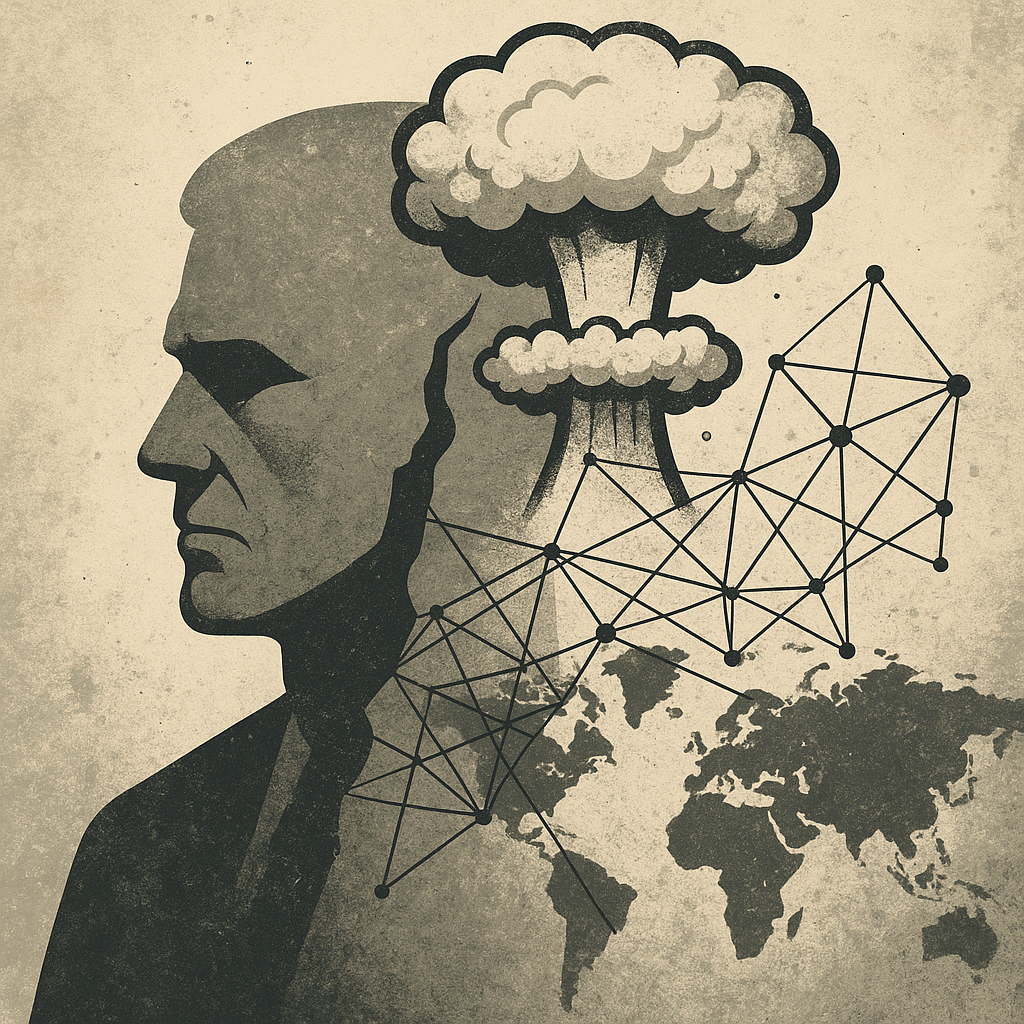
In the evolving landscape of twenty-first-century conflict, traditional domains of warfare—land, sea, air, space, and even cyber—are now accompanied by a more elusive and insidious front: the human mind. Dubbed “cognitive warfare,” this emerging domain does not target physical infrastructure or conventional forces, but the very frameworks individuals and societies use to perceive, interpret, and act upon the world. It is warfare waged through disruption of beliefs, manipulation of perceptions, and fragmentation of shared reality.
In many ways, this is not a new form of war but the most elemental: a struggle over meaning, attention, and decision.
Few thinkers anticipated this shift with as much prescience as Colonel John Boyd, the American Air Force officer and strategist whose work has often been condensed to the now-famous OODA Loop (Observe, Orient, Decide, Act). Yet Boyd’s intellectual contribution far exceeds tactical agility or air combat maneuvering. His 1976 paper “Destruction and Creation,” a dense but profound exploration of epistemology, systems theory, and cognition, offers a deep foundation for understanding and countering cognitive warfare. In fact, Boyd provides what might be the most robust pre-digital framework for mental adaptability and survival in an environment of uncertainty and manipulation.
What Is Cognitive Warfare?
Cognitive warfare refers to the deliberate targeting of human perception, reasoning, emotion, and behavior in order to shape decisions, erode trust, and fracture collective will. It blends influence operations, psychological operations, information warfare, and behavioral science into a cohesive strategy designed not to dominate terrain but to dominate thought. Unlike propaganda, which seeks to persuade, or cyber attacks, which target digital systems, cognitive warfare is about degrading or reshaping the interpretive systems—the mental models—of individuals and societies.
This form of conflict thrives on ambiguity, misinformation, deepfakes, information saturation, narrative disruption, and memetic engineering. It turns attention into a battlefield and orientation into a vulnerability. Nations, non-state actors, and even loosely affiliated networks can now influence outcomes by engineering confusion, fostering mistrust, and accelerating social entropy. The goal is not always to convince or conquer but to destabilize the ability to coherently decide and act.
NATO and various defense think tanks now regard cognitive warfare as a “sixth domain” of warfare. It is persistent, non-kinetic, and often deniable. And its effectiveness hinges not on superior firepower but on an adversary’s inability to maintain internal coherence—that is, on the collapse of orientation.
Boyd’s Orient Phase: The Crux of Cognitive Warfare
At the heart of Boyd’s OODA Loop lies the most misunderstood but most important phase: Orient. While “Observe, Decide, Act” are relatively intuitive, the Orient phase encompasses all the prior experiences, cultural traditions, genetic inheritance, new information, and analytical processes we use to make sense of what we see. Orientation is the seat of sense-making. It is not a passive process; it is active, iterative, and deeply vulnerable.
Boyd argued that agility—strategic or tactical—depended on the ability to reorient faster than an opponent. That is, not just to act quickly, but to rethink quickly. In a cognitive warfare environment, it is this orientation phase that is most persistently targeted: through misinformation (polluting inputs), narrative warfare (reshaping interpretive frames), and digital manipulation (hijacking salience and attention).
In cognitive warfare, the enemy isn’t merely seeking to slow your decisions—they’re trying to corrupt your capacity to understand what you’re even deciding about. The faster you can destroy compromised mental models and create new ones matched to reality, the more resilient you are to this form of warfare.
This is precisely what Boyd outlines in “Destruction and Creation.”
Destruction and Creation: A Dialectic Engine of Thought
In his 1976 essay, Boyd lays out a logic for adaptive cognition. He explains that individuals and societies use mental models—”concepts of meaning”—to make sense of an ever-changing environment. But when the environment shifts rapidly, those models must be dismantled and rebuilt. Boyd describes this as a process of destructive deduction followed by creative induction.
This is not merely philosophical. It is a call to strategic cognition. When old ideas no longer match new observations, they must be torn down. In their place, through the synthesis of new patterns and connections, more useful models emerge. This unstructuring and restructuring cycle is what enables an individual or organization to remain coherent and effective in complex and chaotic conditions.

Boyd references Kurt Gödel (incompleteness), Werner Heisenberg (uncertainty), and the Second Law of Thermodynamics (entropy) to demonstrate that any closed system of thought will eventually become inconsistent or mismatched to reality. The answer is not dogma, but adaptation. The mind must remain an open, dynamic system—constantly engaged in the cycle of destruction and creation.
This is precisely the cognitive capacity under attack in modern cognitive warfare. The goal is to trap the adversary in outdated or false mental models, or overwhelm them with so much contradictory information that they are paralyzed. Boyd offers an antidote: foster mental agility through active unlearning and deliberate model reconstruction.
Cognitive Warfare and the Corruption of Orientation
Consider how misinformation and disinformation campaigns operate today. They rarely rely on convincing arguments. Instead, they overload the system: too much information, conflicting data, viral falsehoods, and emotionally manipulative narratives. This creates cognitive fatigue, disorientation, and fragmentation.
In Boydian terms, these attacks are not directed at decision-making directly, but at the substrate of decision-making: orientation. Once orientation is corrupted, all subsequent actions are misaligned, mistimed, or meaningless.
Social media platforms, AI-generated content, and algorithmic echo chambers exacerbate this vulnerability. They accelerate the entropy Boyd warned about. The challenge is no longer just to process information but to discern what is worth integrating, what must be discarded, and what mental models are being implicitly reinforced.
Boyd’s Legacy as Strategic Countermeasure
Boyd never used the term “cognitive warfare.” But he mapped its terrain better than anyone of his era. He understood that the key to survival and success in competitive environments is not superior weapons, but superior adaptability of thought.
His model asks leaders and strategists to think recursively: to observe not just the world, but how they themselves are observing. To constantly challenge the orientation layer—the most subjective, fragile, and yet decisive element in the OODA loop.
In this way, Boyd’s work is not only a diagnostic tool for understanding how cognitive warfare operates, but a prescriptive guide for how to resist it:
- Destroy outdated or externally-imposed mental models;
- Create new, reality-matched frameworks through synthesis;
- Keep mental and institutional systems open, reflective, and adaptive;
- Outpace the adversary’s capacity to disrupt your orientation.
Conclusion: A New Boydian Frontier
As warfare expands into the cognitive domain, John Boyd’s legacy grows more relevant, not less. Destruction and Creation offers a philosophical engine for maneuvering in thought, just as Patterns of Conflict offered one for maneuvering in war.
Cognitive warfare is here to stay. But Boyd reminds us that the human mind—when trained to adapt, when unafraid to destroy its own certainties—is the most agile weapon of all. In a world of contested narratives and informational entropy, the capacity to think clearly, to reorient swiftly, and to act decisively is not merely strategic advantage—it is survival.
For modern military education, leadership development, and institutional reform, this insight is profound: the future does not belong to those who cling to fixed doctrine, but to those who master the art of destruction and creation.
 Mastermind Century Group