

| May the 4th Celebration, 2025
A Galaxy Far, Far Away—and Closer Than We Think
Maybe I read too much into Star Wars–but every year on May the 4th, fans around the world come together to celebrate one of the most powerful myths of the modern era: Star Wars. It is more than just a film series; it is a cultural phenomenon that has shaped storytelling, imagination, and even political thought for generations.
George Lucas’ creation is a towering achievement of world-building. It draws together ancient myth, futuristic visions, and deep political allegory into a saga that feels timeless. The universe he built is sprawling and diverse, yet personal and intimate — at its heart, it remains a deeply human story of ambition, betrayal, hope, and redemption.
This May, the anniversaries of two key films invite special reflection. The Empire Strikes Back — widely regarded as one of the greatest sequels in cinematic history — turns 45 years old in 2025. Revenge of the Sith, the climactic end of Lucas’ prequel trilogy, marks its 20th anniversary. Together, these films bookend (almost) the great tragedy at the heart of the Star Wars saga: the fall of Anakin Skywalker and the rise of Emperor Palpatine.
Amid the thrill of lightsaber duels and epic space battles, it is Palpatine who defines the darker philosophical core of Star Wars. His slow, methodical rise is not just the story of a galaxy lost to tyranny—it is a meditation on how free societies fall, how corruption festers from within, and how republics, more often than not, die with thunderous applause.
The Arc of Palpatine: Master of Shadows and Deception
Palpatine’s story is one of the most carefully constructed arcs in cinematic history, stretching from the earliest moments of The Phantom Menace (1999) through Revenge of the Sith (2005) and culminating in Return of the Jedi (1983). Yet, as Ian McDiarmid, the actor behind the Emperor, recently reflected, this master plan was not fully mapped out when he first donned the robes.
In a recent interview commemorating Revenge of the Sith‘s 20th anniversary, McDiarmid recalled how George Lucas initially gave little hint about Palpatine’s ultimate importance. “When I first got the part, I had no idea what the world was that I’d be in charge of,” McDiarmid admitted. What began as a relatively minor role evolved into the saga’s gravitational center — a testament to Lucas’ evolving vision and McDiarmid’s chilling, layered performance.
Palpatine was more than just a villain; he was a performance. McDiarmid captured the essence of a monster hiding inside a “fairly hypocritical politician,” portraying the Sith Lord as a man who could simulate kindness and humility while scheming for absolute domination. Playing this duality — a benevolent mask over a ravenous hunger for control — was, McDiarmid said, “always fun” but became even more satisfying during Revenge of the Sith, where Palpatine’s true nature finally erupted into view.
Lucas’ Influences: History, Myth, and Political Philosophy
George Lucas did not create Palpatine out of thin air. His rise draws from a deep well of historical and philosophical influences. Lucas has cited the fall of the Roman Republic, the rise of Adolf Hitler in Germany, and the collapse of post-revolutionary France as inspirations for the Sith Lord’s path to power.
In ancient Rome, Julius Caesar rose amidst corruption, civil strife, and a desperate longing for stability. Although assassinated by senators who believed they were saving the Republic, his death only accelerated its decline. Caesar’s heir, Augustus, completed the transformation, creating an imperial system while maintaining the outward forms of republican governance.
Similarly, Hitler’s rise during the Weimar Republic exploited economic despair, political polarization, and fear of communism. Through legal mechanisms like the Enabling Act of 1933, he dismantled democratic institutions and established a dictatorship that cloaked itself in patriotic rhetoric.
In Revolutionary France, Napoleon Bonaparte capitalized on chaos and instability to seize power. Promising to defend the revolution’s ideals, he crowned himself Emperor within a few short years.
Each of these historical figures, like Palpatine, operated within the system before bending it to their will. They rose not as conquerors from without, but as “saviors” from within.
Fear, War, and the Death of Democracy
Throughout The Phantom Menace, Attack of the Clones, and Revenge of the Sith, Palpatine engineers a galaxy-wide conflict — the Clone Wars — designed not to achieve victory for either side, but to exhaust the Republic politically and morally. The constant state of war normalizes emergency powers, erodes civil liberties, and militarizes society.
The Jedi, once impartial keepers of peace, are drawn into the war effort, serving as generals and commanders. Their spiritual mission is compromised; their ability to perceive the true threat is dulled. By the time they realize the extent of Palpatine’s control, they have become tools of a system already in decay.
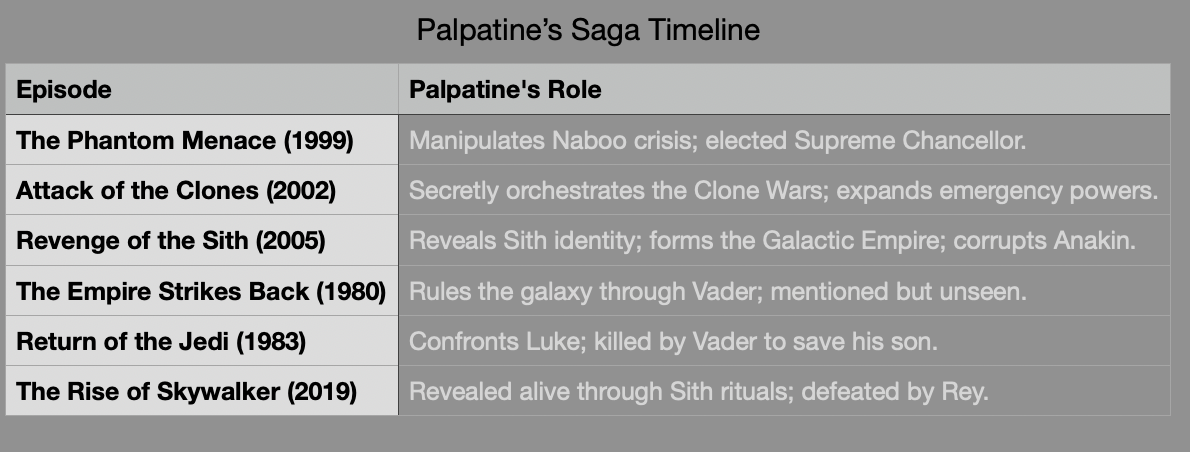
The transformation is subtle but devastating. The Galactic Senate, once a symbol of democratic governance, becomes a rubber-stamp body for Palpatine’s decrees. His declaration of the Empire, far from being a shocking coup, is met with cheers from exhausted citizens desperate for peace.
“So this is how liberty dies,” Padmé Amidala laments, “with thunderous applause.”
Lucas’ message is clear: the death of democracy often comes not with tanks in the streets, but with the willing consent of a frightened and weary public.
Palpatine’s True Nature: Hypocrite, Actor, Monster
McDiarmid has often emphasized that Palpatine is not merely a political figure but a psychological study in deception. “He’s a hypocrite, plain and simple,” McDiarmid explained. “And a very good actor.”
Palpatine’s humanity, such as it is, is only an act — a performance calculated to lull others into complacency. Underneath, he is something altogether different: a being who not only embraces the dark side but relishes it, regarding those who resist as weak or foolish. He is not a fallen man but a creature born of darkness, one who believes that power itself is the highest good.
This shift is fully realized in Revenge of the Sith, where Palpatine’s physical transformation mirrors his psychic unveiling. As McDiarmid noted, the monstrous face revealed during his duel with Mace Windu was not merely a scar from battle—it was a manifestation of his true self, long hidden beneath a thin facade. Like Dr. Jekyll becoming Mr. Hyde, Palpatine’s transition is the eruption of inner evil made grotesquely visible.
May the 4th: Celebration and Reflection
As we celebrate Star Wars this May the 4th, it is right to marvel at the sheer scope of George Lucas’ imagination. He gave us heroes like Luke Skywalker, Leia Organa, and Obi-Wan Kenobi—beacons of hope, resilience, and courage. He gave us stories of redemption, of sacrifice, of daring against impossible odds.
But he also gave us Emperor Palpatine—a character whose shadow looms over the entire saga.
In a universe filled with thrilling battles and wondrous technology, Palpatine reminds us that the true battles are fought in the corridors of power, in the hearts of citizens, and in the slow, often invisible decay of civic virtue. His story is a warning, drawn from the real history of fallen republics, about how easily liberty can be lost when fear, complacency, and ambition converge.
Star Wars is, ultimately, a myth of hope. Even against the vast darkness of the Empire, a small band of rebels refuses to submit. Even in the face of overwhelming power, a son reaches out to save his fallen father. Even amid the ruins of democracy, the spark of freedom endures.
This, too, is part of Lucas’ vision — and why Star Wars remains one of the greatest cultural achievements of the modern era.
Conclusion: Vigilance in a Galaxy Near and Far
The Empire did not rise because of the strength of Palpatine alone. It rose because fear silenced dissent, because ambition corrupted ideals, and because good people failed to act when it mattered most.
The lessons are timeless. Vigilance, courage, and an unwavering commitment to liberty are the true guardians against the forces of darkness—whether in a galaxy far, far away or in our own world.
Let us lift our lightsabers in celebration this May the 4th, let us also remember:
The fight for freedom is never won once and for all.
It is a battle renewed in every generation.
May the Force be with us.
 Mastermind Century Group