


Introduction
I was reading a book the other day and the topic of proto-anarchy was mentioned. Of course, I was like—what? So I had to look it up—ponder what does this mean for leadership, innovation, and strategy. The concept of anarchy has long been associated with chaos and disorder, yet its philosophical roots suggest a more nuanced understanding centered on self-governance, autonomy, and the rejection of centralized authority. Proto-anarchy, a term referring to pre-anarchic states or conditions where centralized authority is weak or absent, offers a framework for examining how decentralization can both aid and hinder leadership, innovation, and strategy. So, the concept here is to explore the origins of anarchic thought, its evolution into proto-anarchy, and the implications of proto-anarchic principles in organizational and strategic contexts.
The Historical Foundations of Anarchist Philosophy
Anarchy, as a political and philosophical concept, can be traced back to ancient times, though it gained formal recognition in the 19th century. The term “anarchy” comes from the Greek anarchos, meaning “without a ruler.” While early human societies often functioned without centralized authority, the intellectual foundations of anarchism emerged with the Enlightenment and the rise of modern political thought.
Early Precedents and Theoretical Foundations

- Laozi and Taoism (6th century BCE): The Chinese philosopher Laozi, in Tao Te Ching, advocated for minimal intervention by rulers, emphasizing natural order and spontaneous harmony, a proto-anarchic idea.
- Stoicism and Cynicism: Greek philosophers like Diogenes and Zeno of Citium challenged hierarchical authority and promoted self-sufficiency, indirectly influencing later anarchist thought.
- Christian Anarchism: Early Christian communities, emphasizing communal living and voluntary cooperation, provided an ideological precursor to modern anarchism.
The Emergence of Modern Anarchism
The Enlightenment and the Industrial Revolution provided fertile ground for anarchist philosophy to develop in opposition to the growing power of the state and capitalism.

- William Godwin (1756–1836): Often considered the first modern anarchist, Godwin argued in Enquiry Concerning Political Justice (1793) that government was an unnecessary evil that stifled individual autonomy and rational decision-making.
- Pierre-Joseph Proudhon (1809–1865): Coined the phrase “Property is theft” in What is Property? (1840), advocating for mutualism, self-management, and voluntary associations.
- Mikhail Bakunin (1814–1876) and Peter Kropotkin (1842–1921): Developed collectivist and anarcho-communist theories, arguing that hierarchy and state control were oppressive and unnecessary.
- Emma Goldman (1869–1940): Expanded anarchist thought into feminism, free speech, and labor rights, promoting self-determination and radical individualism.
Proto-Anarchy: The Evolution of Anarchic Thought

Proto-anarchy is best understood as a precursor to full-fledged anarchism, where conditions or systems exist that resemble anarchic structures but are not explicitly ideological or self-aware in their anarchism.
Key Characteristics of Proto-Anarchy
- Decentralization – Power is distributed across various entities rather than concentrated in a single governing body.
- Autonomy – Individuals or groups operate independently with minimal interference from hierarchical structures.
- Organic Order – Systems of cooperation emerge spontaneously rather than being imposed through formal governance.
- Pre-Theoretical Anarchy – A state of affairs that resembles anarchism in practice but lacks explicit ideological commitment.
The Proto-Anarchy Framework
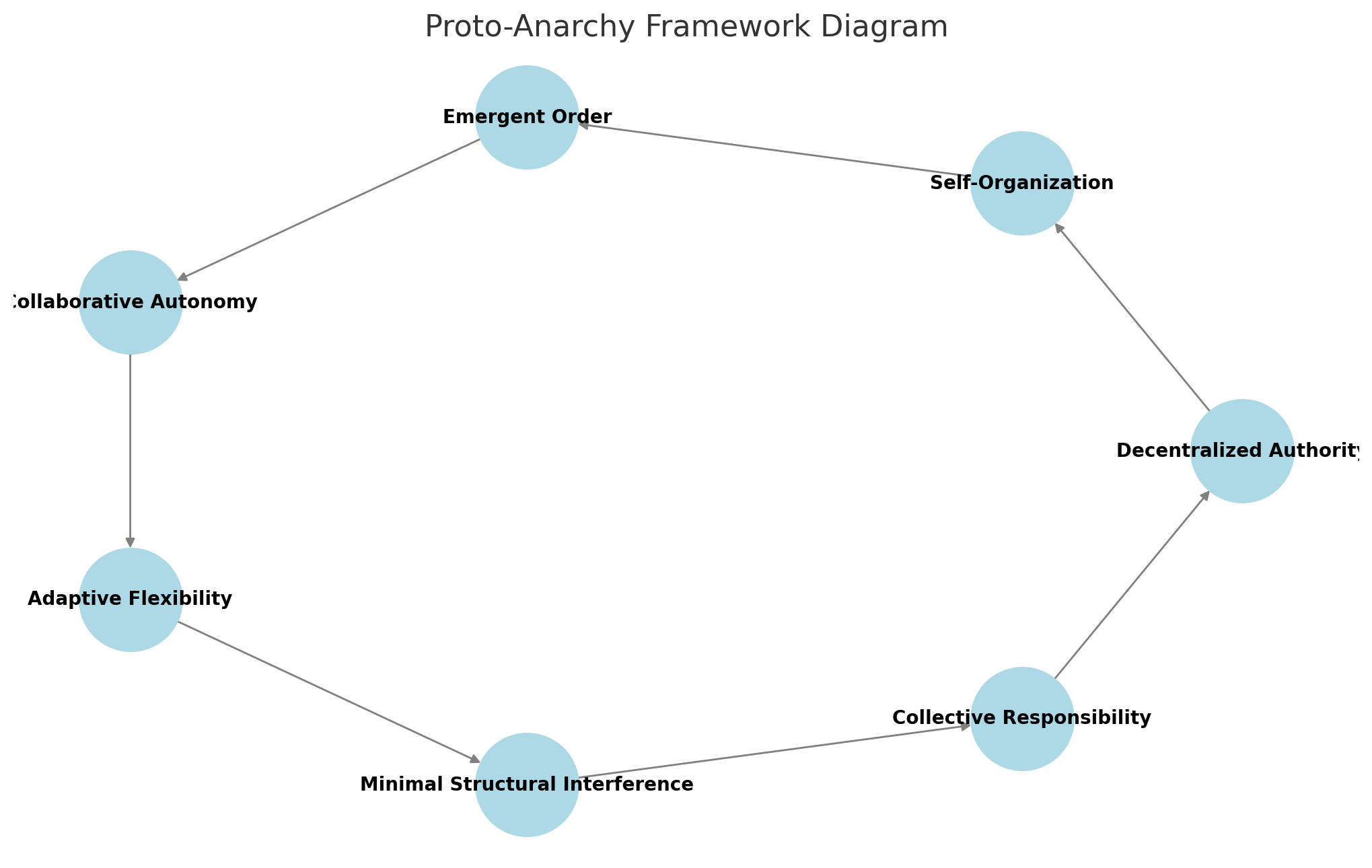
The proto-anarchy framework consists of key principles that guide decentralized and autonomous organization while mitigating the risks of total disorder. The framework includes:
- Decentralized Authority – Decision-making is distributed across a network rather than centralized in a hierarchical system.
- Self-Organization – Individuals and groups are empowered to coordinate and operate independently within a shared set of values or goals.
- Emergent Order – Instead of top-down control, order arises from spontaneous interactions and mutual agreements.
- Collaborative Autonomy – While actors maintain independence, they engage in voluntary cooperation to achieve larger strategic objectives.
- Adaptive Flexibility – The system allows for rapid adaptation to changing circumstances, fostering innovation and resilience.
- Minimal Structural Interference – Bureaucratic oversight is kept to a minimum to prevent stifling creativity and efficiency.
- Collective Responsibility – Decision-making is accompanied by shared accountability to maintain functional coherence within the system.
This framework provides a structured approach to leveraging the benefits of proto-anarchy in leadership, innovation, and strategy while addressing potential drawbacks.
Historical and Contemporary Examples
- Early Tribal Societies: Many indigenous cultures operated through consensus-based decision-making without centralized authority.
- Medieval Guilds and Free Cities: Self-regulated communities that functioned autonomously from feudal lords.
- The Paris Commune (1871): A short-lived experiment in self-governance where citizens took control of Paris without a centralized state apparatus.
- Modern Open-Source Movements: Decentralized innovation communities such as Wikipedia and Linux embody proto-anarchic principles by functioning without centralized governance.
Proto-Anarchy in Leadership, Innovation, and Strategy
The application of proto-anarchic principles in leadership, innovation, and strategy presents both opportunities and challenges.
Proto-Anarchy and Leadership
Advantages:
- Empowers Individuals: Decentralized decision-making enables employees or team members to take ownership of projects.
- Encourages Adaptive Leadership: Leaders must be facilitators rather than authoritarian figures, fostering a culture of collaboration and flexibility.
- Resilience through Distributed Authority: Reduces reliance on a single point of failure, making organizations more resilient in crises.
Disadvantages:
- Coordination Challenges: Lack of hierarchy can lead to inefficiencies and misalignment of goals.
- Accountability Issues: Without clear lines of authority, responsibility for failures or setbacks can be difficult to assign.
Proto-Anarchy and Innovation
Advantages:
- Encourages Experimentation: A decentralized environment fosters creativity and allows for risk-taking without bureaucratic constraints.
- Removes Bottlenecks: Reduces delays caused by hierarchical approval processes.
- Promotes Knowledge Sharing: Encourages open collaboration, much like the open-source movement.
Disadvantages:
- Lack of Structure: Innovation may become directionless without a framework to guide development.
- Scalability Issues: Decentralized innovation may struggle to transition into structured, large-scale implementation.
Proto-Anarchy and Strategy
Advantages:
- Adaptive Strategies: Decentralized decision-making enables rapid responses to changing environments.
- Empowers Tactical Edge: In military and business contexts, lower-level units or teams can execute strategies independently, improving agility.
- Fosters Competitive Disruption: Companies with less hierarchical control, like startups, often outmaneuver larger bureaucracies.
Disadvantages:
- Potential for Fragmentation: Lack of coordination can lead to divergent or conflicting strategies.
- Difficult to Align Long-Term Goals: Without a central vision, efforts may become scattered or ineffective.
Conclusion
Proto-anarchy, as a conceptual bridge between hierarchy and full anarchism, provides a lens through which one might analyze the balance between control and freedom in leadership, innovation, and strategy. While its principles promote adaptability, creativity, and empowerment, they also present challenges related to coordination, accountability, and scalability. Understanding the historical roots of anarchism and its evolution into proto-anarchy may allow leaders to strategically integrate decentralized elements into their organizations while mitigating its potential drawbacks. As modern organizations and governments grapple with complexity and uncertainty, leveraging proto-anarchic principles could offer a powerful tool for fostering resilience and adaptability in an ever-changing world.
References
- Bakunin, M. (1871). God and the State.
- Goldman, E. (1910). Anarchism and Other Essays.
- Kropotkin, P. (1902). Mutual Aid: A Factor of Evolution.
- Proudhon, P.-J. (1840). What is Property?
- Godwin, W. (1793). Enquiry Concerning Political Justice.
- Tao Te Ching, Laozi (6th century BCE).
 Mastermind Century Group