


“And you may ask yourself, ‘Well… how did I get here?’” – Talking Heads
History doesn’t march forward in a straight line—it moves in cycles. From ancient Greece to modern America, civilizations rise, flourish, decline, and collapse, often repeating the same mistakes along the way. Anyone reading this blog knows it is something that has fascinated me for decades.
Thinkers from Polybius to Ibn Khaldun, Vico to Spengler, Toynbee to Strauss & Howe have all recognized this pattern, each offering their own insights into why societies thrive and why they ultimately fail.
But if history repeats, are we doomed to follow the same path? Or can we break the cycle before it’s too late? As we stand at what some argue is another Fourth Turning—a moment of crisis and transformation—the question is no longer theoretical. The lessons of the past may hold the key to shaping the future.
“The Eternal Cycle of Power: How Polybius Saw Governments Rise, Corrupt, and Fall”
Polybius (~200 BCE to 118 BCE), a Greek historian writing in the 2nd century BCE, developed the theory of Anacyclosis, one of the earliest systematic models of political cycles. His framework explains how different forms of government naturally evolve and decay over time in a recurring pattern driven by stability, corruption, and collapse. Observing Rome’s success, Polybius believed that no single system of governance was permanent and that societies oscillate through a predictable sequence.
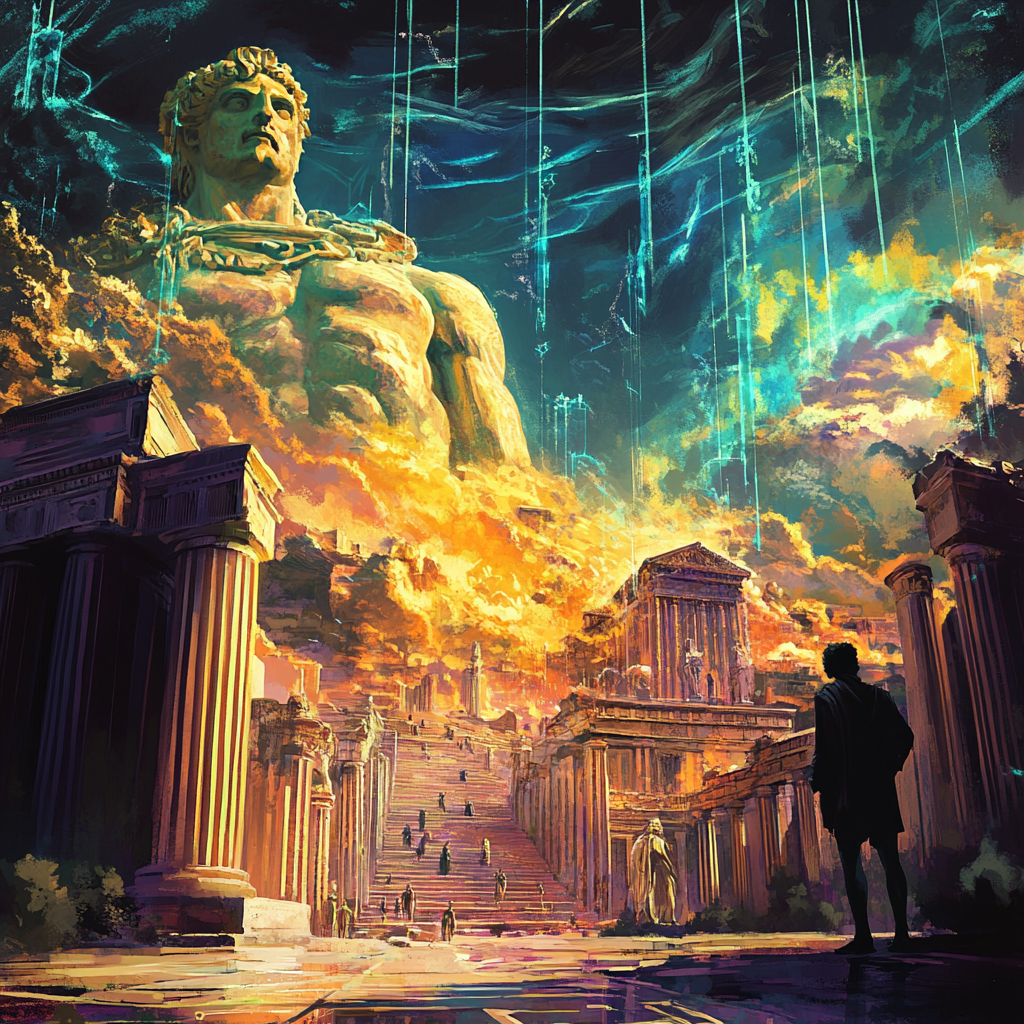
According to his theory, the cycle begins with monarchy, where a strong ruler establishes order and stability. Initially, this leader governs wisely, but over time, power corrupts, leading to tyranny, where the monarch rules despotically, prioritizing personal gain over the common good. Eventually, the people and elites revolt, overthrowing the tyrant and replacing the monarchy with an aristocracy, a system governed by a small group of wise and virtuous leaders. While this system functions effectively at first, it too degenerates as the ruling elite becomes self-serving and hereditary, transforming into a corrupt oligarchy that exploits the lower classes.
As resentment grows, the people overthrow the oligarchs, ushering in democracy, where governance is based on broad participation and equality. However, over time, democracy deteriorates into ochlocracy, or mob rule, as demagogues manipulate public opinion, institutions weaken, and corruption spreads. The resulting chaos and instability create an opportunity for a new strongman or monarch to seize power, restoring order but restarting the cycle.
Polybius’ theory highlights that power inevitably corrupts, and no single form of government can sustain itself indefinitely. However, he believed that a mixed government, like Rome’s combination of monarchy (executive), aristocracy (Senate), and democracy (popular assemblies), could delay decline by balancing these forces. His ideas significantly influenced later thinkers like Machiavelli, Montesquieu, and the Founding Fathers of the United States, who designed the U.S. Constitution with checks and balances to slow the cycle of decay.
The relevance of Anacyclosis extends to modern times. History has repeatedly shown how democratic breakdowns lead to authoritarian rule, with figures like Napoleon, Hitler, and Mussolini rising in the wake of political instability. Today, increasing political polarization, populism, and weakening institutions in many democracies suggest elements of ochlocracy may be emerging once again. Polybius’ insights remain a powerful lens for understanding the fragility of political systems and the ever-present risk of democratic backsliding.
“Rise, Flourish, Decay: Ibn Khaldun’s Timeless Blueprint for Civilizational Cycles”
In the 14th century, the Arab historian Ibn Khaldun (1332 to 1406 CE) developed a sophisticated theory of civilizational cycles, emphasizing the rise and fall of ruling elites over time. His model of history was based on the idea that societies follow a natural lifecycle, progressing from strength and cohesion to decadence and eventual decline. He argued that the vitality of a civilization depends on its ruling class, which inevitably succumbs to corruption and complacency, allowing new challengers to take power.
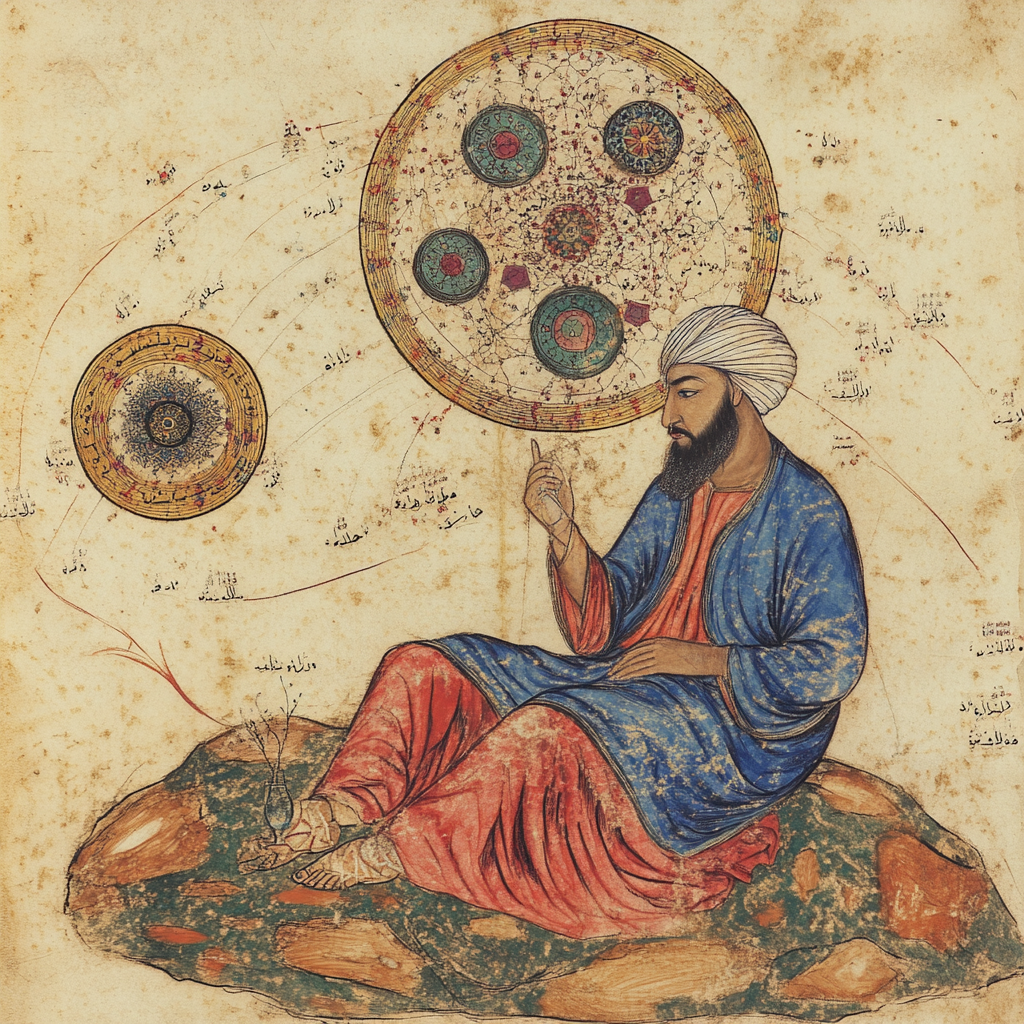
According to Ibn Khaldun, the cycle begins with nomadic warrior conquest, where strong, disciplined groups—often from tribal or rural backgrounds—overthrow decadent and corrupt elites. These new rulers establish order, unify society, and initiate a period of expansion and prosperity, during which economic growth flourishes, institutions strengthen, and the state reaches its peak. However, as generations pass, the ruling class becomes increasingly comfortable and detached from the struggles that initially forged their strength.
This leads to a phase of luxury and decay, where leaders indulge in excess, abandon the values that made their civilization strong, and grow weak in both discipline and governance.
As complacency sets in, corruption and internal divisions emerge, marking the phase of societal decline.
Political fragmentation, economic stagnation, and growing dissatisfaction among the people create vulnerabilities that external forces can exploit. Eventually, a new, more disciplined group rises to conquer and replace the old ruling elite, resetting the cycle with a fresh foundation of strength and unity.
Ibn Khaldun’s theory finds ample historical evidence, from the Mongol conquests leading to new Islamic empires, to the Ottoman Empire’s decline and subsequent European colonial dominance. His insights remain relevant today, offering a framework for understanding how political elites and civilizations succumb to internal decay, making way for new powers to emerge. His work foreshadowed many modern theories on political decay, institutional resilience, and the role of social cohesion in sustaining civilizations over time.
“The Eternal Return: Vico’s Three Ages of Civilization”
The Italian philosopher Giambattista Vico (1668–1744) was one of the first modern thinkers to propose a cyclical theory of history, arguing that civilizations follow a recurring pattern of rise, peak, decline, and renewal. In his seminal work, The New Science, Vico outlined three distinct historical phases that repeat over time, each characterized by different forms of governance and social organization.
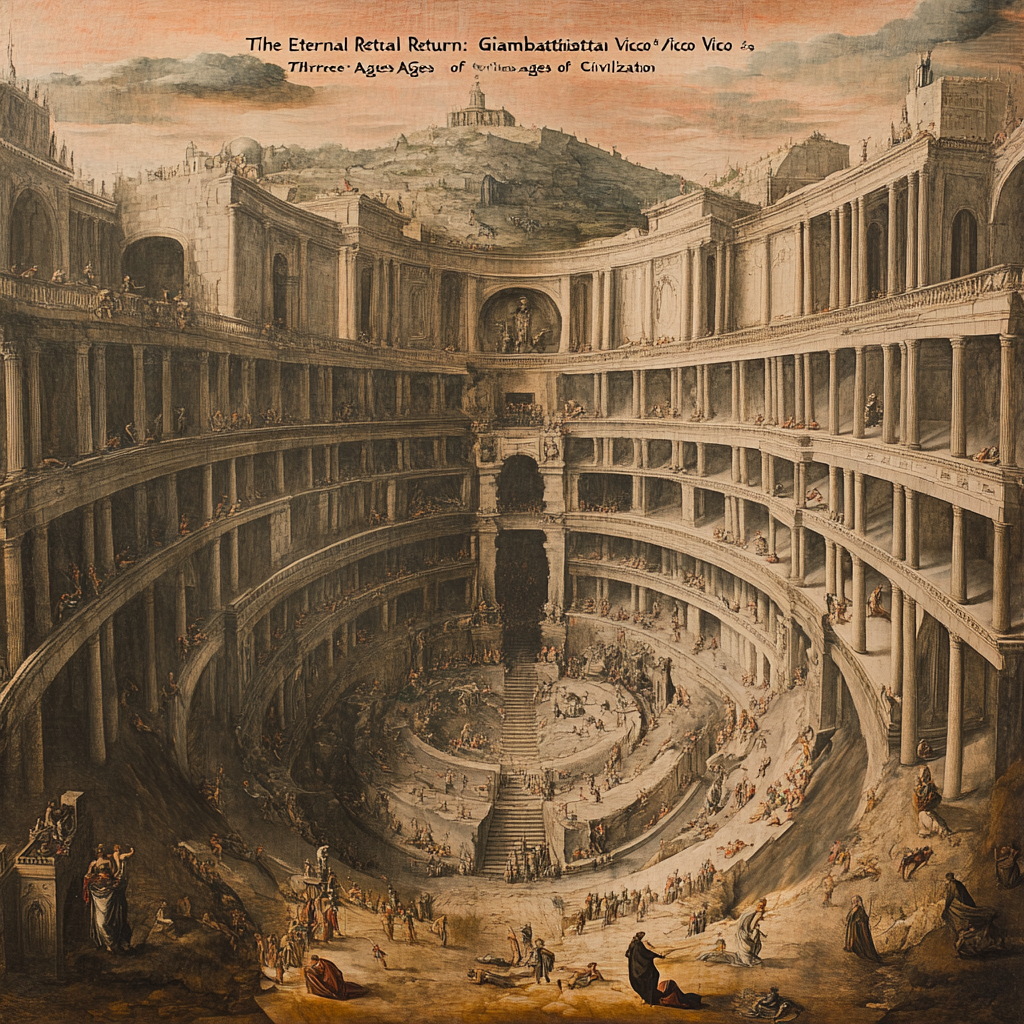
The cycle begins with the Age of Gods, where society is ruled by religious and warrior elites. During this phase, myths, traditions, and divine authority shape governance, and power is concentrated in the hands of priests and strong leaders who claim divine legitimacy. As societies grow and develop, they enter the Age of Heroes, in which aristocrats and monarchs dominate civilization. This period is marked by hierarchical social structures, honor-based societies, and the consolidation of power among the noble class.
Eventually, societies transition into the Age of Men, characterized by rationalism, democracy, and increased political participation. While this era brings scientific progress, individual rights, and intellectual advancements, Vico believed that it also leads to social fragmentation, moral decay, and eventual chaos. As institutions weaken and societies become unstable, civilizations collapse, paving the way for a new Age of Gods, where order is restored through the emergence of new religious or warrior elites, restarting the cycle.
Vico’s theory profoundly influenced later historians and philosophers, including Karl Marx, Oswald Spengler, and Arnold Toynbee, who expanded on the idea that civilizations undergo inevitable cycles of growth and decline. His work remains relevant today, offering a framework for understanding how societies oscillate between authoritarianism, aristocracy, and democracy, often struggling to maintain stability before resetting through crisis and rebirth.
“The Life and Death of Civilizations: Spengler’s Decline of the West”
In 1918, the German historian Oswald Spengler published The Decline of the West, in which he famously compared civilizations to biological organisms that undergo natural life cycles of birth, growth, maturity, decline, and death. Spengler rejected the idea of history as a linear progression and instead argued that all great civilizations inevitably follow a predictable pattern of rise and fall.
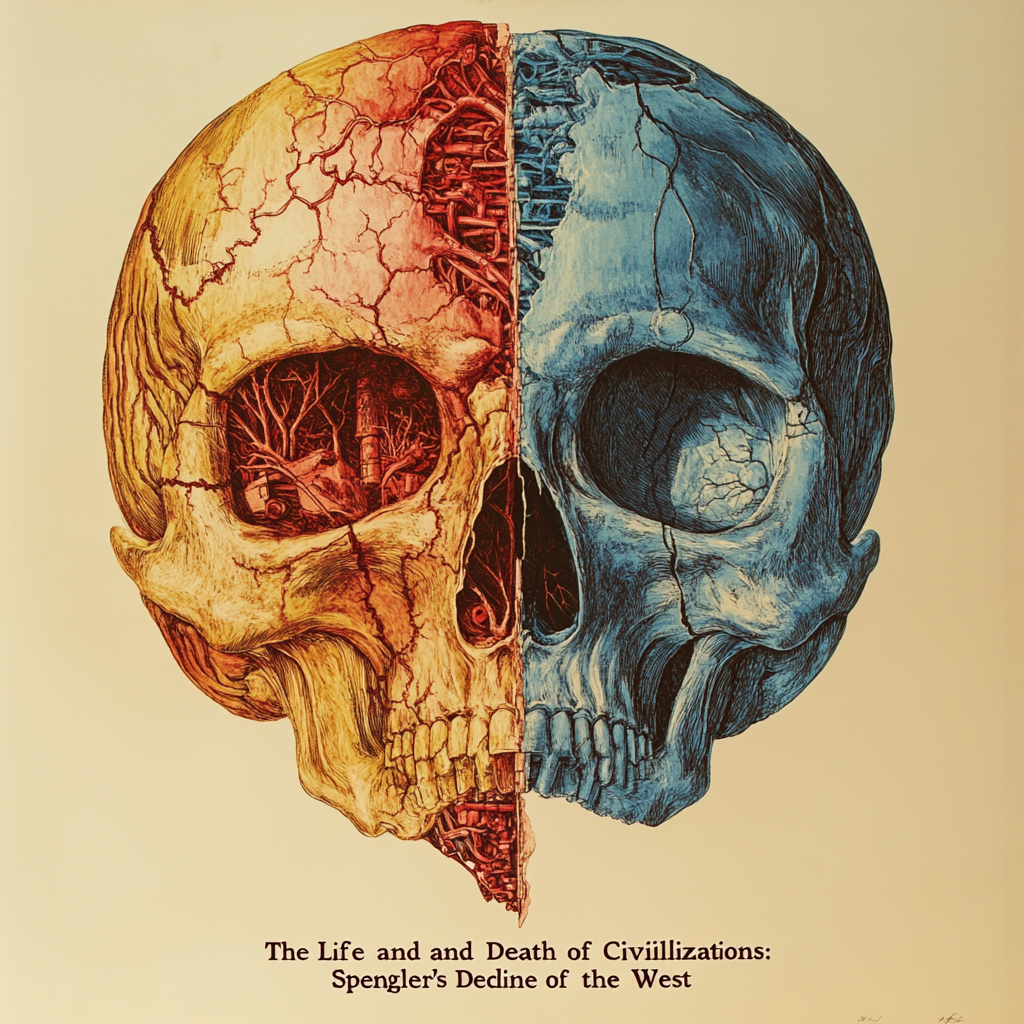
According to Spengler, civilizations begin with birth, a phase marked by discovery, expansion, and the emergence of strong cultural and intellectual foundations. As they grow into youth, they develop military strength, cultural achievements, and a sense of shared purpose that propels them forward. The peak of a civilization comes in its maturity, where it achieves greatness, stability, and political dominance. However, this is followed by old age, a period characterized by luxury, decadence, and moral and institutional decay. As the ruling elites become complacent and disconnected from their society, corruption and stagnation set in, making the civilization vulnerable to external pressures and internal collapse.
Finally, a civilization reaches its death, where it either collapses entirely or is overtaken by a new, rising power that begins the cycle anew. Spengler believed that the West—comprising Europe and the United States—was in its “Old Age” stage and heading toward inevitable decline, marked by cultural stagnation, political dysfunction, and increasing materialism. He argued that Western civilization would eventually be replaced by a new, more vital force, just as previous civilizations like Rome, Greece, and the Islamic empires had once flourished and faded.
Spengler’s theory had a profound impact on later historical and philosophical thought, influencing discussions on the cyclical nature of power, the decline of great nations, and the eventual rise of new civilizations. His work remains a key reference point for scholars and political theorists analyzing modern global shifts and the potential futures of Western societies.
“Adapt or Perish: Toynbee’s Challenge-and-Response Theory of Civilization”
In the 20th century, British historian Arnold Toynbee (1889 to 1975) conducted an extensive study of 21 civilizations and concluded that their success or failure depends on how they respond to challenges. Unlike historians who focused solely on internal decay, Toynbee developed the Theory of Challenge and Response, which argued that civilizations rise when they successfully adapt to crises and fall when they become rigid, complacent, and fail to innovate.
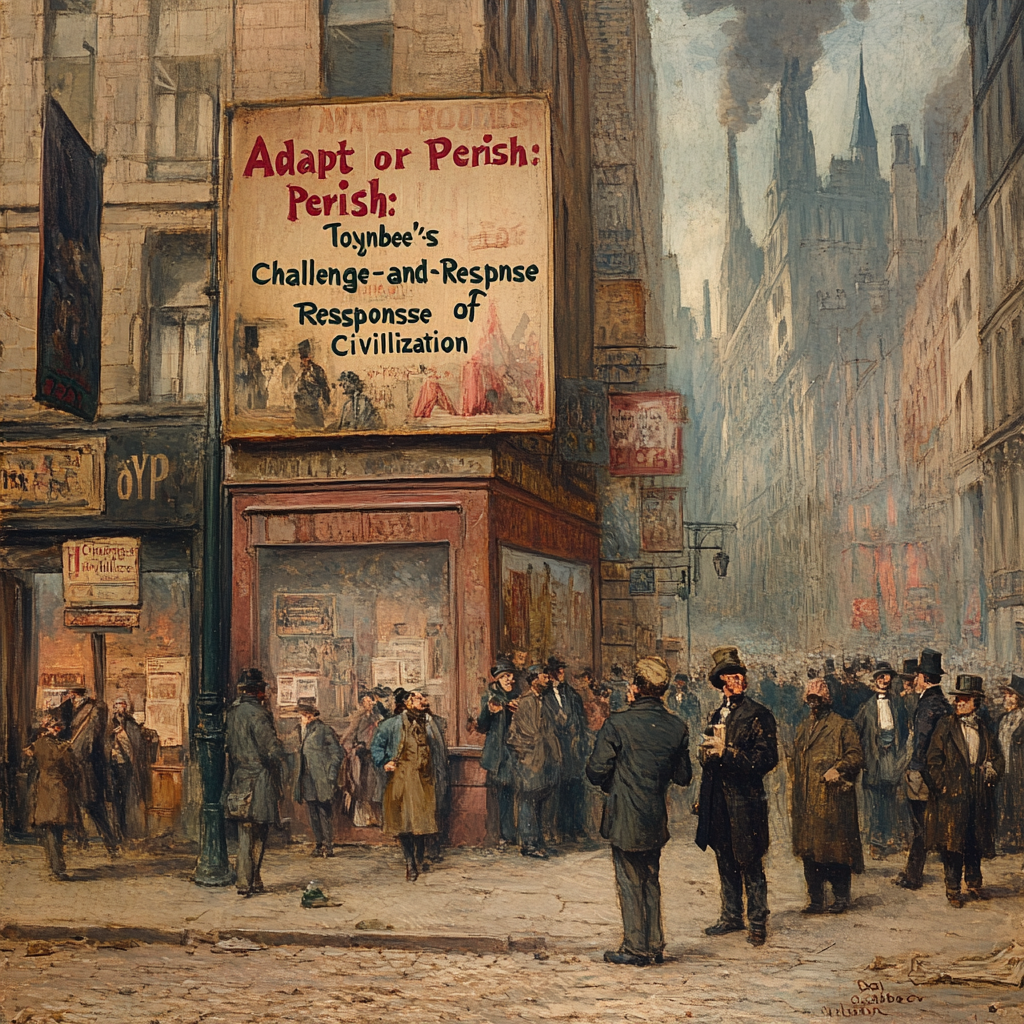
According to Toynbee, every great civilization encounters significant challenges—whether environmental, military, economic, or political. Those that creatively respond by reforming their institutions, embracing new technologies, or adjusting their social structures continue to thrive.However, once a civilization becomes inflexible, losing its ability to adapt, it begins a slow decline. As leadership weakens, institutions stagnate, and innovation stalls, external pressures become overwhelming, leading to collapse.
A key example of this pattern is the fall of Rome, which, despite its immense power, could not reform fast enough to counter internal corruption, economic strain, and external invasions. Toynbee’s work remains influential, shaping modern discussions on resilience, adaptability, and the factors that determine the longevity of societies and institutions. His insights continue to be applied in analyzing contemporary global challenges, from economic crises to geopolitical shifts.
“The Fourth Turning: America’s Fate in the Cycle of Crisis and Renewal”
In 1997, historians William Strauss (1947 to 2007) and Neil Howe (1951 — ) introduced the Fourth Turning theory, which proposes that generational cycles occur every 80 to 100 years, shaping history through recurring periods of crisis and renewal. They argued that societies experience a predictable pattern of four historical phases, or “turnings,” each lasting about 20 to 25 years, driven by generational dynamics and cultural shifts.
The cycle begins with the First Turning (High), a period of post-crisis unity and rebuilding, characterized by strong institutions, economic growth, and social cohesion. An example of this phase is the post-World War II boom, when Western societies enjoyed stability and prosperity. This is followed by the Second Turning (Awakening), an era of social upheaval where younger generations challenge authority, institutions, and traditional values. The 1960s to 1980s, marked by civil rights movements, counterculture, and political protests, exemplify this phase.
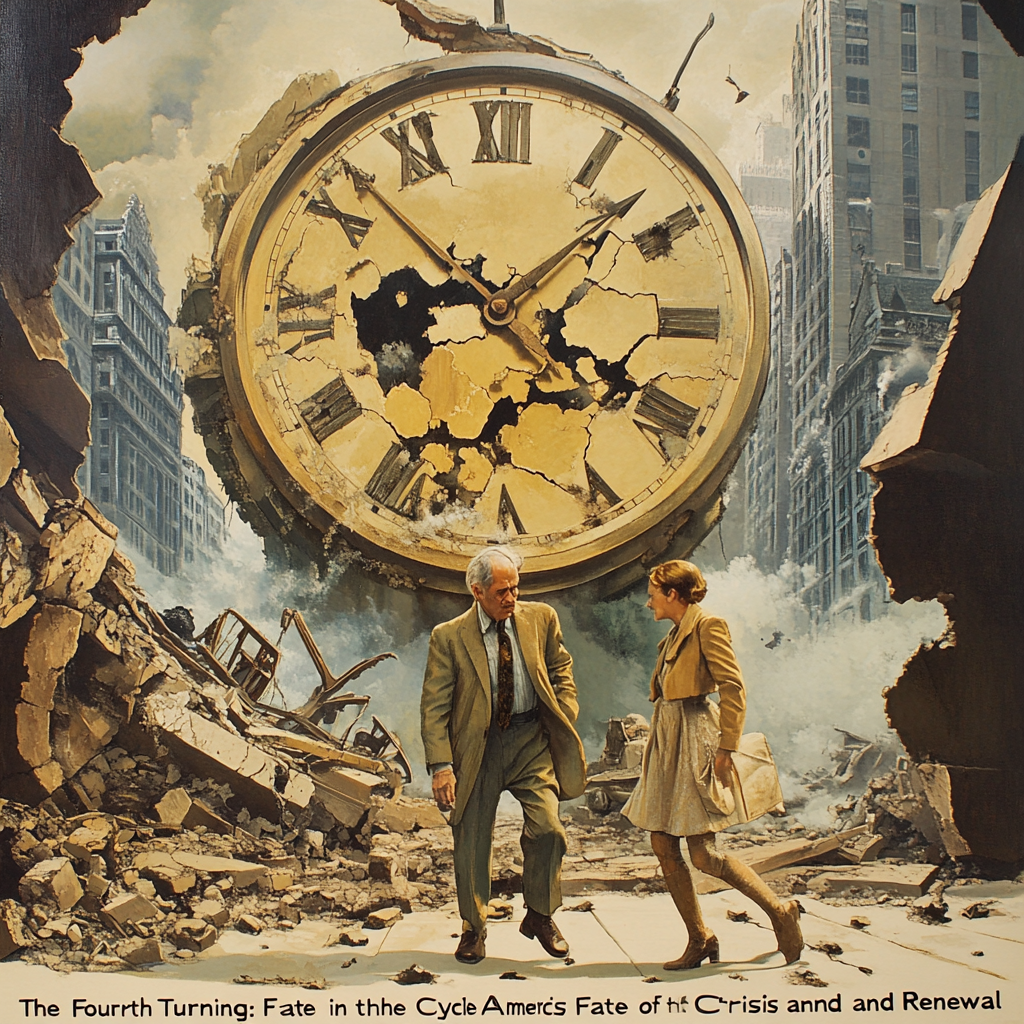
Next comes the Third Turning (Unraveling), a time of increasing polarization, weakening institutions, and declining social trust. The 1980s to 2008, which saw growing economic inequality, political division, and cultural fragmentation, fit this pattern. Finally, societies enter the Fourth Turning (Crisis Phase), marked by institutional collapse, war, economic disasters, and major societal upheaval. According to Strauss and Howe, the world entered this phase around 2008, with the global financial crisis, rising political instability, and social conflicts signaling the breakdown of the previous order.
If their theory holds, we are currently in the Fourth Turning, a period of crisis that may last until the mid-2020s, potentially leading to profound transformations in governance, economics, and global power structures. Their work has gained renewed interest in recent years as political and economic tensions escalate, fueling debates about whether we are on the verge of a major historical reset.
Key Takeaways & Reflections on Historical Cycles
- The Concept of Historical Cycles is Ancient
The idea that history moves in recurring patterns is not new—it dates back to classical thinkers like Herodotus, Thucydides, and Polybius, who observed that civilizations rise, peak, and fall in predictable ways. These cycles suggest that societies are not on a linear path of progress but are instead caught in repetitive loops influenced by power struggles, cultural shifts, and generational change. - Different Thinkers, Different Cycles
While the overarching idea of cyclical history remains constant, different historians and philosophers have emphasized different driving forces behind these cycles:- Polybius focused on political cycles, where governance shifts from monarchy to aristocracy to democracy, before degenerating into chaos and starting anew.
- Ibn Khaldun identified civilizational cycles, where strong, disciplined groups rise to power but eventually become decadent and are replaced by more vigorous challengers.
- Giambattista Vico and Oswald Spengler viewed history through cultural and life-cycle lenses, with societies passing through mythic, heroic, rational, and decadent phases.
- Strauss and Howe took a generational approach, arguing that major crises occur every 80–100 years as different age groups come into power, shaping society through cycles of order, rebellion, decay, and renewal.
- A Shared Lesson: No Civilization Lasts Forever
Despite their differences, all these theories agree on a fundamental truth: no empire, nation, or culture is permanent. Societies flourish when they adapt to challenges but decline when their leaders ignore history’s lessons. Civilizations that become complacent, corrupt, or resistant to change inevitably face collapse, making way for new powers to rise.
The Earliest Observers of Historical Cycles
| Thinker | Era | Key Idea About Cycles |
|---|---|---|
| Herodotus (Greece) | 5th Century BCE | Empires rise and fall due to hubris and moral decay. |
| Thucydides (Greece) | 5th Century BCE | War and power struggles repeat because human nature doesn’t change. |
| Polybius (Greece/Rome) | 2nd Century BCE | Governments cycle through monarchy, aristocracy, and democracy, leading to inevitable decline. |
| Ibn Khaldun (Islamic World) | 14th Century CE | Civilizations rise through strong leadership but decay as elites become corrupt and complacent. |
| Giambattista Vico (Italy) | 18th Century CE | History moves in three repeating phases: rise, decline, and renewal. |
| Oswald Spengler (Germany) | 1918 | Civilizations have life cycles similar to biological organisms. |
| Arnold Toynbee (Britain) | 1934-1961 | Civilizations succeed or fail based on their response to challenges. |
| William Strauss & Neil Howe (U.S.) | 1997 | Societies follow 80-100 year generational cycles (The Fourth Turning). |
Why Does This Matter Today?
Understanding these historical cycles can offer valuable insights into current global shifts. Are Western democracies in their “old age” phase as Spengler suggested? Are we in a “Fourth Turning” crisis, set for major upheaval and transformation? These theories serve as warnings and guides, reminding us that adaptability, innovation, and historical awareness are crucial for the survival of societies.
Final Thought: Can We Break the Cycle?
Throughout history, leaders have often believed that their empire, government, or civilization was exceptional—that they could defy the patterns of decline that had undone their predecessors. The plan is to examine this in a future post. Yet, history suggests otherwise. The evidence from Polybius, Ibn Khaldun, Vico, Spengler, Toynbee, and Strauss-Howe all points to the same fundamental truth: if a civilization does not adapt and innovate, it will eventually decline and be replaced. No society has ever been immune to this reality.
This raises critical questions for today:
- Are we doomed to repeat these cycles, or can we break free?
- Is the U.S. just another empire in decline, following the fate of Rome, Britain, and others?
- Or is there a way to reset the system, to disrupt the historical patterns through foresight, reform, and resilience?
The answers depend on whether societies can recognize the warning signs and make necessary course corrections before it is too late. If history teaches anything, it is that complacency leads to collapse—but awareness, adaptability, and innovation offer the only path to enduring survival.

 Mastermind Century Group