


Welcome to a strange DeMarco journey intertwining the allure of “Star Wars” with the wisdom of ancient Stoicism. My love affair with this epic saga began in 1977, when I first witnessed THE magic at The Laurel Theater in San Carlos, CA. I was so captivated that I saw the original movie 13 times in that year alone. Observing the “Star Wars” universe grow, expand, and even collapse in some aspects has been nothing short of amazing. In the past decade, my interest took a philosophical turn, leading me to explore the principles of ancient Stoics. This exploration led me down an intriguing rabbit hole: drawing connections between the Jedi of “Star Wars” and the ancient Stoic philosophers.
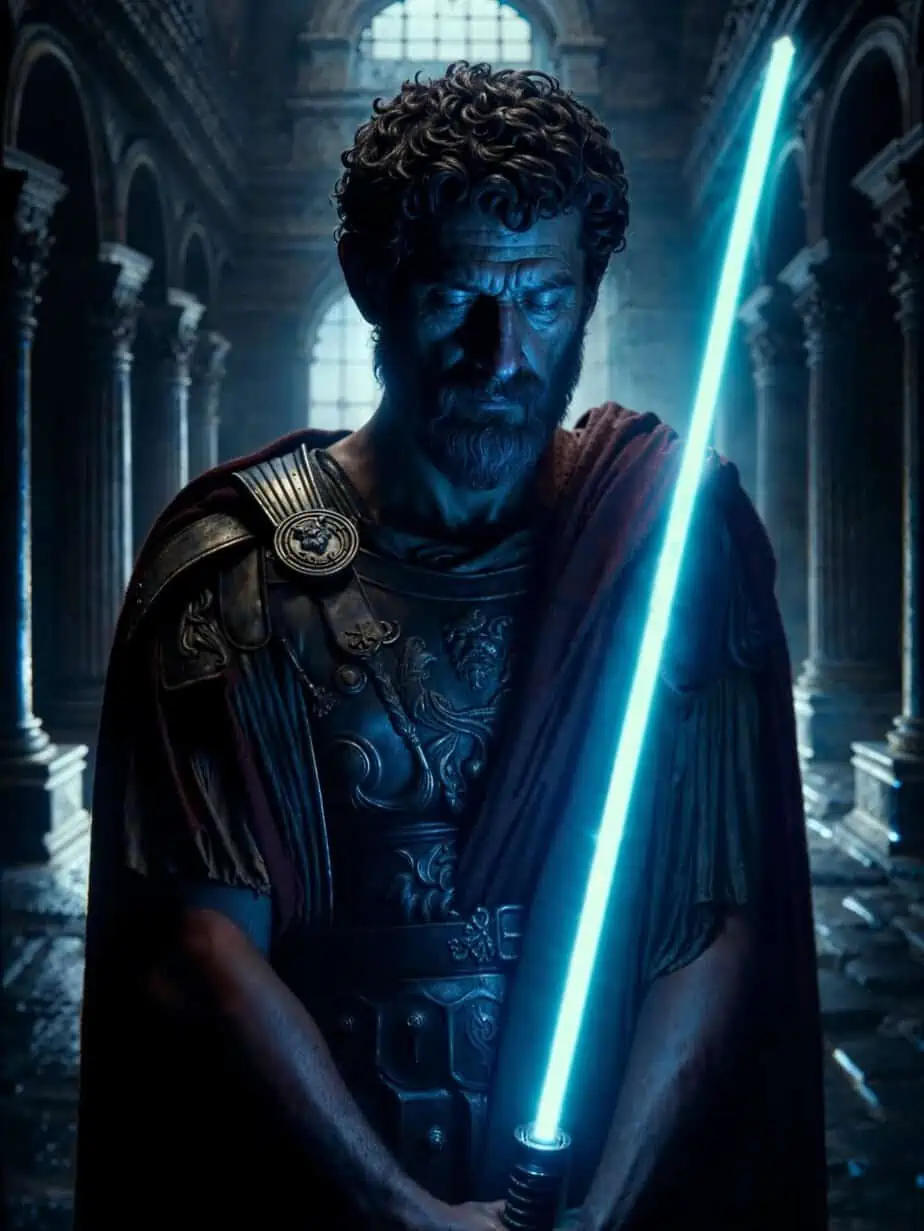
While there is no explicit statement from George Lucas about intentionally making the Jedi Stoic, various analyses and discussions suggest that Stoicism, among other philosophies, influenced the Jedi ways presented in the films. The Jedi philosophy in “Star Wars” combines elements from multiple philosophies and religions, including Stoicism, Christianity, Buddhism, and Taoism. The Jedi’s approach to emotions, duty, and the nature of the Force reflects aspects of these philosophies. It’s evident that the Jedi Order, with its emphasis on emotional control, duty, and mindfulness, parallels key Stoic principles to some extent, but it’s also influenced by a broader range of philosophical and spiritual ideas.
WHAT IS A STOIC
To define what it means to be a Stoic, let’s first look at the core principles of Stoicism, a philosophy founded in ancient Greece by Zeno of Citium and later developed in Rome by thinkers like Seneca, Epictetus, and Marcus Aurelius.
Core Principles of Stoicism:
- Virtue as the Highest Good: Stoicism teaches that the highest good is virtue – living in accordance with reason, wisdom, courage, justice, and self-discipline.
- Control Over Emotions: A Stoic strives to maintain a will that is in harmony with nature, accepting the events as they come with equanimity. They practice emotional resilience, aiming not to be swayed by feelings of sadness, anger, or excessive joy.
- Focus on What Can Be Controlled: Stoics distinguish between what is in their control (their own thoughts and actions) and what is not (events, the actions of others). They focus on the former and accept the latter.
- Mindfulness and Self-Reflection: Stoics regularly engage in self-reflection, examining their actions and thoughts to ensure they align with their values and rational understanding of the world.
- Acceptance of Fate: Stoicism involves the acceptance of fate – the idea that some events are outside human control and must be endured.
Historic Examples:
- Marcus Aurelius: Roman Emperor and Stoic philosopher, exemplified Stoicism through his writings in “Meditations”, which reflect on virtue, rationality, and the acceptance of death and the impermanence of things.
- Seneca: A Roman Stoic philosopher, he emphasized the Stoic values of calmness in the face of adversity and the importance of personal ethics.
- Epictetus: Born a slave, he later became a prominent Stoic philosopher, teaching the importance of focusing on what is within one’s control and accepting what is not.
In summary, being a Stoic means living a life focused on virtue and reason, maintaining control over one’s emotions and reactions, focusing on what one can control, engaging in self-reflection, and accepting the course of nature and fate. The Mandalorian and Grand Admiral Thrawn, though fictional, display traits that align with these principles. Historic figures like Marcus Aurelius, Seneca, and Epictetus exemplify these principles in their teachings and lives.
STOIC JEDI
The Jedi Order in the “Star Wars” universe shares some similarities with Stoic philosophy, but there are also key differences. To understand whether Jedi can be considered Stoic, we should compare the core tenets of Stoicism with the principles and practices of the Jedi.
Similarities between Jedi and Stoicism:
- Emotional Control: Stoicism teaches the importance of controlling one’s emotions to maintain inner peace. Similarly, Jedi are trained to master their emotions, avoiding attachments and maintaining calmness, especially in the face of conflict.
- Duty and Service: Both Jedi and Stoics place a high value on duty and service. Jedi are expected to be guardians of peace and justice in the galaxy, often putting the needs of others before their own, which echoes the Stoic virtue of living a life of service and moral responsibility.
- Focus on the Present and Rational Thought: Stoicism emphasizes living in the present and using rational thought to guide actions. Jedi teachings also stress the importance of being mindful of the present moment and making decisions based on wisdom and clarity.
- Acceptance of Fate: Stoics believe in accepting the course of events as they unfold, understanding that some things are beyond their control. Jedi teachings similarly embrace the will of the Force, often accepting the unfolding of events as part of a larger cosmic plan.
Differences between Jedi and Stoicism:
- The Force: Jedi philosophy is intrinsically linked to the Force, a spiritual and metaphysical energy that Stoicism does not parallel. The Force imbues Jedi with abilities and a connection to the universe that goes beyond the naturalistic and rationalistic scope of Stoicism.
- Emotional Detachment vs. Emotional Transformation: While both Jedi and Stoics advocate for control over emotions, Stoicism aims more towards transforming emotions through reason and virtue, rather than suppressing them. The Jedi, especially in the prequel era, often seem to advocate for a more complete detachment from emotional bonds.
- Active Intervention: Jedi are often actively involved in galactic affairs, sometimes even in warfare. Stoicism, on the other hand, while not strictly pacifistic, generally advocates for a more passive approach to external events, emphasizing inner virtue over external action.
- Mysticism and Spirituality: Jedi teachings include elements of mysticism and spirituality, particularly in their connection to the Force, which goes beyond the more grounded and practical philosophy of Stoicism.
So, there are notable similarities in their emphasis on self-control, duty, and rational thought, the Jedi philosophy also incorporates mystical elements and a different approach to emotions and intervention in external affairs. Therefore, it can be said that the Jedi exhibit some Stoic-like qualities, but they are not wholly Stoic in their philosophy.
WHO ARE THE STOIC JEDI (or SITH and CLONES)
Several characters in the “Star Wars” universe exhibit traits that align with Stoic philosophy. Here are some “Star Wars” characters who could be considered Stoic, at least in certain aspects of their behavior and philosophy:
- Obi-Wan Kenobi: Throughout the series, Obi-Wan often exhibits Stoic traits. He shows great emotional restraint, wisdom, and a deep understanding of the Force, which he views in a way that aligns closely with the Stoic concept of living in accordance with nature. He accepts his fate, particularly in his final moments facing Darth Vader.
- Yoda: As a wise and seasoned Jedi Master, Yoda often demonstrates a Stoic-like demeanor. He emphasizes control over one’s emotions, speaks about the importance of peace and harmony, and teaches young Jedi to accept the things they cannot change.
- Qui-Gon Jinn: Qui-Gon shows a Stoic-like belief in the will of the Force, accepting and adapting to the circumstances as they unfold. He focuses on the present moment and maintains a calm demeanor in various situations.
- Mace Windu: Known for his wisdom and combat prowess, Mace Windu also exhibits a level of self-discipline and emotional control that aligns with Stoic principles. He often approaches situations with a rational and level-headed demeanor.
- Luke Skywalker (in later years): In the original trilogy, Luke is often driven by emotion, but in his later years, as seen in the sequel trilogy (ugh) and further in the expanded universe, he shows more Stoic characteristics. He exhibits self-reflection, acceptance of his past failures, and a deeper understanding of the Force.
- Darth Vader/Anakin Skywalker: I know, this is a controversial pick, but in some ways, Darth Vader (especially post-transformation) exhibits Stoic traits. He accepts his fate and endures physical and emotional pain. However, his earlier life as Anakin Skywalker is marked by passion and emotional turmoil, which is contrary to Stoic ideals.
- Captain Rex: As a clone trooper, Captain Rex demonstrates a strong sense of duty, self-control, and practical wisdom. He often accepts the harsh realities of war and focuses on what he can control – his actions and decisions.

These characters, through their actions and philosophies, echo various aspects of Stoicism, such as emotional control, acceptance of fate, and living in accordance with a larger natural order (in this case, the Force). I want to dive a bit deeper into two characters.
DIN DJARIN
“The Mandalorian,” whose real name is Din Djarin, is the central character of the Disney+ television series “The Mandalorian,” which is part of the “Star Wars” franchise. Created by Jon Favreau, the series marks a significant expansion of the “Star Wars” universe.
Character Background and Traits:
- Mandalorian Culture: Din Djarin is a member of the Mandalorians, a group of skilled warriors known for their distinctive armor and combat prowess. Mandalorian culture is central to his identity, with its code, history, and traditions influencing his actions and beliefs.
- Bounty Hunter: Initially, the Mandalorian is portrayed as a bounty hunter, taking on various missions. His skills in combat, strategy, and survival are prominently displayed throughout the series.
- The Child (Grogu): A significant part of the series revolves around his relationship with a young, Force-sensitive being known as Grogu (popularly referred to as “Baby Yoda”). The Mandalorian becomes a father figure and protector to Grogu, highlighting his sense of duty, honor, and a growing sense of compassion.
- Lone Wolf Persona: Din Djarin often works alone and is depicted as a quintessential “lone wolf” character. He is taciturn, stoic, and highly skilled, fitting the archetype of the lone hero in a dangerous galaxy.
- Moral Development: As the series progresses, the Mandalorian evolves from a solitary bounty hunter to a more complex character, showing increasing depth, moral complexity, and empathy, especially in his interactions with Grogu and other characters he meets along his journey.
- Notable Equipment: He wears traditional Mandalorian armor, made from beskar steel, which is highly durable and resistant to blaster fire. He also utilizes a variety of weapons and tools typical of a bounty hunter.
Significance in “Star Wars” Universe:
- Expansion of Lore: The series has expanded the “Star Wars” lore, exploring new planets, characters, and cultures, including a deeper look into Mandalorian society.
- Cultural Impact: The Mandalorian, both the character and the series, has had a significant impact on popular culture, with elements like Grogu and the Mandalorian’s creed becoming widely recognized.
- Timeline: The series is set after the fall of the Empire (as seen in “Return of the Jedi”) and before the emergence of the First Order (as seen in “The Force Awakens”), filling a previously unexplored timeline in the “Star Wars” saga.
DIN DJARIN THE STOIC

Din Djarin exhibits traits that could be considered stoic.
- Self-Control and Emotional Restraint: Din Djarin often shows remarkable control over his emotions, a key tenet of Stoicism. He rarely expresses strong emotions and maintains a calm demeanor, even in stressful situations.
- Duty and Responsibility: Stoicism places a high value on duty, something The Mandalorian takes very seriously. His commitment to his missions and the code of the Mandalorians is a reflection of this.
- Acceptance of Fate: Another aspect of Stoicism is the acceptance of fate, and Din Djarin often accepts the unfolding of events without unnecessary despair or elation, adapting and responding to circumstances as they arise.
- Focus on Personal Ethics: The Mandalorian’s actions are often guided by a strong personal code of ethics, resonating with the Stoic emphasis on living a virtuous life.
- Endurance: The character often endures physical and emotional hardships without complaint, reflecting the Stoic value of enduring pain or hardship without showing feelings or complaining.
GRAND ADMIRAL THRAWN
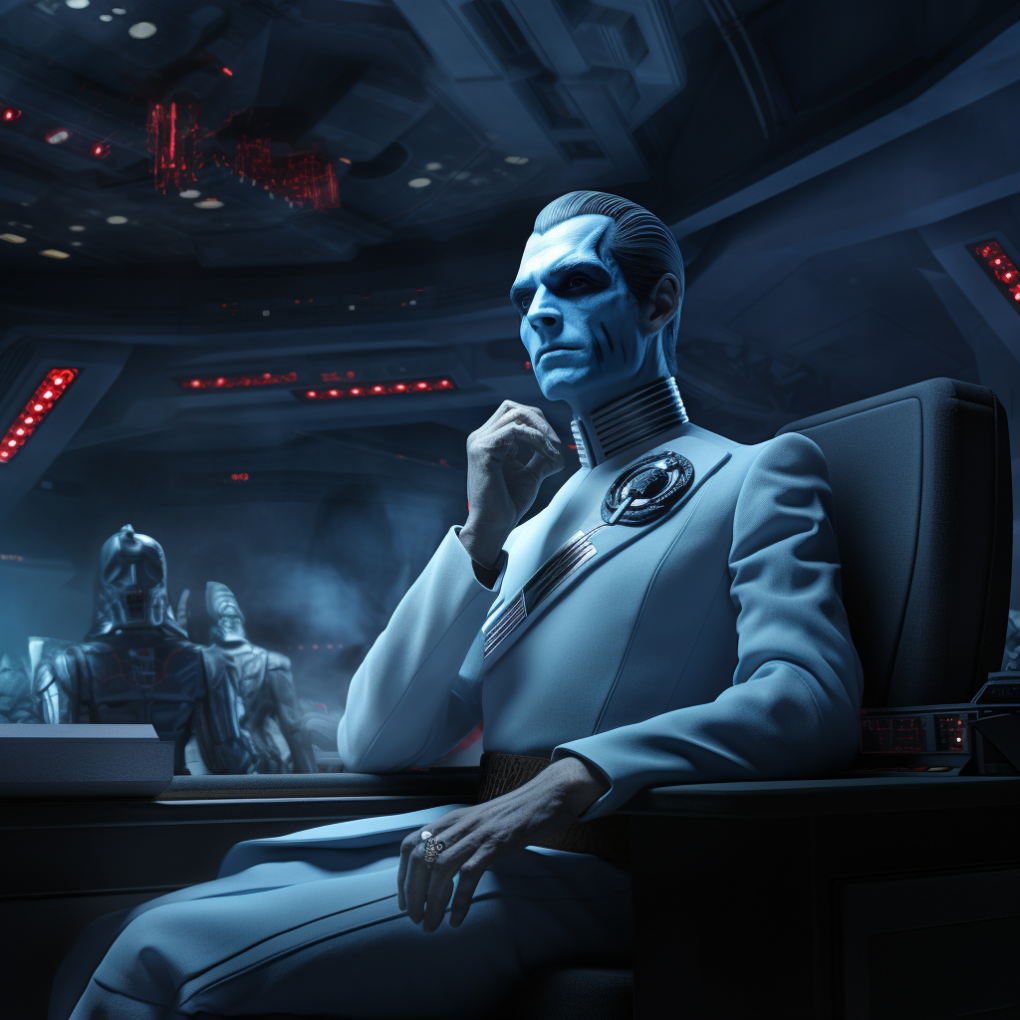
Grand Admiral Thrawn, originally known as Mitth’raw’nuruodo, is yet another fictional character in the “Star Wars” universe. Created by writer Timothy Zahn, Thrawn first appeared in the 1991 novel “Heir to the Empire,” the first book in Zahn’s “Thrawn Trilogy.” He has since become one of the most popular characters in the “Star Wars” expanded universe, known for his strategic genius and cool demeanor.
Character Background and Traits:
- Chiss Ascendancy: Thrawn belongs to the Chiss species, a humanoid race known for their blue skin and red eyes, originating from the Unknown Regions in the “Star Wars” galaxy. His background as a Chiss in the largely human-centric Galactic Empire is significant, marking him as an outsider who rises through the ranks due to his extraordinary abilities.
- Military Genius: Thrawn is depicted as a brilliant strategist and tactician, able to outmaneuver his opponents through careful planning and an almost prescient ability to predict their moves. He is known for studying the art and culture of different species to gain insight into their thinking and strategies.
- Calm and Collected Demeanor: Unlike many “Star Wars” villains, Thrawn is characterized by his calm, collected, and rational demeanor. He rarely shows anger or frustration, instead approaching situations with a level head and a focus on logic and efficiency.
- Rise in the Imperial Navy: Thrawn’s ascent to the rank of Grand Admiral in the Imperial Navy is notable, especially given the Empire’s bias against non-humans. His rise is a testament to his exceptional skills and strategic mind.
- Role in the Empire: Thrawn is often portrayed as a more principled and less overtly evil figure compared to other Empire leaders. He is driven by a desire to bring order and stability, and he often shows respect for his adversaries.
- Appearances in Various Media: After his introduction in Zahn’s “Thrawn Trilogy,” Thrawn has appeared in other novels, comics, and was notably included in the “Star Wars: Rebels” animated TV series and Ahsoka, further expanding his story and impact on the “Star Wars” universe.
Significance in “Star Wars” Universe:
- Expanded Universe and Canon: Thrawn played a major role in the “Star Wars” Expanded Universe (now known as Legends). His popularity led to his inclusion in the official “Star Wars” canon following the Disney acquisition of Lucasfilm.
- Cultural Impact: Thrawn is considered one of the most compelling and well-developed antagonists in the “Star Wars” universe, praised for his intelligence, strategic prowess, and the depth of his characterization.
- Influence on Storytelling: Thrawn’s character has influenced how villains are portrayed in the “Star Wars” universe, offering a contrast to the more traditional, force-wielding antagonists like Darth Vader and Emperor Palpatine.
Grand Admiral Thrawn stands out as a unique and complex character in the “Star Wars” saga, known for his intellectual approach to warfare and governance, as well as his unique cultural and species background. His character adds depth and sophistication to the portrayal of the Galactic Empire and its hierarchy.
THRAWN AS A STOIC
Grand Admiral Thrawn, a character from the “Star Wars” expanded universe and prominently featured in the “Star Wars: Rebels” animated series, Ahsoka, and Timothy Zahn’s novels, exhibits several characteristics that could be interpreted as stoic. Stoicism, as a philosophy, emphasizes virtues like wisdom, courage, justice, and temperance, and promotes living in harmony with reason and nature.
Here’s an analysis of Thrawn’s character in relation to Stoicism:
- Rationality and Strategic Thinking: Thrawn is renowned for his exceptional strategic thinking and rational analysis. Stoicism values rationality and clear thinking, which Thrawn demonstrates in his approach to military tactics and understanding of his adversaries.
- Emotional Control: Thrawn often displays remarkable control over his emotions, a key aspect of Stoicism. He remains calm and collected, even in stressful situations, which allows him to think clearly and make strategic decisions.
- Respect for Adversaries: Stoicism teaches respect for others and understanding of their perspectives. Thrawn’s ability to understand and respect his adversaries, often studying their culture and art to gain insights, aligns with this aspect of Stoicism.
- Focus on Practical Action: Thrawn is very much focused on practical and effective action, aligning with the Stoic belief in focusing on what one can control and acting effectively within those bounds.
- Endurance and Resilience: Thrawn shows a high degree of endurance and resilience in the face of challenges, aligning with the Stoic virtue of enduring hardship with a calm and composed demeanor.
Again, it’s important to remember that Thrawn is a fictional character created for a science fiction universe. He displays traits that can be likened to Stoicism, he is not a character explicitly based on Stoic philosophy. His actions and personality are designed to serve the story and the dynamics of the “Star Wars” universe, rather than to adhere strictly to any specific philosophical doctrine.
In conclusion, delving into the relationship between the Jedi of “Star Wars” and Stoic philosophy has been an intriguing and somewhat unusual journey. While it’s difficult to definitively label the Jedi as true Stoics, there’s no denying that certain aspects of their conduct and beliefs resonate with Stoic values and principles. This exploration provides a simple lens through which we can view the Jedi, enriching our understanding of their roles and philosophies in the “Star Wars” universe.
 Mastermind Century Group