


Breakin’ rocks in the hot sun
I fought the law and the law won. –The Clash (sort of)
I had a colleague ask the other day—what’s the story behind innovation in a massive bureaucracy like the US Department of Defense—what are the enabling factors? That last part had me a bit miffed—what are the enabling factors to innovation?
Enabling Factors Defined
An enabling factor is a characteristic, condition, or element that makes it possible for a certain outcome or event to occur. It serves to facilitate, encourage, or pave the way for something to happen, whether it’s the success of a project, the implementation of a strategy, the achievement of a goal, or innovation.
In the context of innovation, enabling factors might include strong leadership support, a culture that fosters creativity and accepts risk, adequate resources such as funding and personnel, and access to relevant technologies or market information.
Innovation in Corporate vs Military Setting
Innovating in a corporate setting is often driven by competitive pressures, customer demands, and the desire to increase profitability. There tends to be more freedom to take risks in corporations, and failures can be viewed as opportunities for learning and improvement. Corporations typically have the ability to pivot quickly, adjust their strategies, or enter new markets as they innovate.
On the other hand, innovation in the military or similar hard structures is driven by the need to enhance capabilities, improve efficiency, and address evolving security threats. While there is a recognition of the need for innovation, the risk appetite tends to be lower due to the potential consequences of failure, such as impacts on national security or lives. Innovating in the military often involves navigating complex bureaucracies, rigid hierarchies, and stringent regulations. However, the military has access to significant resources and cutting-edge technologies, and it often collaborates with a wide range of partners, from industry to academia, to foster innovation. Both settings require a supportive culture, leadership commitment, and strategic allocation of resources to drive innovation.
Enabling Factors
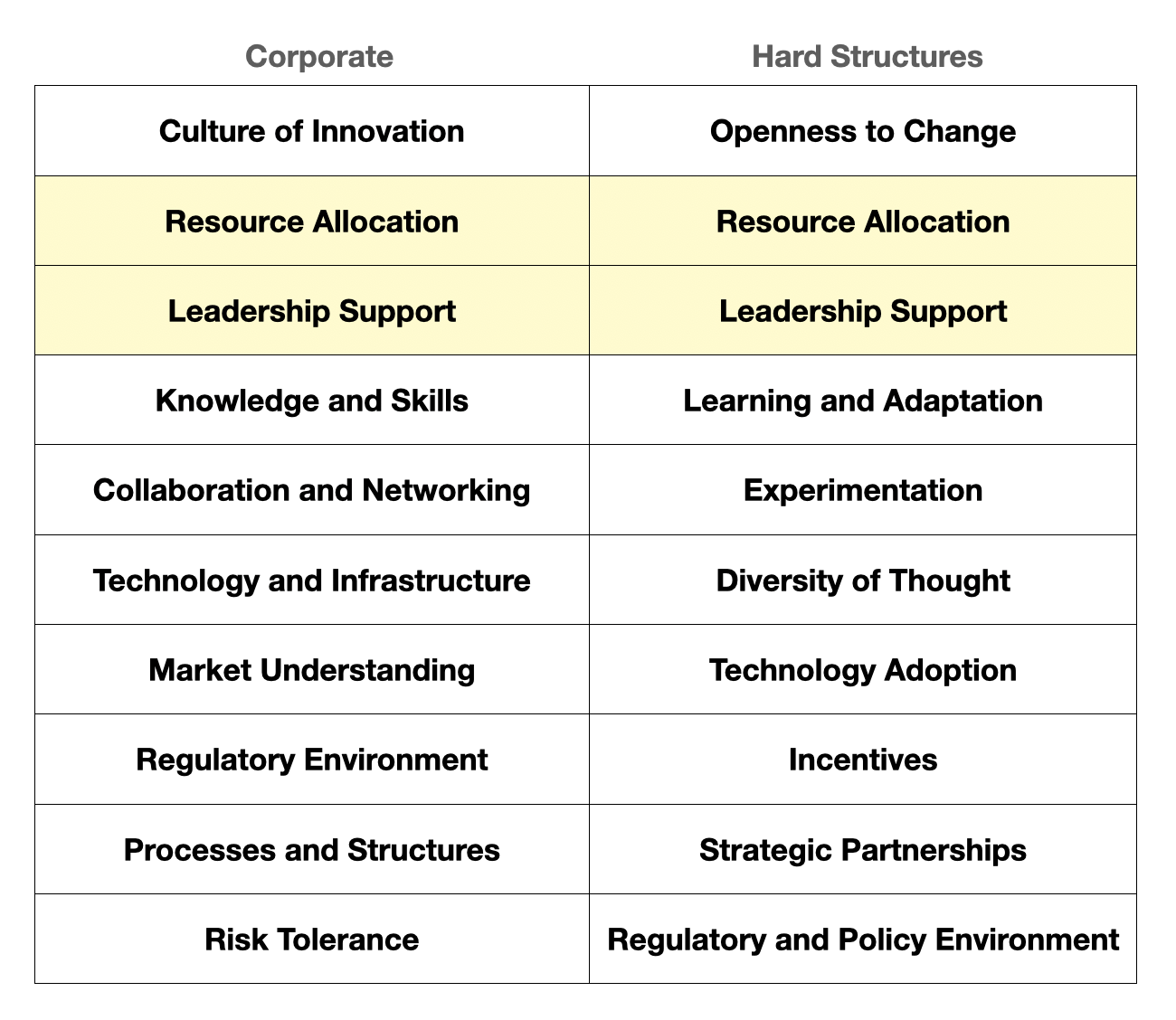
CORPORATE Enabling Factors
Corporate innovation is a complex process that is influenced by a variety of factors. Below are some of the key enabling factors for innovation:
- Culture of Innovation: A culture that encourages questioning, creativity, risk-taking, and the challenging of the status quo is essential for fostering innovation. This culture must be supported from the top down.
- Resource Allocation: Innovation often requires investment in research and development, new technologies, and human resources. It can require significant time and capital, and thus needs to be a strategic priority.
- Leadership Support: Leaders need to inspire, motivate, and support their teams in being innovative. They should create an environment that values new ideas and is open to experimentation and learning from failures.
- Knowledge and Skills: A knowledgeable and skilled workforce is critical for innovation. This includes not only technical skills but also creative thinking, problem-solving, and adaptability skills.
- Collaboration and Networking: Innovation often occurs at the intersection of different fields, technologies, or ideas. Encouraging collaboration both within and outside the organization, as well as fostering a diverse network of relationships, can lead to innovative ideas and solutions.
- Technology and Infrastructure: Access to the latest technologies and infrastructure can enable innovation, especially in sectors like IT, biotech, etc. This includes physical infrastructure as well as software, tools, platforms, etc. that facilitate innovation.
- Market Understanding: A deep understanding of the market, including customers’ needs and wants, competitors, trends, etc., can enable innovation by revealing opportunities for new or improved products, services, or processes.
- Regulatory Environment: Policies and regulations can either support or inhibit innovation. Policies that encourage research, protect intellectual property, provide tax incentives for innovation, etc., can enable innovation.
- Processes and Structures: Organizational structures and processes can support innovation. For example, structures that allow for autonomy and flexibility, and processes that facilitate the ideation, development, and implementation of new ideas.
- Risk Tolerance: Innovation involves a degree of risk, as not all new ideas will succeed. An organization’s willingness to accept and manage this risk is a critical enabler of innovation.
These factors are interrelated and often need to be aligned for innovation to thrive. The specific importance of each factor obviously varies depending on the context, such as the industry, the nature of the organization, the type of innovation (e.g., product, process, business model), etc. I would argue innovation in a hard structure requires a different set of enabling factors for innovation.
MILITARY Enabling Factors
Innovation in large, hierarchical organizations such as the U.S. military or similar “hard” structures is a bit more challenging due to the size, complexity, and often rigid procedures. Nonetheless, there are several enabling factors that can foster innovation in these settings:
- Leadership Support: Senior leadership buy-in is critical. Leaders must understand the strategic importance of innovation, support it, and be willing to accept the risks it entails.
- Openness to Change: Even in rigid structures, there must be a willingness to change and adapt. This could be driven by external threats, technological advancements, or changing strategic objectives.
- Diversity of Thought: Diverse perspectives can lead to novel ideas and solutions. This can be encouraged by promoting diversity in personnel, cross-functional collaboration, and the inclusion of civilians or external partners in the innovation process.
- Learning and Adaptation: The ability to learn from successes and failures, and to adapt accordingly, is crucial. This requires a culture that encourages learning, reflection, and the sharing of knowledge and experiences.
- Experimentation: Providing space for controlled and deliberate experimentation, where new ideas can be tested and iterated upon, can foster innovation.
- Resource Allocation: Specific resources (time, personnel, funds) must be allocated to innovation efforts. This could involve setting up dedicated innovation units or funding innovation competitions or research initiatives.
- Technology Adoption: The U.S. military and similar structures often have access to cutting-edge technology. The willingness and ability to adopt and integrate these technologies can drive innovation.
- Incentives: Rewarding innovative behavior, whether through formal recognition, promotions, or other incentives, can encourage individuals and teams to be more innovative.
- Strategic Partnerships: Collaboration with academia, industry, and international partners can bring in new ideas and capabilities, and facilitate technology transfer and diffusion.
- Regulatory and Policy Environment: Policies and regulations that support research, cognitive/generational diversity, and development, protect intellectual property, or incentivize innovation can enable innovation. In the military context, this could also involve regulations relating to procurement, technology adoption, etc.
NO NIRVANA
Innovation within rigid or “hard” structures like the military, government, or some large corporations can indeed be challenging when traditional enabling factors are not present. In less-than-ideal conditions, one must maximize the potential of existing enabling factors which becomes crucial for fostering innovation. Every organization, even the most rigid ones, will likely have some latent or under-utilized resources that can be mobilized to encourage and support innovation. Taking the info above and building a matrix may prove useful:
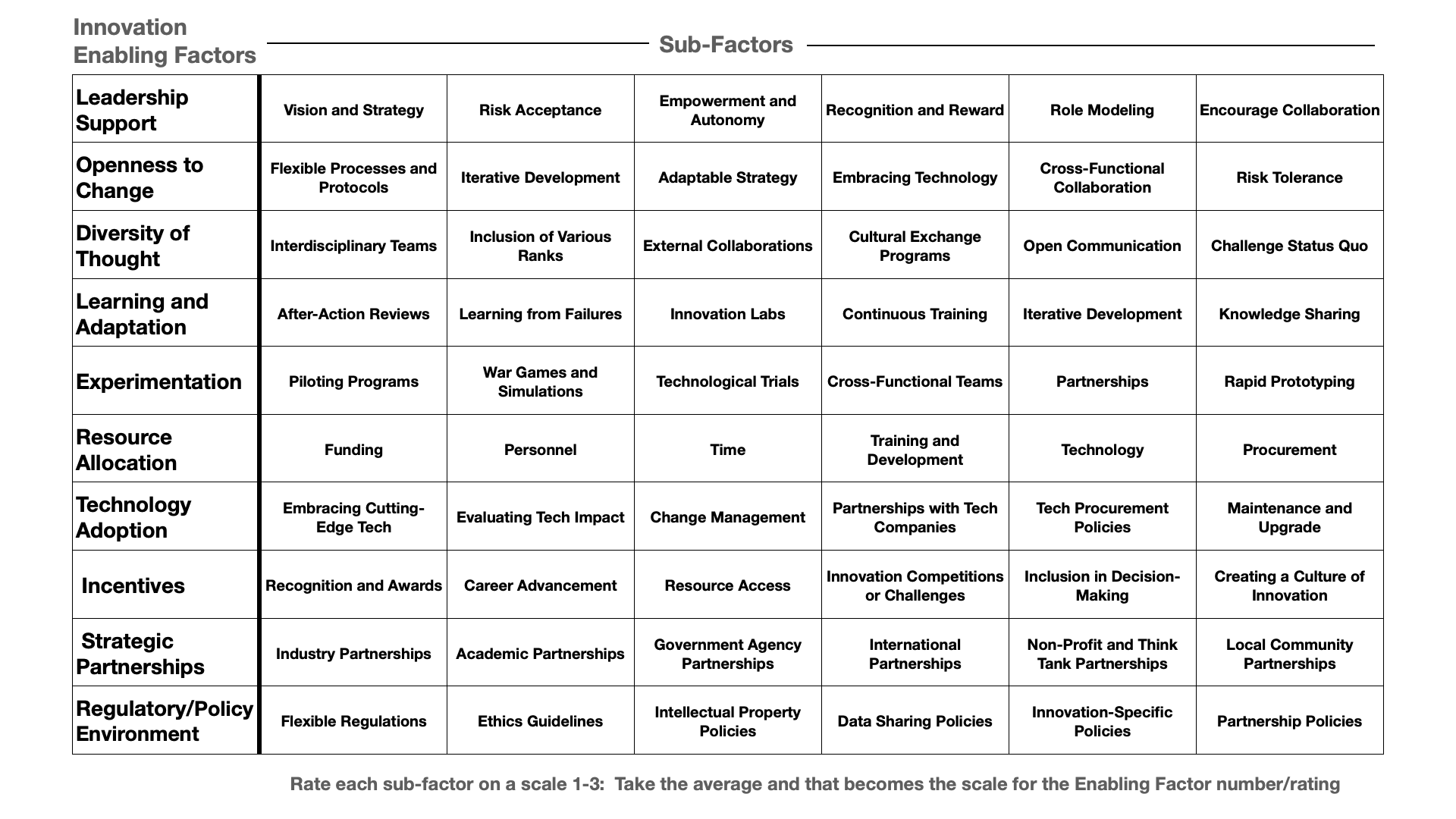
MATRIX EXPLAINED:
Leadership Support requires: (Leadership support is essential for fostering a culture of innovation. This support can take many forms and typically includes the following):
- Vision and Strategy: Leaders must articulate a clear and compelling vision for innovation that aligns with the organization’s strategic objectives. This vision should be communicated consistently and authentically to inspire and motivate the team.
- Risk Acceptance: Innovation inherently involves risk and uncertainty. Leaders can support innovation by demonstrating a tolerance for calculated risks and viewing failures as learning opportunities.
- Empowerment and Autonomy: Leaders can empower employees to innovate by giving them autonomy, trust, and the tools they need to experiment and implement their ideas.
- Recognition and Reward: Leaders can create an environment where innovative behavior is recognized and rewarded. This could involve formal recognition programs, promotion opportunities, or other incentives.
- Role Modeling: Leaders can also model the behaviors and mindsets that support innovation, such as curiosity, resilience, open-mindedness, and collaboration.
- Encourage Collaboration: Leaders can facilitate collaboration and knowledge sharing within and outside the organization. This can expose the team to diverse perspectives and ideas, which can spark innovation.
In sum, leaders play a critical role in fostering a culture of innovation by setting the direction, providing the necessary resources, creating a supportive environment, and leading by example.
Openness to change in the context of innovation within hard structures such as the military involves several factors:
- Flexible Processes and Protocols: While the military and similar organizations typically have rigid processes and protocols, there needs to be some flexibility built into these systems to accommodate and encourage innovation. This could mean creating channels to fast-track the testing and implementation of new ideas, or establishing ‘safe spaces’ where the usual rules can be bent for experimental purposes.
- Iterative Development: Openness to change also means embracing an iterative approach to development. This involves testing out ideas, learning from the results, and refining the idea based on feedback and learning, rather than expecting a perfect solution right from the start.
- Adaptable Strategy: Strategies should be adaptable to changing circumstances, whether those are changes in technology, adversary’s tactics, resource availability, or the broader geopolitical context.
- Embracing Technology: The military often has access to cutting-edge technology. Being open to change means actively seeking out and integrating these new technologies into operations, even when they disrupt established ways of doing things.
- Cross-Functional Collaboration: Encouraging collaboration between different functional areas, branches, or units can also facilitate change by introducing new perspectives and breaking down silos.
- Risk Tolerance: Openness to change also requires a certain level of risk tolerance. Not all innovations will work out as planned, and the organization needs to be able to handle setbacks and learn from them rather than avoiding all risks.
Openness to change is challenging in a structured environment like the military, where stability and predictability are often prized. However, it’s a necessary component of innovation and can be cultivated with the right leadership and institutional supports.
Diversity of thought in the innovation space, even in rigid structures like the military, is about fostering a range of perspectives, ideas, experiences, and cognitive styles within the organization. Here are some of the ways it can manifest:
- Interdisciplinary Teams: Forming teams from different disciplines or functions can help incorporate a wide range of perspectives and ideas. This can lead to creative problem-solving and innovative solutions.
- Inclusion of Various Ranks: Including personnel from different ranks and levels of the organization in the innovation process can ensure that a variety of experiences and viewpoints are considered. Often, those on the front lines may have valuable insights that aren’t apparent to those in leadership positions.
- External Collaborations: Partnerships with civilians, academia, industry, and international partners can introduce new ideas and approaches. Military-to-military cooperation can also facilitate the exchange of best practices and innovative strategies.
- Cultural Exchange Programs: Programs that allow for the exchange of personnel between units, services, or even nations can help introduce fresh perspectives and ideas.
- Open Communication: Creating an environment where all members of the organization feel comfortable voicing their ideas and opinions can encourage diversity of thought. This requires an open, respectful, and inclusive communication culture.
- Challenge Status Quo: Encouraging members of the organization to challenge existing norms, assumptions, and procedures can bring forth innovative ideas.
Something to consider, diversity of thought can only thrive in an inclusive environment where different ideas are valued and respected, and where there is a willingness to consider and test new ideas, even if they challenge the status quo.
In the context of the military and similar rigid structures, learning and adaptation refer to the capability to continually evolve based on new knowledge, experiences, and feedback. Here is how it can appear in the innovation space:
- After-Action Reviews: Regularly reviewing missions, exercises, and projects can provide opportunities to learn and adapt. This includes analyzing both successful and unsuccessful initiatives to identify what worked, what didn’t, and why.
- Learning from Failures: Fostering an environment where failures are viewed as learning opportunities, not just setbacks, can encourage more innovative risk-taking. This involves acknowledging and analyzing failures to understand their causes and prevent future repetitions.
- Innovation Labs: Creating dedicated spaces or units where new ideas can be tested, refined, and iterated upon based on feedback and results can support learning and adaptation.
- Continuous Training: Providing ongoing training opportunities helps personnel stay up-to-date with the latest knowledge, skills, and technologies, and adapt to changing circumstances or requirements.
- Iterative Development: Implementing an iterative development approach, where new solutions are tested, refined, and tested again, can allow for continual learning and adaptation.
- Knowledge Sharing: Facilitating the sharing of knowledge, experiences, and best practices within and between units, branches, or even partner nations can support collective learning and adaptation.
In essence, learning and adaptation in the innovation space involve continuously gathering and integrating new knowledge, staying open to change, and evolving strategies, tactics, and technologies based on experience and feedback.
Experimentation is a key aspect of innovation, even in rigid structures like the military. In such settings, it usually involves a controlled approach to testing and validating new concepts, technologies, and strategies. Here’s how it can manifest:
- Piloting Programs: Before a new technology or strategy is implemented widely, it might first be deployed on a small scale in a specific unit or setting. The results of the pilot program can then inform any necessary adjustments before wider implementation.
- War Games and Simulations: These activities can be used to experiment with new strategies, tactics, or technologies in a controlled environment. They provide a risk-free way to test out innovative ideas and learn from the results.
- Technological Trials: The military often has access to cutting-edge technology. Experimentation might involve testing out these new technologies in training or operations to see how they perform and how they might be integrated into existing systems.
- Cross-Functional Teams: Bringing together personnel from different functions or units can facilitate the exchange of ideas and enable experimentation with different approaches or perspectives.
- Partnerships: Collaborating with industry, academia, or other military organizations can provide opportunities for experimentation. This might involve testing out new technologies, conducting joint research, or learning from each other’s approaches.
- Rapid Prototyping: This is a method of quickly creating, testing, refining, and retesting prototypes of new products or systems. It allows for fast feedback and iterative improvement.
In a military or similar context, experimentation needs to be carefully managed to balance the need for innovation with the need to maintain safety, security, and operational effectiveness.
In the context of innovation within rigid structures such as the military, resource allocation is about directing specific resources – time, personnel, funds, equipment, and so on – to foster and support innovation efforts. Here are a few ways this might be realized:
- Funding: Budgeting specifically for innovation is a clear sign of commitment. This could involve setting aside funds for research and development, investing in new technologies, or funding innovation competitions or challenges.
- Personnel: Human resources are crucial for innovation. This could mean hiring personnel with specific expertise, designating existing personnel to focus on innovation, or creating dedicated innovation teams or units.
- Time: Innovation often requires time for exploration, brainstorming, experimentation, and implementation. Providing personnel with dedicated time to focus on innovation, perhaps as part of their regular duties, can support these activities.
- Training and Development: Allocating resources to training and development can support innovation by providing personnel with the skills and knowledge they need to innovate. This could involve training in areas like critical thinking, problem-solving, creativity, technology, or specific innovation methodologies.
- Technology: Investing in new technology can be a significant part of resource allocation. This might involve purchasing new equipment, software, or systems, or investing in research to develop new technologies.
- Procurement: In the military context, the procurement process can be a crucial part of resource allocation for innovation. This might involve prioritizing the procurement of innovative technologies or adjusting procurement policies to favor innovative solutions.
Remember, while resource allocation is crucial, it’s also important to ensure these resources are used effectively. This requires strong leadership, clear strategic direction, and robust mechanisms to monitor and evaluate the impact of innovation initiatives.
Technology adoption in the innovation space within structured organizations like the military refers to the acceptance, integration, and utilization of new and emerging technologies. It is a key enabling factor for innovation, offering the potential to revolutionize processes, improve efficiency, enhance capabilities, and generate new strategies. Here’s how technology adoption might look:
- Embracing Cutting-Edge Tech: The military often has access to cutting-edge technology, from artificial intelligence and machine learning to autonomous vehicles, drones, cyber tools, advanced sensors, and more. Embracing these technologies and integrating them into operations represents a key facet of technology adoption.
- Evaluating Tech Impact: After adoption, it’s important to evaluate the impact and effectiveness of the technology. This helps in learning and improving future tech adoption.
- Change Management: Introducing new technologies can require significant changes in processes, roles, and even culture. Effective change management can help ensure these transitions are successful and that new technologies are adopted smoothly.
- Partnerships with Tech Companies: Collaborations with tech companies or research institutions can facilitate access to the latest technology and accelerate its adoption.
- Tech Procurement Policies: Policies that prioritize or encourage the procurement of innovative technologies can also support technology adoption.
- Maintenance and Upgrade: Once technologies are adopted, they need to be maintained and upgraded as needed. This requires a certain level of resources and expertise.
In the military and similar structures, technology adoption must be balanced with considerations around security, cost, and potential disruption to operations. Nonetheless, with a strategic and systematic approach, technology adoption can greatly enhance capabilities and drive innovation.
Incentives in the innovation space, including rigid structures such as the military, are rewards or motivations that encourage personnel to engage in innovative activities. These incentives can be both intrinsic (self-motivation, fulfillment, job satisfaction) and extrinsic (tangible rewards). Below is how incentives for innovation might be realized:
- Recognition and Awards: Recognizing and rewarding innovative ideas or projects can incentivize innovation. This could involve formal awards, public recognition, or even promotions for those who lead or contribute significantly to innovative efforts.
- Career Advancement: Opportunities for career advancement can also serve as a powerful incentive. For example, leading an innovative project or demonstrating creative problem-solving skills could lead to promotion or more challenging assignments.
- Resource Access: Providing access to resources such as funding, technology, or expert guidance can incentivize innovation. This might involve, for instance, granting an innovative team additional funding or equipment, or allowing them to consult with an external expert.
- Innovation Competitions or Challenges: Organizing competitions or challenges around specific problems or objectives can incentivize innovation. Prizes or recognition for the winners can provide additional motivation.
- Inclusion in Decision-Making: Allowing personnel who are involved in innovation to participate in decision-making processes can make them feel valued and motivated.
- Creating a Culture of Innovation: Fostering a culture where innovation is valued and recognized can provide a powerful intrinsic incentive. In such a culture, personnel feel that their ideas are valued and that they can contribute meaningfully to the organization’s mission.
Incentives need to be carefully designed to ensure they truly encourage meaningful innovation and not just the appearance of innovation. They should be part of a broader strategy that includes leadership support, resource allocation, and an environment that fosters creativity and risk-taking.
Strategic partnerships in the context of military innovation are collaborations with external entities that are designed to bolster the capacity for innovation. These partnerships can provide access to new ideas, expertise, technologies, and resources that the military or other rigid structures might not otherwise have. Here’s what strategic partnerships might look like:
- Industry Partnerships: Collaborations with defense contractors or other private sector companies can facilitate access to cutting-edge technology and expertise. This might involve joint research and development initiatives, procurement contracts, or other forms of collaboration.
- Academic Partnerships: Collaborations with universities or research institutions can support innovation by providing access to cutting-edge research, expert knowledge, and specialized resources. These partnerships might involve joint research projects, personnel exchanges, or training programs.
- Government Agency Partnerships: Collaborations with other government agencies can leverage complementary skills, resources, and knowledge. For instance, partnerships with space agencies can support innovation in space technology, while partnerships with intelligence agencies can support innovation in data analysis and cybersecurity.
- International Partnerships: Collaborating with military organizations from other nations can facilitate the exchange of best practices, innovative strategies, and technologies. This might involve joint exercises, personnel exchanges, or coordinated research and development initiatives.
- Non-Profit and Think Tank Partnerships: Collaborations with non-profit organizations or think tanks can provide access to specialized knowledge and independent perspectives. This can support innovation in areas like strategy, policy, and organizational culture.
- Local Community Partnerships: These partnerships involve collaboration between the military and the local community to undertake specific projects or programs. They leverage the resources, efficiency, and innovative potential of the private sector, while ensuring that the projects align with possible military objectives.
In all these partnerships, it’s important to establish clear objectives, roles, and expectations. Effective communication, mutual trust, and a shared commitment to innovation are crucial. It’s also important to manage potential risks associated with these partnerships, such as the protection of sensitive information or conflicts of interest.
The regulatory and policy environment in the context of military and other rigid structures can either support or hinder innovation, depending on how it’s structured. In an ideal situation, this environment should be designed to facilitate and encourage innovative activities while managing risks. Here’s how this might look:
- Flexible Regulations: Regulations that allow for some degree of flexibility can facilitate innovation. For instance, procurement regulations might be adjusted to allow for the purchase of innovative technologies or to encourage defense contractors to invest in research and development.
- Ethics Guidelines: As new technologies and methodologies are introduced, it’s important to consider ethical implications. Having clear guidelines around ethical issues can ensure innovation is conducted responsibly.
- Intellectual Property Policies: Policies that protect the intellectual property rights of inventors and innovators can encourage innovation by ensuring they can benefit from their ideas and inventions.
- Data Sharing Policies: In today’s data-driven world, policies that facilitate the sharing of data while protecting privacy and security can support innovation. This could involve guidelines for sharing data within the organization, or between the organization and its partners.
- Innovation-Specific Policies: The organization might have policies specifically aimed at promoting innovation. This could involve policies around funding for innovation, personnel assignments to innovation projects, or the evaluation of innovative initiatives.
- Partnership Policies: Policies that encourage and guide partnerships with industry, academia, or other military organizations can provide access to additional innovation capabilities.
In essence, a supportive regulatory and policy environment for innovation would provide clear frameworks and guidelines for innovative activities, protect the interests of innovators, manage risks, and facilitate collaboration, all while remaining flexible enough to accommodate new and unexpected developments.
GRADING THE HARD STRUCTURE: Executing Innovation In Hard Structures
Given the above, the innovator must seek to rate the structure in order to map the innovation environment. It is a matter of finding the enabling factors that are positive and maneuvering around the ones that are less than positive, while seeking to perhaps turn the RED and YELLOW ares to GREEN. Consider the hypothetical matrix below:

The matrix suggests: It would appear leadership is supportive, but bureaucratic structures are not in place to support innovation over the longer term. Openness to change is lacking and the organization may suffer from homogeneous way of thinking. The organization has the processes in place to learn, but is not yet sure how to process the information deeper into the hard structure. There is an experimentation process and funding is available, but again the bureaucracy struggles in actually implementing an innovation culture. Internally technology is embraced, but external tech struggles to break into the structure. Incentives tend to be lacking as to strong strategic partnerships and the organization is a bit hamstrung by regulations and policies.
What innovative approach would an innovator adopt knowing the information above? Is there a way to navigate the above organization given the information provided? Or does the innovator simply give up as the incentives are limited and the road unsure? These are all questions any leader, innovator, or strategist must ask before stepping into the innovation space. Remember as Tom Hank’s said in A League of Their Own:
“It’s supposed to be hard. If it were easy, everyone would do it.”
BALANCE: It is a balance between the YANG of Order and the YIN of Chaos—it is too easy to simply dismiss innovation in a hard structure as too difficult or impossible. Balancing innovation in military or similar hard structures is a delicate process that requires a multifaceted approach. Here are some strategies that can help:
- Incremental Innovation: Incremental innovation involves making continual improvements to existing processes, technologies, or strategies. This can reduce risk while still leading to significant enhancements over time.
- Pilot Projects and Simulations: Testing new ideas or technologies through small-scale pilot projects or simulations can help manage risk. This allows potential issues to be identified and addressed before the innovation is implemented on a larger scale.
- Cross-functional Teams: Creating teams that include individuals with diverse skills and perspectives can foster more innovative ideas. These teams can also help ensure that the potential risks and benefits of an innovation are thoroughly evaluated.
- Partnering with External Entities: Collaboration with industry, academia, or international partners can provide access to additional expertise and resources. These partners can help in driving innovation while managing associated risks.
- Fostering a Culture of Innovation: Encouraging a culture where creativity, learning, and calculated risk-taking are valued can drive innovation. This involves leadership support, recognizing and rewarding innovative efforts, and providing training and resources to support innovation.
- Robust Evaluation Processes: Having rigorous processes for evaluating the potential risks and benefits of new technologies or strategies can help balance innovation and risk. This can include technology assessments, scenario planning, or risk-benefit analyses.
- Iterative Development: Using iterative development approaches, such as agile methodology, allows for rapid testing, feedback, and adaptation. This can help manage risks by allowing potential problems to be identified and addressed early on.
- Clear Communication: Clear and open communication about the importance of innovation, the acceptable level of risk, and the potential benefits and drawbacks of specific innovations can help ensure all members of the organization are aligned.
Balancing innovation and risk in hard structures like the military is a complex task, but with strategic planning, open communication, and a supportive culture, it can be achieved effectively.
FINALLY:
Innovation in rigid or “hard” structures such as the military is undoubtedly a complex challenge, especially when traditional enabling factors seem absent or limited. However, this challenge can be mitigated through strategies like grassroots innovation, leveraging external innovation, promoting incremental innovation, providing education and training, creating a safe space for failure, and executing small-scale pilot projects. Moreover, even under constraints, it’s crucial to capitalize on the enabling factors that are present, which may include existing resources, networks, technologies, and free or low-cost opportunities. Encouraging cross-functional collaboration and intrapreneurship can also serve as substantial drivers of innovation. It’s all about nurturing a culture of innovation by maximizing the available resources, rewarding creative problem-solving, and continually striving for improvement, no matter how incremental. As organizations adapt and evolve to maximize these factors, they foster a flexible, resilient structure that encourages innovation, despite inherent challenges.
 Mastermind Century Group