

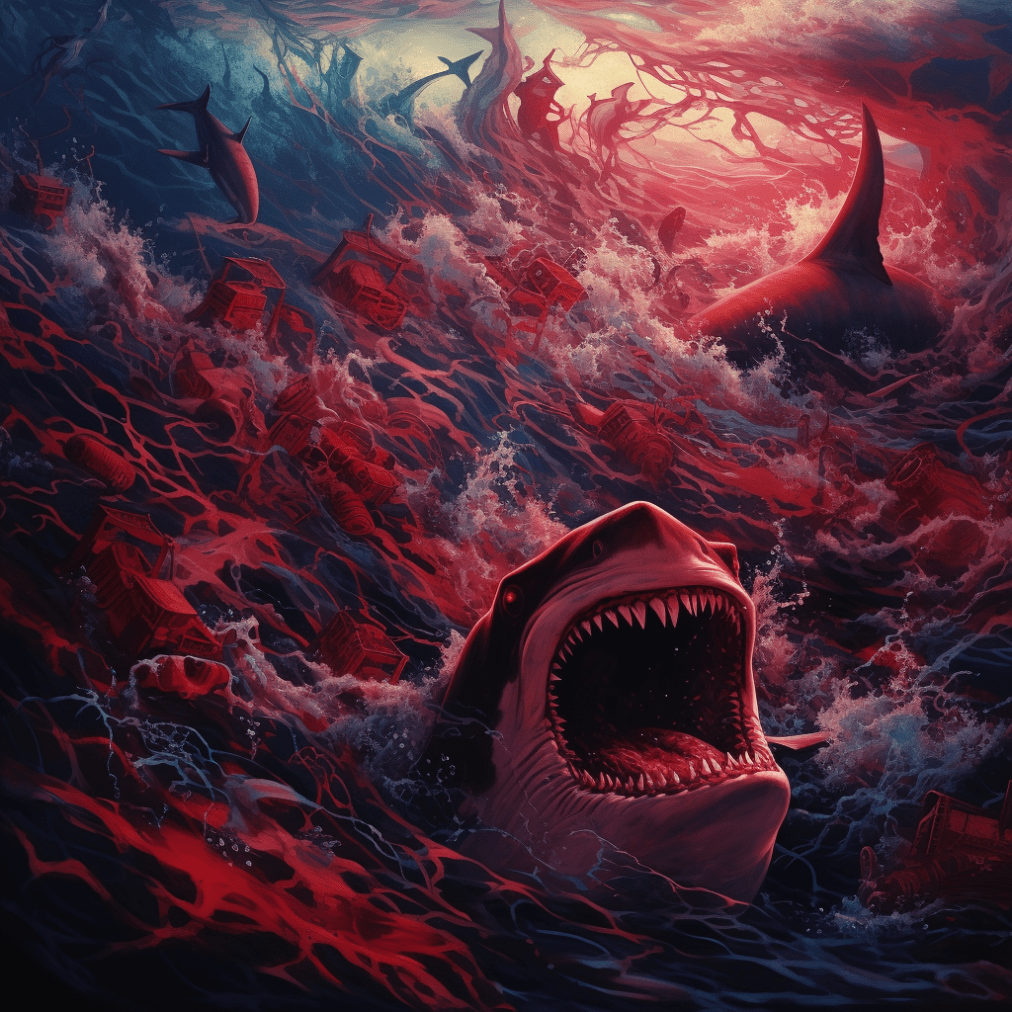
When I first heard of the Blue Ocean Strategy—all I could think of was Blue Ocean, like open skies—few competitors, etc. Red Ocean, lots of blood, sharks, competition, and so on. I recently read Friedman’s book Strategy: A History where he addresses Blue and Red Ocean strategies. Just thought it might be interesting to dive into the “thrilling” world of ocean strategy, but with a twist—to take these dry, corporate concepts and apply them to something a bit more… explosive. …What do they mean for military history and strategy. So what happens when boardroom jargon meets sees “combat?”.

The terms “Red Ocean” and “Blue Ocean” are used in business strategy to describe the market landscape and competition. They were first introduced in the book “Blue Ocean Strategy,” written by W. Chan Kim and Renée Mauborgne. Here’s a brief comparison of the two:
Red Ocean Strategy:
- This strategy operates in existing market space.
- It involves beating the competition to succeed.
- It exploits existing demand.
- It often involves making the value-cost trade-off.
- The competition in these markets is often cut-throat, hence the term “red” ocean.
Examples of Red Ocean Strategy might include traditional cola wars like Pepsi vs. Coca-Cola, where both companies are trying to gain market share in the same product space.
Blue Ocean Strategy:
- This strategy creates uncontested market space, making the competition irrelevant.
- It creates and captures new demand.
- It breaks the value-cost trade-off.
- It aligns the whole system of a firm’s activities in pursuit of differentiation and low cost.
An example of a Blue Ocean Strategy is the launch of the Nintendo Wii. Instead of competing directly with powerful competitors like Sony’s PlayStation and Microsoft’s Xbox in terms of processing power and graphics, Nintendo created a new market of casual gamers with a unique, easy-to-use, and physically engaging gaming system.
Simply put: Red Ocean Strategy is about competing in existing markets and capturing a larger share of existing demand, while Blue Ocean Strategy is about exploring and creating new markets and demand. Both strategies have their own merits and can be used depending on the company’s situation, resources, and objectives.
MAIN THESIS OF THE BOOK: BLUE OCEAN STRATEGY
The main thesis of the book “Blue Ocean Strategy” by W. Chan Kim and Renée Mauborgne is that companies can succeed not by battling competitors, but rather by creating “blue oceans” of uncontested market space. These blue oceans are ripe for growth and are created through a process of market innovation.
Here are the key points of the book’s thesis:

- Create Uncontested Market Space: Instead of competing in a crowded industry with many competitors (a “red ocean”), companies should seek to create new, uncontested market space (a “blue ocean”) where competition is irrelevant.
- Value Innovation: The cornerstone of blue ocean strategy is ‘value innovation’. This involves creating a leap in value for both the company and its customers. It’s not about technology innovation, but about utility, price, and cost positions.
- Break the Value-Cost Trade-off: Companies should seek to break the value-cost trade-off, meaning they should aim to provide higher value to customers at a lower cost.
- Align the Organization: The strategy involves aligning the whole system of a firm’s activities in pursuit of differentiation and low cost.
- Overcome Key Organizational Hurdles: The book discusses how to overcome key organizational hurdles that can stymie the implementation of a blue ocean strategy.
- Build Execution into Strategy: The authors argue that successful blue ocean strategy includes proper execution, which involves building execution into the strategy from the start.
- Renew Blue Oceans: Finally, the book suggests that once a blue ocean has been created, it’s necessary to renew it over time to ensure that it doesn’t turn into a red ocean.
The book provides a framework and tools for organizations to create and capture their own blue oceans. It’s a shift from a competition-focused approach to a strategy of market creation and innovation.
HISTORICAL EXAMPLES OF BLUE OCEAN STRATEGY
There are several historical examples of companies that have successfully implemented a Blue Ocean Strategy, creating new markets where there was little to no competition. Here are a few:

- Cirque du Soleil: Instead of competing with traditional circuses, Cirque du Soleil created a new market for a circus-like entertainment experience that appeals to an adult demographic. They removed elements like animal shows and star performers, and added elements of theater and character-driven plots, creating a unique blend of circus and theatre.
- Apple’s iPod and iTunes: When Apple introduced the iPod and iTunes, it created a new market for legal digital music downloads, which was a blue ocean at the time. The iPod wasn’t just another MP3 player; it was part of an integrated music downloading and management system.
- Southwest Airlines: Southwest Airlines created a new market for budget travel by eliminating many of the “extras” that traditional airlines offered and focusing on providing reliable, low-cost flights. This appealed to a new demographic of travelers who might not have been able to afford air travel otherwise.
- Nintendo Wii: Instead of competing on graphics and processing power like Sony’s PlayStation and Microsoft’s Xbox, Nintendo created a new market of casual gamers with a unique, easy-to-use, and physically engaging gaming system.
- Netflix: Netflix created a blue ocean by offering a subscription-based, ad-free streaming service with an extensive library of films and TV shows. Later, they expanded into producing their own content, further differentiating themselves from traditional TV networks and other streaming services.
Each of these companies found success by not competing directly with existing industries but by creating new market spaces and value innovation.
MILITARY EXAMPLES OF BLUE OCEAN STRATEGY
While the concept of Blue Ocean Strategy is primarily used in the business world, it can also be applied to military history. Here are a few examples:

- Hannibal’s Crossing of the Alps: During the Second Punic War, the Carthaginian general Hannibal Barca took a completely unexpected route to invade Roman Italy by crossing the Alps. This was a Blue Ocean Strategy as it was an uncontested and unexpected move that caught the Romans off guard.
- Normandy Invasion (D-Day): The Allies in World War II created a “blue ocean” by choosing to invade Normandy, a less fortified area, instead of the heavily defended Pas-de-Calais region. The deception strategies used to mislead the Germans about the invasion point also fall into the Blue Ocean Strategy.
- Guerilla Warfare: The use of guerrilla warfare tactics by smaller or less equipped forces against larger, traditional armies can be seen as a Blue Ocean Strategy. By not engaging in conventional warfare and instead using tactics like ambushes, sabotage, and hit-and-run attacks, these forces create a new, uncontested “battlefield” where they have the advantage.
- Submarine Warfare: The development and use of submarines in warfare created a new “ocean” for naval combat. Instead of engaging in traditional surface naval warfare, submarines could attack unseen from beneath the waves, creating a new dimension of naval warfare.
- Cyber Warfare: The rise of cyber warfare has created a new “blue ocean” in military strategy. Instead of traditional physical warfare, nations can now attack each other’s infrastructure through the internet, which is a largely uncontested and rapidly evolving “battlefield”.
Remember, these examples are metaphorical applications of the Blue Ocean Strategy concept to military history. The actual Blue Ocean Strategy framework is a business strategy concept and doesn’t directly apply to military strategy.
HISTORICAL EXAMPLES OF RED OCEAN STRATEGY
A “Red Ocean Strategy” refers to a business approach where companies compete in existing market space, try to beat the competition, and exploit existing demand. Here are a few historical examples:

- Coca-Cola vs. Pepsi: The cola wars between Coca-Cola and Pepsi represent a classic example of a Red Ocean Strategy. Both companies compete in the same market space (carbonated soft drinks), and they continually try to outdo each other in terms of pricing, marketing, and product variations to win a larger market share.
- Ford vs. General Motors: The automobile industry, particularly the competition between Ford and General Motors in the 20th century, is another example. Both companies competed fiercely for market share, offering similar products to the same customer base.
- McDonald’s vs. Burger King: In the fast-food industry, McDonald’s and Burger King have been long-standing competitors. They offer similar products (fast food burgers) and compete for the same customers, often through price wars, promotional offers, and advertising campaigns.
- Apple vs. Samsung: In the smartphone market, Apple’s iPhone and Samsung’s Galaxy series are direct competitors. They continually try to outperform each other with new features, design elements, and technological advancements.
- Microsoft vs. Sony in the Console Market: The competition between Microsoft’s Xbox and Sony’s PlayStation is a clear example of a Red Ocean Strategy. Both companies are fighting for market share in the same space, constantly trying to outdo each other with more powerful hardware, exclusive games, and subscription services.
In each of these examples, companies are operating in a “Red Ocean” – a market where boundaries are defined and known, and the competitive rules of the game are set. The competition can be fierce, and it often revolves around price, product features, quality, and branding.
MILITARY HISTORICAL MILITARY EXAMPLES OF RED OCEAN STRATEGY
The concept of “Red Ocean Strategy” is primarily used in the business world to describe a competitive environment where companies fight for dominance in the same market space. However, if we apply this concept metaphorically to military history, a Red Ocean Strategy would involve direct, head-to-head confrontation with the enemy using similar tactics and weapons. Here are a few examples:

- Trench Warfare in World War I: Both sides used similar tactics and weaponry, resulting in a stalemate with enormous casualties. This is a classic example of a Red Ocean Strategy, where neither side could gain a decisive advantage because they were fighting in the same way.
- The Battle of Waterloo: Napoleon Bonaparte’s final battle was against an allied army under the command of the Duke of Wellington. Both sides used traditional tactics of the time, and the battle was a direct confrontation.
- The Pacific Theater in World War II: The island-hopping strategy used by the Allies and the defensive tactics used by the Japanese involved direct, often brutal confrontations. Both sides were fighting for control of the same territories.
- The Cold War Arms Race: The United States and the Soviet Union were in direct competition to build up their nuclear arsenals. This is a Red Ocean scenario where two superpowers were vying for dominance in the same space – nuclear weaponry.
- The Hundred Years’ War: The long conflict between England and France during the Middle Ages involved many battles fought using similar tactics and weapons. Both sides sought to gain control of the same territory (the Kingdom of France), making it a Red Ocean situation.
Remember, these examples are metaphorical applications of the Red Ocean Strategy concept to military history. The actual Red Ocean Strategy framework is a business strategy concept and doesn’t directly apply to military strategy.
FINALLY
And there you have it. So, what’s the strategy going to be? Charge headlong into the bloody red ocean, swords clashing and banners flying? Or chart a course for the serene blue waters, where the potential for victory is as vast as the sea itself? Choose wisely, for in the game of strategy, whether in business or warfare, the stakes are high. Now, go forth and conquer…

 Mastermind Century Group