

Systems Thinking
My head is on straight
My heart is in peace
My soul is incredibly
Ready to change history
It’s a good day
To fight the system, to fight the system
It’s a good, good, good day
Yes, a good, good, good day. – Shungudzo, 2021
Systems thinking is an approach to problem-solving that views “systems” – whether they’re parts of a business, societal issues, or natural phenomena – as wholes rather than as collections of parts. It emphasizes the relationships between these parts and how they interact to form the overall system, rather than focusing on the parts in isolation.
This approach recognizes that a change in one area of a system can affect other areas of that system, and that such interactions can drive the system’s behavior and performance over time. It also takes into account that systems are often nested within other systems and that they are dynamic and constantly changing.
For example, in an ecological system, changing one element (like the population of a certain species) can have cascading effects on the rest of the system, affecting other species and potentially the overall health of the ecosystem.

Similarly, in a business context, changes in one department (like a new hiring policy in human resources) can affect other departments (like the productivity of the marketing department).
Systems thinking encourages holistic understanding and addressing underlying systemic issues rather than symptomatic problems. It is valuable in dealing with complex issues and problems that are interconnected and interdependent, and it can be applied in many fields, from strategy, to business and management to healthcare, education, and environmental planning.
Systems thinking views problems as part of a wider system, rather than isolating them. It focuses on the relationships and interactions among the components of a system, as well as the system’s behavior as a whole, rather than concentrating on individual parts in isolation.
Here are some key elements of systems thinking:
- Holistic Perspective: Systems thinking involves looking at the whole system, rather than focusing solely on its individual components. It considers how the components are interrelated and how they work together to form the system’s behavior.
- Understanding Relationships and Connections: A critical aspect of systems thinking is recognizing that the components of a system are interconnected, and changes in one part of the system can have ripple effects on other parts.
- Feedback Loops: Systems often have feedback loops where the output of a system affects its input, and this, in turn, influences the output. Understanding these feedback loops is crucial in systems thinking.
- Dynamic Complexity: Systems can be highly complex and dynamic. They change over time, and their behavior can be difficult to predict. Systems thinking acknowledges this complexity and attempts to understand how different factors influence each other over time.
- Emergent Properties: These are properties that emerge from the interactions of the parts of a system, which cannot be found in the individual parts. In systems thinking, it is recognized that a system’s behavior often arises from the interplay of its components.
- Leverage Points: Systems thinking seeks to identify points in a system where a small change can lead to significant improvements in the system as a whole.
- Delay: Acknowledging that in complex systems there might be delays between the time an action is taken and the time its effects are fully seen.
- Perspective: Recognizing that different people may have different perspectives on a system, and these multiple perspectives can be valid and provide valuable insights.
SYSTEMS THINKING AND STRATEGIC COMPETITION
In the context of strategic competition, whether it’s between businesses, nations, or any other entities, systems thinking can provide critical insights and advantages. Here’s how:

- Understanding Interdependencies: Systems thinking helps to understand the interconnectedness and interdependencies within and between systems. This can illuminate how changes in one part of the system might impact other parts, and how these ripple effects can influence the overall competitive landscape.
- Identifying Leverage Points: Systems thinking can aid in identifying leverage points in the system—places where a small shift can produce significant impacts on the whole system. These leverage points can be targeted to bring about desired changes or to counter the moves of competitors.
- Anticipating Unintended Consequences: By taking a holistic view, systems thinking can help anticipate the unintended consequences of strategic actions. This can prevent strategies that look good in isolation but might have negative impacts when the broader system is considered.
- Long-term Planning: Systems thinking encourages a focus on long-term impacts and sustainability. This can lead to strategies that provide lasting competitive advantage, rather than short-term gains that may be unsustainable in the long run.
- Adaptability: Recognizing that systems are dynamic and constantly evolving can foster adaptability and resilience. This is particularly important in today’s rapidly changing world, where the ability to adapt to new circumstances can be a key competitive advantage.
In the “age of strategic competition,” whether it’s geopolitical competition between nations or corporate competition in global markets, systems thinking provides a more nuanced understanding of complex realities. It can help to formulate strategies that are effective, resilient, and adaptable, thereby providing a competitive edge.
SYSTEMS THINKING AND THE COLD WAR
Pondering “The Cold War as a system of systems” refers to the idea that the Cold War was not a monolithic conflict, but rather a complex network of interconnected systems. These systems include political, economic, social, cultural, technological, and military elements. Each of these systems, in turn, was composed of many sub-systems. For instance, the political system would include the domestic politics of various nations, international diplomacy, propaganda, espionage, and more.

To elaborate:
- Political System: This was arguably the most visible aspect of the Cold War. It was characterized by a bipolar global order, with the United States and the Soviet Union being the two superpowers. Within each of these blocs were numerous allied nations, and many other countries attempted to maintain a non-aligned status. This system also included international bodies like the United Nations, where Cold War tensions often played out.
- Economic System: The economic systems of the US and the USSR were fundamentally different, with the former being capitalist and the latter being communist. This led to the development of different economic blocs, each with its own trade agreements, financial institutions, and economic policies.
- Social System: The ideological differences between the two superpowers were reflected in their societies. This led to different cultural values, norms, and institutions. The conflict between these social systems was a major factor in the Cold War, and it manifested in various ways, from educational policies to mass media.
- Technological System: The Cold War saw significant advancements in technology, particularly in areas related to military and space exploration. The “Space Race” and the nuclear arms race are examples of this. These developments were driven by a complex system of research institutions, industries, and government agencies.
- Military System: The Cold War was characterized by a massive build-up of military forces and complex alliances. The North Atlantic Treaty Organization (NATO) and the Warsaw Pact are examples of the military systems that were created during the Cold War.
Each of these systems influenced and was influenced by the others, creating a highly complex and dynamic situation. For instance, developments in the technological system (like the invention of nuclear weapons) would have profound effects on the military, political, and social systems. Similarly, changes in the political system (like the rise or fall of certain leaders) could impact all the other systems.
Therefore, considering the Cold War as a “system of systems” can provide a more nuanced and comprehensive understanding of this historical period.
CHINA AS A SYSTEM OF SYSTEMS
Similar to the Cold War, tensions with China can also be seen as a “system of systems.” This includes various interconnected systems such as political, economic, technological, military, and cultural.
- Political System: Tensions between China and other nations often play out in the political realm. This can include disagreements over human rights, territorial disputes, and differing ideologies. China’s rise as a global power and its increasing influence in international organizations like the United Nations also play a part in this system.
- Economic System: The economic relationship between China and the rest of the world is complex and multifaceted. There is substantial trade between China and other countries, but there are also significant tensions. These can arise from issues like trade imbalances, allegations of intellectual property theft, or differing economic policies and regulations. The growth of China’s economy and its influence in global economic institutions are also key factors in this system.
- Technological System: Technology is a major area of competition between China and other nations. This includes areas like telecommunications (e.g., the 5G technology), artificial intelligence, and cybersecurity. Concerns about the use of Chinese technology for surveillance or espionage also contribute to this tension.
- Military System: China’s military expansion in the South China Sea and its increasing global military presence are sources of tension. Its military modernization, including the development of advanced weapons systems and capabilities, contributes to regional and global security concerns.
- Cultural System: There can be tension between the cultural systems of China and other countries. This can manifest in various ways, such as differing views on issues like freedom of speech or the role of the state in society. The spread of Chinese state media and Confucius Institutes around the world can also be a point of contention.

Each of these systems is interconnected with the others, and changes in one system can influence the others. For example, a technological development (like a new piece of Chinese technology) could impact the economic, military, and political systems.
Understanding the tensions with China as a “system of systems” provides a holistic and nuanced view of these complex relationships. It can help policymakers and analysts identify potential points of conflict or cooperation and develop more effective strategies for managing these relationships.
SYSTEMS THINKING AND STRATEGY
Systems thinking is extremely valuable when applied to strategy. It helps in understanding the complexity and interconnectedness of various elements and provides insights for making better strategic decisions. Here’s how it applies to strategy:
- Understanding the Big Picture: Systems thinking enables strategists to see the big picture and understand how different parts of an organization or environment are interrelated. This helps in making strategic decisions that take into consideration the entirety of the system rather than just isolated parts.
- Adapting to Change: Systems are often dynamic and change over time. By understanding the feedback loops and interconnections, strategists can be more agile and adaptable in their approach, making it easier to respond to changes in the environment.
- Identifying Leverage Points: Systems thinking helps in identifying points in the system where a small change can have a large impact. Strategists can use this knowledge to focus efforts where they will be most effective.
- Mitigating Unintended Consequences: Traditional approaches may not always consider the ripple effects of strategic decisions. Systems thinking enables strategists to anticipate and mitigate unintended consequences by understanding how various elements are connected.
- Innovation and Problem Solving: By looking at problems through the lens of systems thinking, strategists can find innovative solutions that might not have been evident through a more narrow focus.
- Stakeholder Perspectives: In systems thinking, understanding different perspectives is crucial. In strategy, this translates to considering the perspectives of various stakeholders – customers, employees, partners, and others. This helps in creating strategies that are more inclusive and effective.
- Long-term Focus: Systems thinking encourages a long-term focus, considering not just immediate outcomes but how actions will affect the system over time. This is particularly important in strategy, where short-term gains can sometimes undermine long-term success.
- Resource Optimization: By understanding how different parts of a system interact and affect each other, strategists can optimize the allocation of resources across the system to achieve desired outcomes more efficiently.
- Risk Management: Systems thinking can be used to identify potential risks by analyzing the relationships and dependencies within a system. This information can then be used to create strategies that are more resilient and can better manage these risks.
- Learning and Improvement: Systems thinking encourages continuous learning and improvement. By analyzing how a strategy affects the system, and how the system responds, strategists can learn and refine their approach over time.
Further, In terms of geostrategy, understanding each system and how they interact can help in the development of comprehensive and effective approaches to managing tensions and fostering cooperation. Here’s how each system could inform strategic considerations:
- Political System: Understanding the political landscape is key to diplomatic strategy. This involves recognizing the motivations and goals of political leaders, the structure and dynamics of the political system, and the role of international bodies. With this understanding, a nation could formulate strategies to navigate political tensions, negotiate effectively, and build alliances.
- Economic System: Economic strategy could involve leveraging trade relations, economic aid, sanctions, and investment to incentivize cooperation or to put pressure on the other party. Understanding the nuances of the economic system, including the other party’s key industries, economic vulnerabilities, and trade policies, is crucial to developing such strategies.
- Technological System: In the realm of technology, strategy could involve fostering innovation, protecting intellectual property, and managing cybersecurity threats. This could mean investing in research and development, creating policies to protect domestic industries, and building robust cybersecurity defenses.
- Military System: Military strategy would involve understanding the other party’s military capabilities, their strategic objectives, and their alliances. This could inform decisions about defense spending, military alliances, force deployment, and arms control negotiations.
- Cultural System: In the cultural realm, strategy could involve public diplomacy and information campaigns to foster a better understanding and goodwill. This could involve exchange programs, the promotion of a nation’s culture and values abroad, and efforts to counter misinformation.
Each of these strategic approaches would not exist in isolation but would need to be coordinated to ensure they are mutually reinforcing and not working at cross-purposes. For instance, a decision in the military realm (like increasing defense spending) could have implications in the political, economic, and cultural systems. Therefore, a “system of systems” perspective can help ensure that strategies are holistic, coordinated, and responsive to the complex realities of international relations.
DIAGRAM
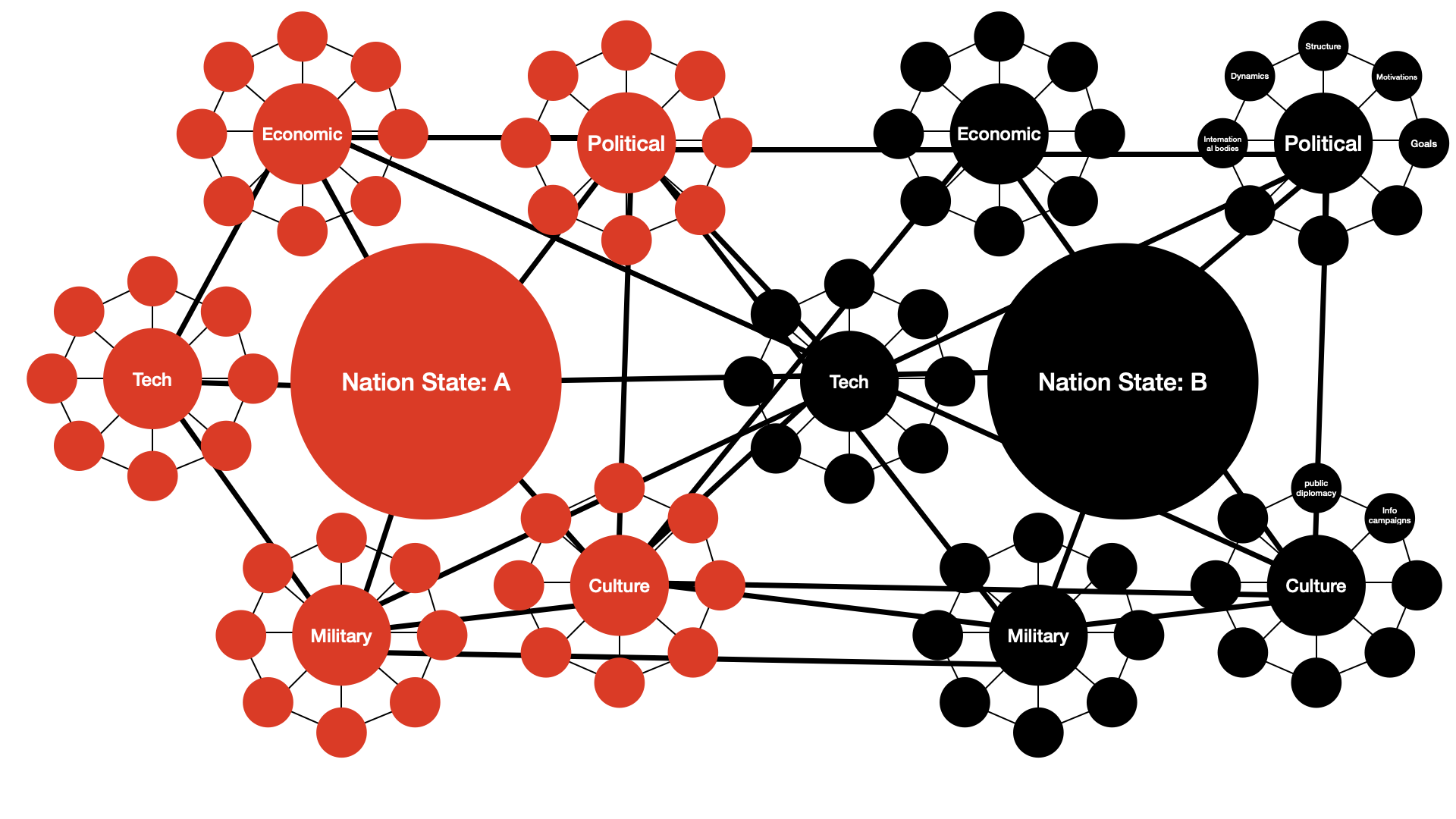
To diagram the “system of systems” concept for the tensions with China, one might begin with a central circle that represents the overall relationship between China and the other nation (e.g., United States). From this central circle, you could draw lines to smaller circles that represent each system: Political, Economic, Technological, Military, and Cultural.
In each of these system circles, one could include key elements. For example, in the Political system circle, one might include elements like “Diplomatic Relations,” “International Bodies,” and “Political Ideologies.” Similarly, in the Economic system circle, you could include elements like “Trade,” “Investment,” and “Economic Policies.”
To represent the interconnections between these systems, one could draw lines or arrows between the different system circles. For example, one might draw a line from “Trade” in the Economic system to “Diplomatic Relations” in the Political system to represent how economic ties can influence diplomatic relations.
Finally, to represent strategic considerations, one might draw another layer of circles around each system circle. These would represent the strategic approaches relevant to each system, like “Negotiation Tactics” for the Political system or “Defense Spending” for the Military system.
This would result in a complex web of circles and lines, representing the various systems, their elements, and their interconnections. This kind of diagram could provide a visual representation of the complexity of the “system of systems” concept and could be a useful tool for strategic planning and analysis.
In conclusion, the complexity of our world, especially in the age of strategic competition, necessitates a systems thinking approach. The interconnected and interdependent nature of global systems – political, economic, technological, military, and cultural – demands a comprehensive perspective that considers the whole rather than just the parts. Systems thinking allows us to understand interdependencies, identify leverage points, anticipate unintended consequences, focus on long-term impacts, and foster adaptability.
We urge policymakers, business leaders, strategists, and all stakeholders to embrace systems thinking in their decision-making processes. Do not view challenges or opportunities in isolation but consider their broader context and the systems in which they operate. Invest in training and tools that facilitate a systems perspective. It is through this holistic approach that we can navigate the complexities of strategic competition, mitigate risks, seize opportunities, and build a more sustainable and resilient future.

 Mastermind Century Group