
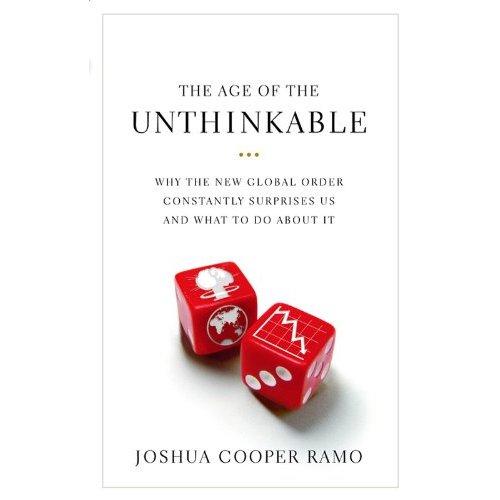
Several weeks ago the 100th Operations Group hosted Statoil’s Chief Global Strategist and Business Developer, Mr John Knight. John mentioned “The Age of the Unthinkable” shaped much of Statoil’s new Global look… and launched Statoil to new and exciting growth. I had read the book when it was first released but needed to go back and refresh my knowledge. Great piece and worth a read… or at least a quick look at the summary below.
Also encourage a quick look at Statoil and John Knight, here
Good news- It is a stimulating book that make you more seriously contemplate the alarming nature of our rapidly changing and crazy world; a world in which uncertainty and indeterminacy are givens, and avalanches, negative cascades and tectonic shifts are ever-present dangers.
Bad news- A little “new agey”, political, and sometimes fuzzy. –might need a thesaurus to help. It was also difficult to glean some practical applications and tactics.
Summary:
Joshua Cooper Ramo is the managing director of Kissinger Associates; the controversial “geostrategic advisory firm” founded by the former secretary of state, and was formerly an editor for Time Magazine. In this provocative book, Mr. Ramo argues that today’s complex, interconnected, globalized world requires policy makers willing to toss out old assumptions (about cause and effect, deterrence and defense, nation states and balances of power) and embrace creative new approaches. Today’s world, he suggests, requires resilient pragmatists who, like the most talented Silicon Valley venture capitalists on the one hand or the survival-minded leadership of Hezbollah on the other, possess both an intuitive ability to see problems in a larger context and a willingness to realign their organizations continually to grapple with ever-shifting challenges and circumstances. He assesses the precarious state of today’s post-cold-war world in which nation states face asymmetric threats from the likes of terrorists, drug cartels and computer hackers.
The central image that the author uses to evoke what he calls this “age of surprise” is Per Bak’s sand pile. Danish-American physicist, Per Bak, argued two decades ago that if grains of sand were dropped on a pile one at a time, the pile, at some point, would enter a critical state in which another grain of sand could cause a large avalanche, or nothing at all. It is a hypothesis that shows that a small event can have momentous consequences and that seemingly stable systems can behave in highly unpredictable ways.
It is also a hypothesis that Ramo employs in this book as a metaphor for a complex world in which changes in politics, ecosystems or financial markets take place not in smooth, linear progressions but as sequences of fast, sometimes catastrophic events. Real-life sand-pile avalanches, like the collapse of the Soviet Union or the 1929 crash of the stock market, the author declares, demand “a complete remapping of the world”. Policymakers must dump a lot of their old thinking to cope with this unpredictable new order.
As Ramo observes,“Theories that involve only armies and diplomats don’t have much use” when “confronted with the peculiar nature of a financially interconnected world, where danger, risk and profit are linked in ways that can be impossible to spot and manage”…and complex systems “tend to become more complex as time goes on”
And the systems never get simpler.“There was no moment at which they would evaporate or condense into a single, easy-to-spot target such as the U.S.S.R. The 1979 Islamic revolution in Iran, for example, was a single very knotty event that, in turn, gave birth to hundreds of jihadist groups, each of which developed different methods of terror, particular techniques of attack and destruction, which themselves were always changing and evolving.”
In this sand-pile world, a small group of terrorists armed with box cutters can inflict a terrible blow on a superpower as Al Qaeda did on 9/11/2001, just as bands of insurgents in Iraq managed to keep the mighty United States military at bay for years. In Iraq, Ramo notes, is a war that showcased all of America’s most “maladaptive” tendencies. It was inaugurated on the premise of flawed thinking and planning: that it would have “a clean, fast end” and would lead to a democratic regime that would transform the Middle East in a positive fashion. And the certainty of administration officials not only led to incorrect assumptions (like the bet that “the ‘ecosystem’ of Iraq would settle into something stable that could be left to run itself”) but also resulted in an ill-planned and rigid occupation that was “incapable of the speedy refiguring that life in a war zone” inevitably requires.
Applications:
So how should leaders cope with the sand-pile world? How can they learn to “ride the earthquake” and protect their countries from the worst fallout of such tremors? Mr. Ramo suggests that they must learn to build resilient societies with strong immune systems: instead of undertaking the impossible task of trying to prepare for every possible contingency, they ought to focus on things like “national health care (oops), construction of a better transport infrastructure and investment in education.”
He suggests that leaders should develop ways of looking at problems that focus more on context than on reductive answers. And he talks about people learning to become gardeners instead of architects, of embracing Eastern ideas of indirection instead of Western patterns of confrontation, of seeing “threats as systems, and not objects.” So…..
1. Get smarter and think differently
Really think out of the box in planning, problem solving and more. Your competitors are.
Read more about new ways of thinking. Google interesting and new topics highlighted in this BVC Opinion.
2. Change and Lead Change More Quickly Than Ever
The pace will never slow down. It will only get faster. So understand it, benefit from it and help others understand it and benefit from it too.
3. Connect Rather Than Alienating, Isolating or Striking Back
This is a tough one, but as I have believed for years, in the face of conflict we all have options and all are appropriate at times. We can:
• Avoid
• Accommodate • Compete
• Compromise or • Collaborate
This author certainly leans toward compromise and collaboration and a bit more of that may be helpful in this “unthinkable” new age.
4. Do Unthinkably Decent Things
Use your imagination in the workplace, at home, in other walks of life to make a POSITIVE difference. If not you, who and if not now, when?
5. Step Up, Be Bold, Be Courageous
And answer this question posed by the author: What does this new age demand of me?
 Mastermind Century Group