

 Bad strategy is more than just the absence of good strategy. All too often, bad strategy consists of nothing more than platitudes, unrealistic goals and warm-and-fuzzy sounding slogans. Good strategy, by contrast, specifies how an organization will focus its resources to respond to challenges and move forward toward greatness.
After reading Does U.S. Need Grand Strategy by Harry Kazianis in State Department’s “Flash Points:” The Diplomat Blog–I was a bit perturbed that we would have folks in the Federal Government that have no appreciation or understanding of Grand Strategy.
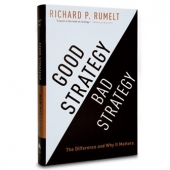 There is definitely room here for a long dissertation, but it’s Sunday and it’s snowing…so I recently picked up “GOOD STRATEGY BAD STRATEGY: The Difference and Why It Matters” by Richard Rumelt (www.goodbadstrategy.com)–so without going to Clausewitz, Jomini, or JFC Fuller… felt perhaps we could pull from a business book by Rumelt.
A quick glance at Rumelt’s points:
The four major harbingers of bad strategy are:
Fluff – the stated strategy is gibberish or superficial restatements of the obvious mixed with buzzwords. It’s like a bank saying: “Our fundamental strategy is to be a bank.” Fluff results when expertise, thought and analysis are completely absent.
 Failure to face the challenge – which is serious…if you cannot define the challenge, you cannot come up with a strategy to improve it. A strategy is a way to respond to a challenge or to overcome an obstacle. If the challenge is not defined, it becomes impossible to assess the quality of the strategy and instead one ends up with something which is more like a goal, a budget or a laundry list of things an organization HOPES will come to pass.
Mistaking goals for strategy – being content to have statements of intent rather than concrete plans for overcoming obstacles. Stating “We will grow revenue by 20% a year while maintaining a profit margin of at least 20%” isn’t a strategy. It’s a goal. There’s nothing wrong with setting goals but they are not strategy. To obtain higher performance, leaders must identify obstacles to growth and develop a coherent approach to overcoming them. This–of course–is when a true strategy will emerge.
 Utilizing bad strategic objectives – an organization fails to address critical issues or develops something completely impractical. Good strategy focuses energy and resources on a very few pivotal objectives which will lead to a cascade of favorable outcomes.
Bad strategy flourishes because:
– Organizations are unwilling or unable to choose goals.
– Leaders are following a fill-in-the-blanks template.
– Leaders are attempting to do something/anything to make up for their lack of talent, training, experience, etc.
– It’s easier to “go with the crowd than to ask “why are we doing this…” or worse yet–disrupt the status quo.
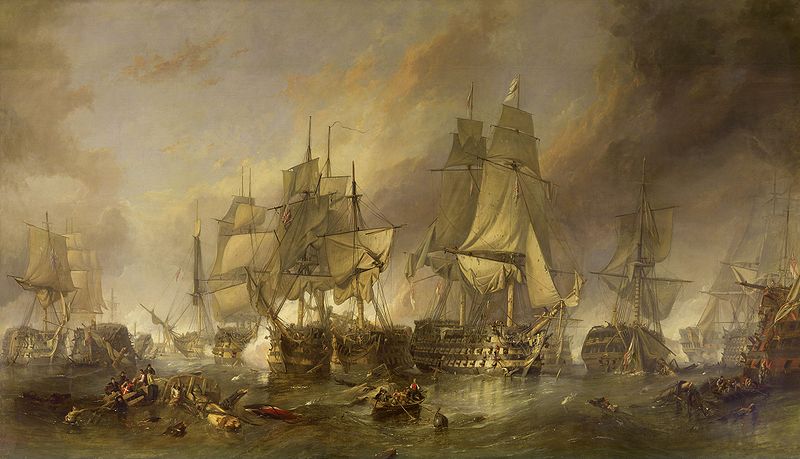 Strategy in Action: Lord Admiral Horatio Nelson had a problem. The British admiral’s fleet was outnumbered at Trafalgar by an armada of French and Spanish ships that Napoleon had ordered to disrupt Britain’s commerce and prepare for a cross-channel invasion. The prevailing tactics in 1805 were for the two opposing fleets to stay in line, firing broadsides at each other. But Nelson had a strategic insight into how to deal with being outnumbered. He broke the British fleet into two columns and drove them at the Franco-Spanish fleet, hitting its line perpendicularly. The lead British ships took a great risk, but Nelson judged that the less-trained Franco-Spanish gunners would not be able to compensate for the heavy swell that day and that the enemy fleet, with its coherence lost, would be no match for the more experienced British captains and gunners in the ensuing melee. He was proved right: the French and Spanish lost 22 ships, two-thirds of their fleet. The British lost none.
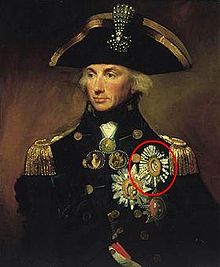 Nelson’s victory is a classic example of good strategy, which almost always looks this simple and obvious in retrospect. It does not pop out of some strategic-management tool, matrix, triangle, or fill-in-the-blanks scheme. Instead, a talented leader identified the one or two critical issues in a situation—the pivot points that can multiply the effectiveness of effort—and then focused and concentrated action and resources on them. A good strategy does more than urge an organization forward toward a goal or vision; it honestly acknowledges the challenges said entity faces and provides an approach to overcoming them.
So–Does America need a coherent National Security Strategy today? Just asking…
 Mastermind Century Group