


The Obsolescence of Overmatch
A tectonic shift is underway in the character of war….and maybe I am just spitballing here…but, the traditional Clausewitzian conception—war as the destruction of an enemy’s military forces to compel political will—is collapsing under the weight of modern complexity. In its place emerges a new model of victory: one achieved not by overwhelming force but by orchestrated disruption. Strategic success in the 21st century is increasingly defined not by battles won or territory seized, but by a state’s ability to induce systemic paralysis—crippling the economic, political, and cognitive machinery of adversary societies without necessarily engaging in open combat.
This transformation heralds a new form of conflict, where decisive action targets the nervous system of the modern state. Supply chains, digital infrastructure, public trust, and national cohesion have supplanted trenches and tank battalions as the key terrain of warfare.
The Fading Power of the Kinetic State
For much of the 20th century, military strength was measured in tanks, ships, jets, and soldiers. Doctrine emphasized firepower, maneuver, and protection. Forces were trained, equipped, and deployed in pursuit of battlefield dominance. Strategic planners assumed that control of physical terrain and destruction of enemy formations would yield victory.
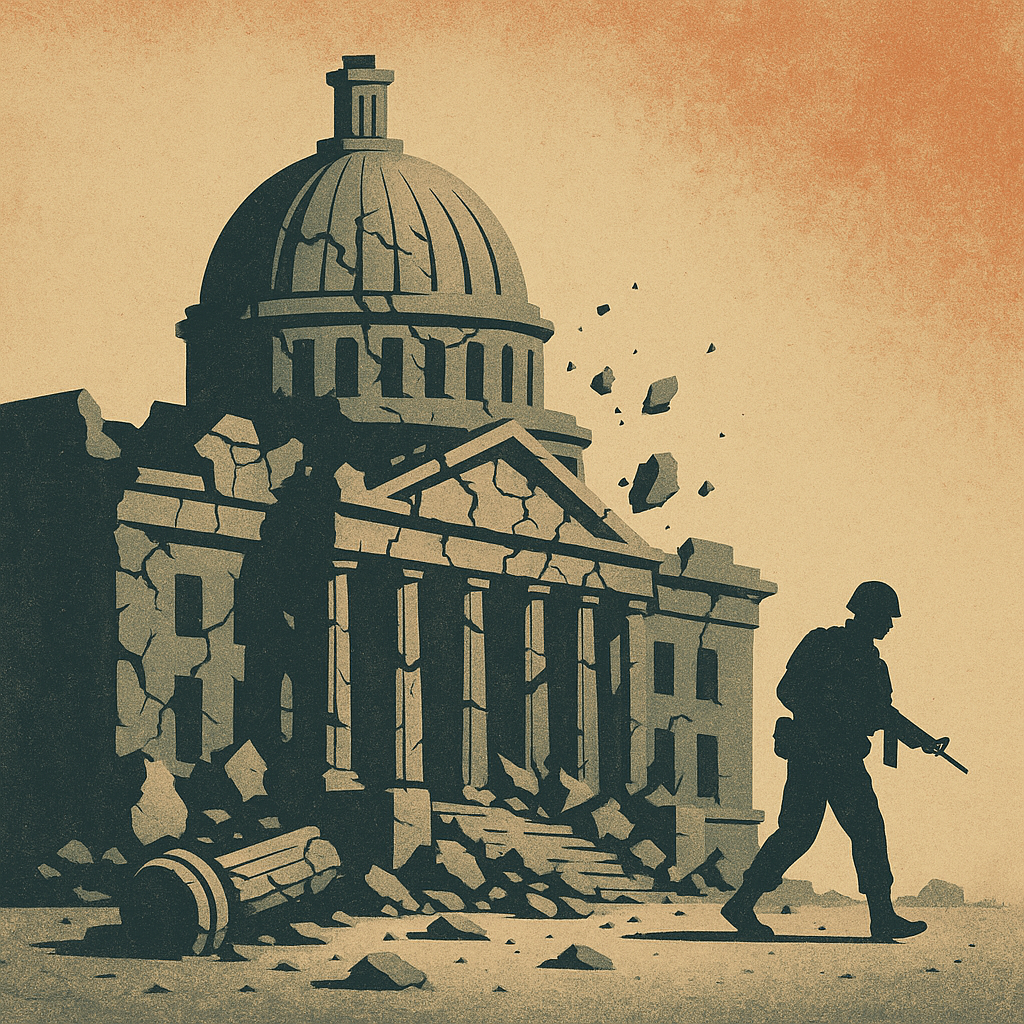
Yet in practice, this model is being rendered obsolete. The law of diminishing returns has set in. Overmatch no longer guarantees control of the strategic narrative or the pace of conflict. Kinetic supremacy cannot immunize a society against economic coercion, digital sabotage, or cognitive erosion.
The traditional sequence—societal strength begets industrial output, which enables military power—has inverted. Now, adversaries bypass militaries entirely and strike at the enabling layers beneath them. The aim is to fracture societies so thoroughly that armed forces become stranded assets, unable to mobilize or act coherently because the polity they defend has ceased to function.
The New Triad: Economic, Cyber, and Cognitive Warfare
Rather than a single battlefield, 21st-century conflict unfolds across three mutually reinforcing domains. Together, they form a “new triad” of strategic coercion:
1. Economic Warfare: Weaponized Interdependence
The age of globalization created supply chains optimized for efficiency, not resilience. These systems now represent high-value targets. Modern economic warfare weaponizes this fragility by:
Restricting access to critical resources like semiconductors and rare earth minerals;
Targeting logistical chokepoints (ports, canals, shipping lanes);
Exploiting systemic fragility, where the loss of a single supplier or component causes cascading failures.
Economic coercion can generate collapse without combat. As geopolitical trust erodes and “friend-shoring” gains traction, the fragmentation of the global economy risks accelerating the very tensions it seeks to mitigate. Economic warfare, if successful, may provoke internal unrest, force political concessions, or trigger preemptive kinetic escalation from a cornered adversary.
2. Cyber Warfare: Paralyzing the National Backbone
Critical infrastructure—from power grids to financial networks—has become digitized, interconnected, and dangerously exposed. As information technology (IT) merges with operational technology (OT), a single intrusion can have far-reaching consequences.
The Stuxnet worm (2007–2010) marked the first strategic cyber weapon capable of causing physical destruction.
The Ukraine power grid attack (2015) demonstrated how coordinated malware and denial-of-service attacks could plunge cities into darkness.
The Colonial Pipeline ransomware incident (2021) revealed how a simple IT breach can force the shutdown of national infrastructure through a “forced-hand” dynamic.
In each case, the attack didn’t require large-scale force or high-end military platforms. Instead, inexpensive tools, stolen credentials, and clever coding proved sufficient to paralyze complex systems. The strategic asymmetry of the cyber domain empowers not just great powers, but rogue states and non-state actors to wield disproportionate influence.
3. Cognitive Warfare: Subverting Reality
Perhaps the most destabilizing domain is the cognitive front. Here, the battleground is perception itself.
Modern disinformation campaigns use AI-generated content, deepfakes, and social media manipulation to:
Fabricate false flag operations
Undermine trust in leadership
Fragment shared reality
The strategic objective is not persuasion but pollution. Through techniques like the “liar’s dividend,” aggressors degrade public trust until truth becomes unknowable. In this state of epistemic confusion, democracies—reliant on informed consent and open discourse—become uniquely vulnerable. Authoritarian regimes, with tight control over domestic narratives, are largely immune to such tactics while being best positioned to deploy them offensively.
This evolution from propaganda to perception warfare makes resisting aggression harder than ever. If the public cannot distinguish real from fake, collective action becomes impossible. Disruption becomes victory.
Doctrinal Manifestations: Russia and China
The shift toward non-kinetic conflict is not speculative. Both Russia and China have formalized doctrines that prioritize these new domains.
Russia: Controlled Chaos and Hybrid Warfare
While the so-called “Gerasimov Doctrine” is more interpretive than formal, Russian strategic practice clearly emphasizes hybrid conflict. Information operations are paramount, with military power deployed selectively to reinforce broader campaigns of psychological manipulation, proxy support, and societal disruption.
Russia’s use of:
Private military companies (PMCs) like Wagner,
Cyberattacks against infrastructure (e.g., Ukraine, Estonia),
Electoral interference and disinformation,
…reveals a coherent vision: to make adversary states ungovernable and destabilized without full-scale invasion. This is Clausewitz in reverse—politics not as the continuation of war, but as the medium of war itself.
China: The ‘Three Warfares’ Doctrine
Codified in PLA regulations, China’s “Three Warfares” doctrine—public opinion, psychological, and legal warfare—offers a blueprint for shaping the battlefield before a shot is fired.
Public opinion warfare floods global media and academia with state-sponsored narratives.
Psychological warfare includes provocative military actions designed to sap the adversary’s morale (e.g., incursions near Taiwan).
Legal warfare (lawfare) reinterprets international law to assert contested claims while paralyzing opponents’ legal and political responses.
China’s approach aims to present adversaries with fait accompli scenarios rendered irreversible by time and ambiguity. Control is achieved not through conquest, but through shaping narratives, exploiting rules, and undermining the enemy’s will to resist.
Case Studies in Strategic Paralysis
The following incidents illustrate how non-kinetic warfare has moved from theory to practice:
Stuxnet (2007–2010)
A state-sponsored cyber-weapon targeted Iran’s nuclear centrifuges, causing mechanical failure via manipulated industrial controls. It demonstrated that software alone could achieve military effects previously reserved for kinetic action.
Ukraine Power Grid (2015)
Russian hackers synchronized a multi-stage attack that shut down electricity for hundreds of thousands. By corrupting SCADA systems and jamming customer support lines, the attackers inflicted both physical and psychological disruption.
Colonial Pipeline (2021)
A criminal group, not a state actor, used ransomware to compromise IT systems. The operators shut down the pipeline themselves, fearing operational risks. The ensuing panic buying and fuel shortages revealed how societal reactions can amplify minor disruptions into national crises.
Each incident shows that the cost of disruption is plummeting, while the scale of potential impact is rising. The strategic leverage of relatively low-tech operations has never been higher.
The Privatization of War and the Collapse of Distinction
The blurring of lines between state and non-state actors has fractured the traditional laws of armed conflict.
Authoritarian regimes use proxies offensively (Wagner in Africa, hacktivists in Ukraine);
Democratic nations, lacking centralized control of critical infrastructure, depend on private sector partners defensively (e.g., Colonial Pipeline, Microsoft, CrowdStrike).
This dynamic introduces profound legal ambiguity. If civilian contractors defending a power grid are participating in cyber defense during wartime, do they remain civilians under international law? Can an adversary target them legally?
This is the paradox of privatized resilience: in open societies, civilian infrastructure becomes the battlespace, and civilians become combatants. The very openness and complexity that fuels innovation also creates strategic exposure.
Redefining Victory: Collapse Without Combat
Victory in the 21st century may increasingly resemble paralysis rather than triumph. A nation’s military may remain intact, but if its economy has seized, its lights have gone out, its population no longer trusts its leaders—or each other—it has already lost.

This logic demands a fundamental reframing of national security priorities.
Strategic Recommendations
- Resilience Over Overmatch: National strength must be measured not only in missiles and tanks, but in supply chain integrity, infrastructure security, and public trust. Hardening the “homefront” is not a back-office task—it is strategic front-line defense.
- Non-Kinetic Doctrine Development: Western militaries must codify new doctrines that integrate economic statecraft, cyber defense/offense, and information operations. Attribution frameworks, thresholds for response, and proportionality rules must be built into strategic planning.
- Cognitive Security: Democracies must invest in media literacy, pre-bunking mechanisms, and AI detection of disinformation. Countering cognitive warfare cannot be left to fact-checkers alone—it requires national strategy.
- Clarify Legal Boundaries: The Geneva Conventions were not written for cyber wars. Clear rules must be established for civilian participation, public-private defense partnerships, and the legal status of infrastructure under hybrid attack.
- Modernize Force Structure: Kinetic capabilities remain essential but must be augmented with specialized cyber, intelligence, and influence operations teams. Militaries should act as hubs for interagency and public-private coordination, not as solitary actors.
Conclusion: A Contest of Systems, Not Armies
The future of conflict is not a race for battlefield dominance, but a contest of systems: political, economic, informational, and psychological. The victor is not the state that destroys the most tanks, but the one that degrades the other’s capacity to function, cohere, and respond.
Paralysis, not destruction, is now the strategic endstate. And in this new age of warfare, the weapons of choice are not bombs and bullets—but narratives, networks, and nodes.
 Mastermind Century Group