


Well, I ain’t evil
I’m just good lookin’
Start a little fire
And baby start cookin’
I’m a hungry man
But I don’t want pizza
I’ll blow down your house
And then I’m gonna eat ya
—FEED MY FRANKENSTEIN
I’ve always been fascinated by the evolution of military strategies, specifically the offset strategies employed by the United States during various periods of the Cold War and beyond. The concept of offset offers a compelling lens to examine the interaction of technology, geopolitics, and defense doctrine. Beginning with the Eisenhower administration’s reliance on nuclear deterrence in the 1950s to counter Soviet conventional superiority in Europe (known retrospectively as the First Offset), through to the technological advancements in precision-guided munitions and intelligence capabilities of the 1970s and 1980s (the Second Offset), and culminating in the more recent emphasis on artificial intelligence and autonomous systems in the 2010s (the Third Offset), these strategies highlight the U.S.’s consistent endeavor to leverage technological advancements to maintain its strategic advantage on the global stage. I simply thought it might be interesting to explore a bit of the origins, development, and implications of these offset strategies, providing some insight into the dynamic nature of military strategy and its role in shaping international relations.
FEED MY FRANKENSTEIN
Of course my mind always tends to go a bit sideways. This journey of military evolution bears intriguing parallels to the tale of Mary Shelley’s “Frankenstein.” Just as Dr. Frankenstein ambitiously sought to create life, pushing the boundaries of known science, the U.S. has continually sought to harness cutting-edge technologies for defense, often venturing into uncharted terrains. Yet, Shelley’s narrative offers a cautionary tale; the creation, once unleashed, presented unforeseen challenges. This introduction seeks to explore the trajectories of the offset strategies in light of this analogy, probing the intricate balance between innovation and its potential repercussions in the theater of global defense.

THE OFFSET BUSINESS
Typically, an offset strategy refers to a method used in business or investment where one transaction or operation is intended to compensate for the potential risk or loss of another. It can be used in several different contexts, including:
- Investments: In finance and investment, an offset strategy might involve investing in diverse assets to balance potential losses. If a portfolio is heavily invested in one sector, for instance, the investor might choose to also invest in another sector that tends to perform well when the first one underperforms. This is often referred to as a hedge or hedging strategy.
- Business Operations: Within the business arena, companies might employ offset strategies to counteract potential loss from a particular business unit or region. For example, a multinational company might expand into different regions to offset potential losses that could arise due to region-specific economic downturns or regulations.
- Carbon Offset: In environmental policy, an offset strategy may refer to carbon offsetting. This is where a company compensates for its greenhouse gas emissions by funding an equivalent carbon dioxide saving elsewhere, like renewable energy projects or reforestation initiatives.
- Trade Offsets: In international trade, offset agreements often occur where a company agrees to counterbalance the cost of a large sale (like military equipment) to one country by providing investment in other sectors of that country’s economy. This is a common practice in defense procurement.
MILITARY OFFSET
In the context of military strategy, an offset strategy usually refers to a method adopted by a country (typically the United States) to maintain or enhance its strategic advantage over potential adversaries. This typically involves leveraging technological advancements or superior operational concepts. There have been three notable offset strategies pursued by the United States:
- First Offset Strategy (1950s): This was a response to the Soviet Union’s superior conventional military strength in Europe during the Cold War. The U.S. and its NATO allies decided to offset the numerical disadvantage with a technological advantage: nuclear weapons.
- Second Offset Strategy (1970s-80s): When the Soviet Union achieved nuclear parity with the U.S., a new offset strategy was needed. The U.S. pursued a second offset strategy focused on precision-guided munitions and advanced intelligence, surveillance, and reconnaissance capabilities. These systems, combined with new operational concepts, gave the U.S. military a decisive edge.
- Third Offset Strategy (2014 onward): Announced by the U.S. Department of Defense in 2014, this strategy aimed to counter the decreased advantage held by the U.S. as other nations developed and acquired high-end, precision-guided weapons systems. The third offset strategy emphasized advancements in artificial intelligence, machine learning, autonomous systems, and other high-tech areas to maintain U.S. superiority on the battlefield.
OFFSET #1
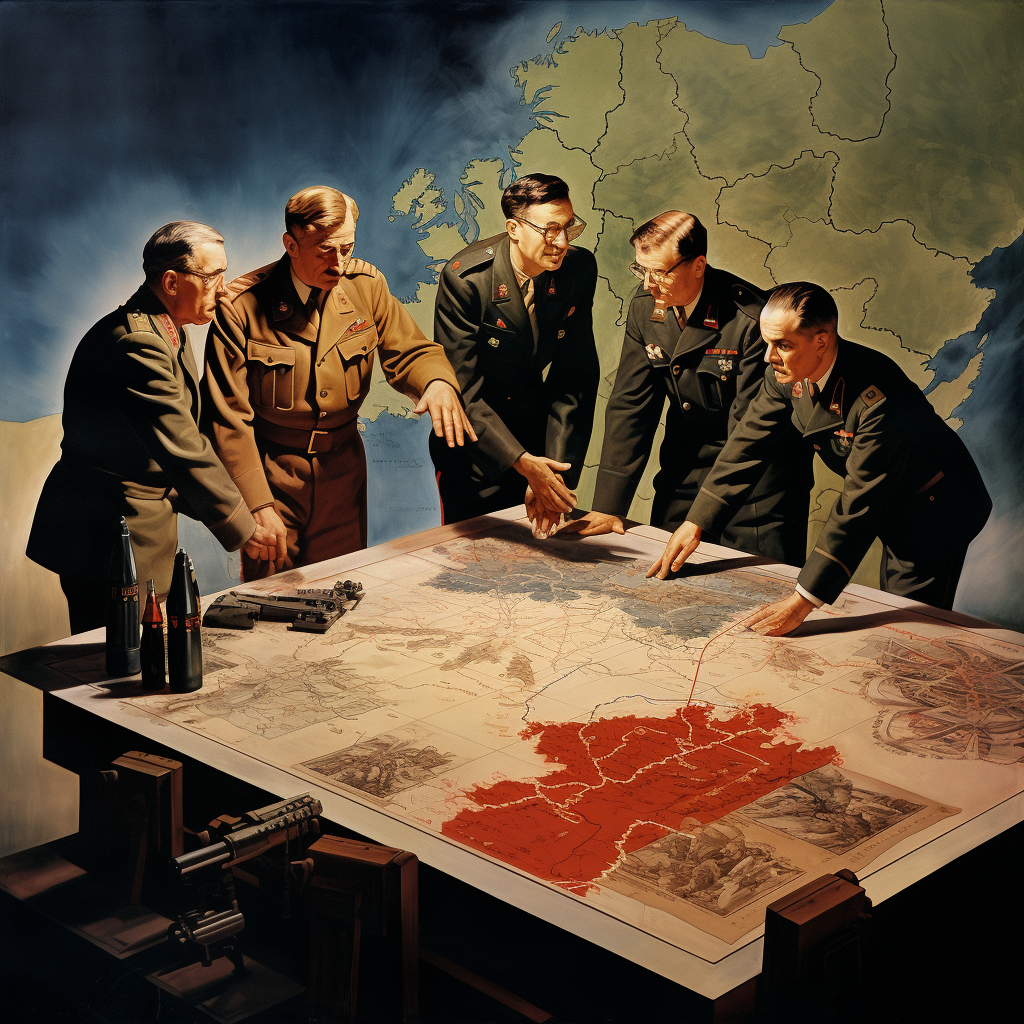
The First Offset Strategy, was not formally announced at a specific time or place, but morphed over time. The strategy evolved during the early years of the Cold War in the 1950s when the United States and its NATO allies recognized the overwhelming conventional superiority of the Soviet Union and Warsaw Pact forces in Europe.
To offset this numerical advantage, the U.S. and its allies relied on a strategy that centered around the use of nuclear weapons. The Eisenhower administration, in particular, adopted a policy known as the “New Look,” which placed a heavy emphasis on nuclear deterrence and the capacity for massive retaliation against any aggression by the Soviet Union. This approach sought to deter a Soviet conventional attack on Western Europe by threatening a nuclear response, thus effectively using the U.S.’s technological edge in nuclear weapons as an offset to Soviet conventional superiority.
While there was no singular, definitive announcement of the First Offset Strategy, the principles of the approach were woven into policy statements and defense postures throughout the Eisenhower administration and beyond. It should be noted that the term “First Offset Strategy” is a retrospective label, applied to describe this historical approach to managing the strategic balance during the early Cold War.
OFFSET #2.
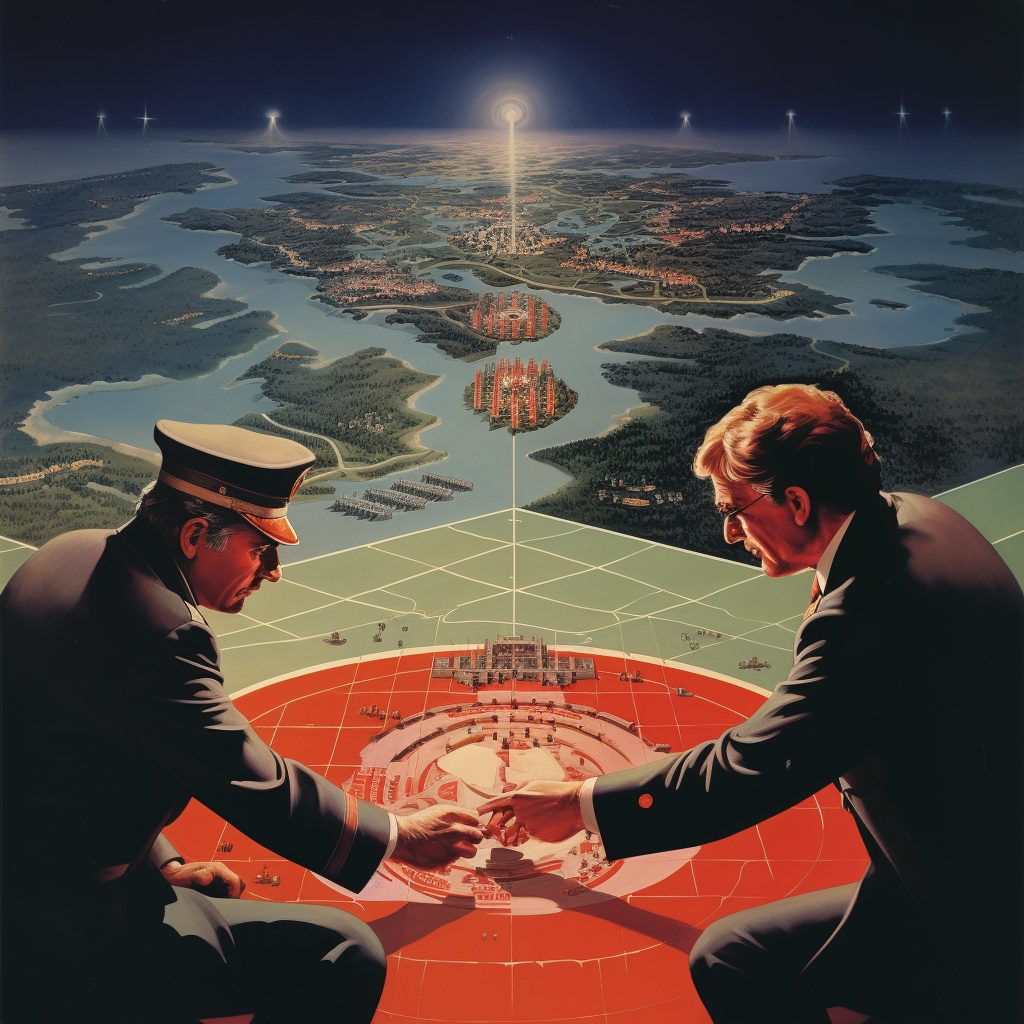
The Second Offset Strategy emerged during the 1970s and was implemented in earnest during the 1980s. Unlike the First Offset strategy, the Second Offset was not officially announced in a single speech or location. Instead, it developed gradually in response to evolving global circumstances during the Cold War.
The backdrop to this strategy was the growing capability of the Soviet Union, which had achieved a level of nuclear parity with the U.S., and had a numerical advantage in conventional forces in Europe. This raised concerns in the U.S. and among its NATO allies about their ability to deter Soviet aggression.
In response, the U.S. developed a strategy centered around leveraging technological advantages to offset the Soviet numerical superiority. This strategy emphasized precision-guided munitions, stealth technology, advanced intelligence, surveillance, and reconnaissance capabilities, and new operational concepts like AirLand Battle.
While not announced in a single, definitive moment like the Third Offset (below), the foundational concepts and technologies of the Second Offset were often discussed and presented in various forms by U.S. military and defense leadership throughout the late 1970s and 1980s. The success of this approach was later demonstrated during the Gulf War in the early 1990s, which showcased the effectiveness of these technologies and concepts in a real-world setting.
OFFSET #3

The Third Offset Strategy was announced by then U.S. Secretary of Defense Chuck Hagel on November 15, 2014, during the Reagan National Defense Forum at the Ronald Reagan Presidential Library in Simi Valley, California.
In his speech, Secretary Hagel highlighted that the Department of Defense (DoD) was developing the strategy to maintain the U.S. military’s technological superiority and ensure it could continue to project power and win decisively in any future conflicts. The strategy was designed to counter the advancements in technology and military capabilities of potential adversaries.
Key components of the Third Offset Strategy included artificial intelligence, autonomous systems, miniaturization, big data, and advanced manufacturing, including 3D printing. These technologies were seen as a way to offset the advantages that adversaries might gain from their own technological developments or from the proliferation of advanced military technology.
OFFSET #4?
OBVIOUSLY it’s difficult to predict exactly what a Fourth Offset Strategy might look like but, there are several areas where advancements might define the next generation of military strategy.

- Increased Autonomy and Artificial Intelligence: As AI and autonomous systems become more sophisticated, we might expect these technologies to play an increasingly prominent role in military strategy. This could involve everything from swarms of autonomous drones to AI-enhanced decision making in command and control systems.
- Cyber and Information Warfare: As the world becomes increasingly digital, cyber warfare and the ability to control and manipulate information will likely become more important. This could involve defending against cyber attacks, conducting such attacks against adversaries, or using information to influence public opinion.
- Space and Hypersonics: The militarization of space and the development of hypersonic weapons could also play a significant role in a Fourth Offset Strategy. The ability to quickly and accurately strike anywhere in the world and to control vital assets like satellites could be important strategic advantages.
- Biotechnology: The advancement in biotechnologies could lead to various applications in defense strategy, such as improved medical treatments for soldiers, bioengineered materials for military use, or even biological weapons.
- Quantum Computing and Communication: With the potential to revolutionize encryption and data processing, quantum technologies might become a key component of future offset strategies.
- Enhanced Human Performance: Technologies that improve the physical and cognitive capabilities of soldiers, such as powered exoskeletons or neuro-enhancements, could also play a role in future military strategy.
The specific form a Fourth Offset Strategy might take would depend on various factors, including the nature of the threats faced, the available technology, and the strategic decisions made by military and political leadership. It’s also worth noting that a future offset strategy would likely need to consider not just technological factors, but also geopolitical, economic, and ethical considerations.
Finally
The strategic evolution of the U.S. military, encapsulated in the three offset strategies, underscores the complex interplay between technological innovation, geopolitical challenges, and evolving defense paradigms. From the nuclear deterrence of the First Offset in the 1950s to the precision-guided munitions and intelligence systems of the Second Offset during the Cold War, and the Third Offset’s integration of emerging technologies like artificial intelligence, each phase signifies the U.S.’s determination to preserve its strategic edge in an ever-fluctuating global landscape. Of course, the trajectory of these strategies can be likened to the creation of Mary Shelley’s Frankenstein monster; each technological advancement, while offering immense power, brings with it unforeseen challenges and ethical considerations. Just as Dr. Frankenstein grappled with the consequences of bringing his creation to life, so too must policymakers and strategists recognize the potential ramifications of unchecked technological advancements in the realm of defense. As we continue into the 21st century, the lessons derived from these offset strategies, augmented by the cautionary tale of Frankenstein, will be pivotal for navigating the intricacies of defense and security in an age of rapid technological progress.

 Mastermind Century Group